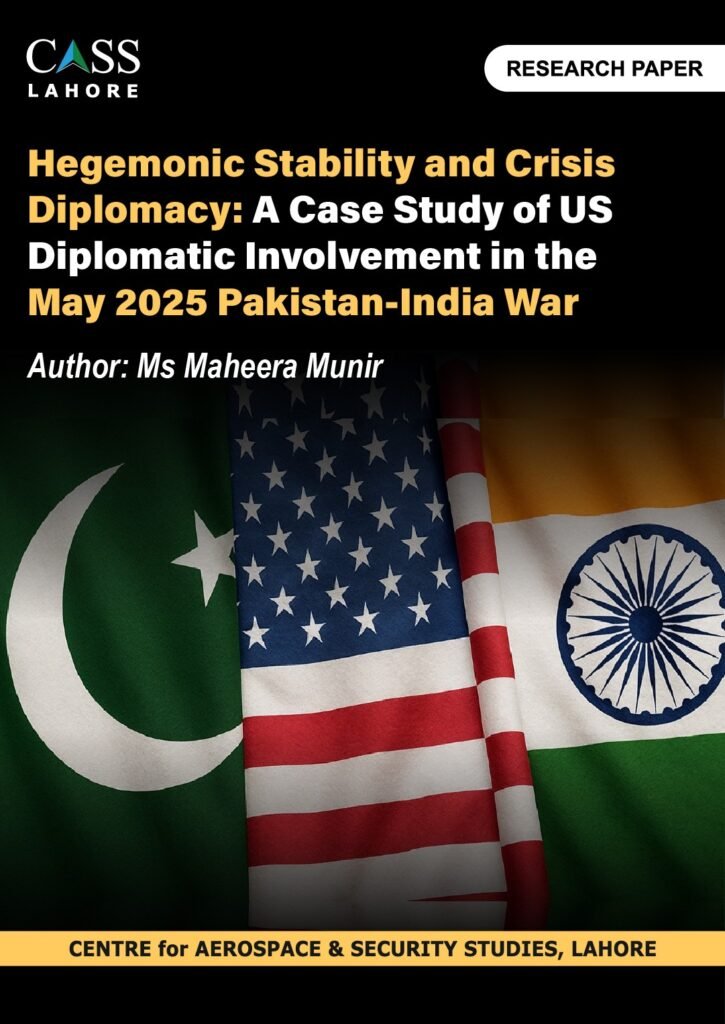
HEGEMONIC STABILITY AND CRISIS DIPLOMACY: A CASE STUDY OF US DIPLOMATIC INVOLVEMENT IN THE MAY 2025 PAKISTAN-INDIA WAR
SEPTEMBER 2025
ABSTRACT
US crisis diplomacy has historically played a crucial role in managing India-Pakistan crises. However, the May 2025 war presented a distinct case. Despite Vice President JD Vance’s earlier assertions that the war between India and Pakistan is fundamentally none of the US’s business, President Trump’s abrupt mediation raised questions over the underlying motivations behind the diplomatic intervention. This paper establishes a nexus between hegemonic stability theory and crisis diplomacy, highlighting that hegemonic powers use crisis diplomacy as a tool to assert their authority and protect their strategic interests. Under a qualitative approach, this paper employs discourse analysis and expert interviews. It argues that, in addition to preventing nuclear escalation, the US diplomatic intervention was motivated by multiple political and strategic drivers, including hegemonic assertion, offshore balancing, international signalling, preserving regional and international stability, and reinvigorating relations with Pakistan after the war exposed India’s limitations to act as a regional security provider and counterweight to China. It damaged India’s international credibility and strengthened Pakistan’s position as a middle power in the new regional environment.
Keywords: Crisis diplomacy, US mediation, Hegemonic Stability, India, Pakistan, China, May 2025 war
This paper is currently under review for publication in a domestic/international journal. It will be available once published.
The Centre for Aerospace & Security Studies (CASS) was established in July 2021 to inform policymakers and the public about issues related to aerospace and security from an independent, non-partisan and future-centric analytical lens.