



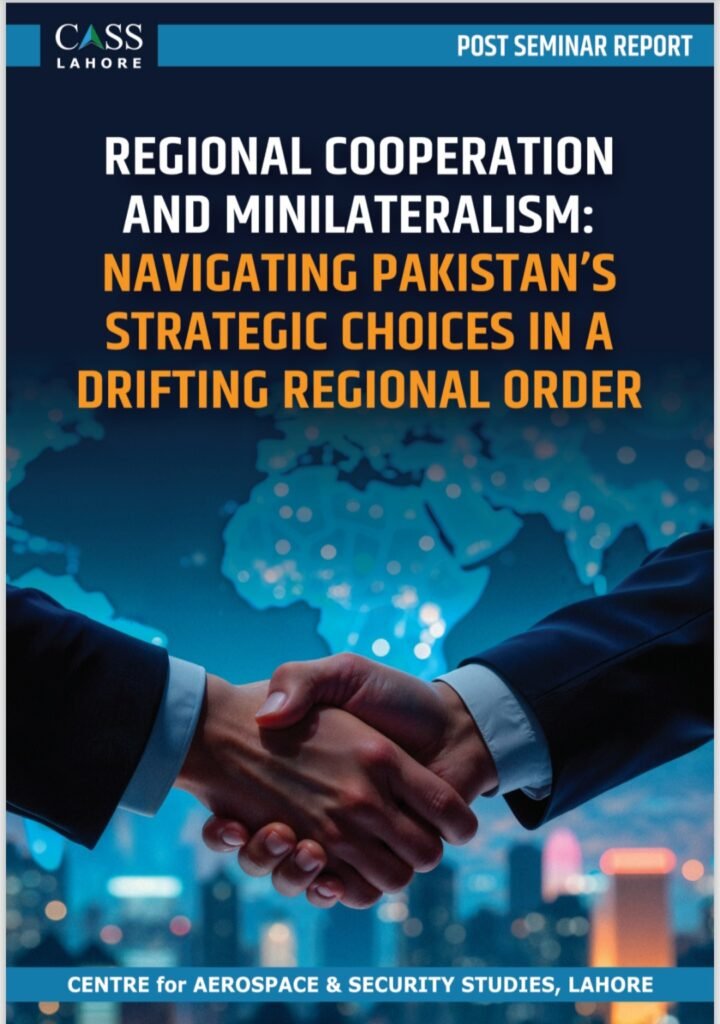
SEMINAR
Regional Cooperation and Minilateralism: Navigating Pakistan’s Strategic Choices in a Drifting Regional Order
October 23, 2025
The complete PSR is available upon request. Please use the button below to submit your request.
president
Air Marshal Asim Suleiman (Retd)
SEMINAR COORDINATOR
Ambassador M Haroon Shaukat (Retd)
EDITOR
Dr Zahid Khan
RAPPORTEURS
Ms Ezba Walayat Khan & Mr Amjad Fraz
Executive Summary
The Centre for Aerospace and Security Studies (CASS), Lahore, organised a seminar on the theme “Regional Cooperation and Minilateralism: Navigating Pakistan’s Strategic Choices in a Drifting Regional Order” on 23 October 2025. In his opening remarks, Ambassador Muhammad Haroon Shaukat (Retd), Director, CASS Lahore, began by defining minilaterlism as cooperation within smaller groups of like-minded and willing states that seek common objectives of peace, stability, and shared development. As Pakistan-India relations are frozen at a very low level and the traditional pathways to regional cooperation, such as SAARC, are severely obstructed by hegemonic India, minilateralism emerges as a practical tool, a way forward, and a strategic pivot.
Senator Mushahid Hussain Sayed, speaking online, first reflected upon the historic transformation of the global order characterised by the decline of Western dominance and the phenomenal rise of China. He highlighted that power is shifting from the West to the East in technology, geopolitics, and economic prowess. China’s rise has been peaceful, without colonisation or military aggression. Pakistan itself has undergone a strategic transition from a South Asian power to a “Muslim Middle Power” with growing influence across the Middle East and the wider Muslim world. The Senator added that global power reconfigurations are also causing shifts in regional dynamics. The changing US priorities and President Trump’s transactional policies are major factors causing schisms in the existing order. This has opened strategic space for Muslim countries to diversify their security partnerships, citing Pakistan’s Strategic Mutual Defence Agreement (SMDA) with Saudi Arabia and Turkiye’s military presence in Qatar. He observed that China has become a de facto part of South Asia and is now a party to the Kashmir dispute, particularly after India’s annulment of Article 370 in August 2019. China has created new trilateral arrangements involving Pakistan and Bangladesh and Pakistan and Afghanistan. China’s influence and partnerships with South Asian countries are growing. Senator Mushahid stated that after its decisive victory over India in May this year, Pakistan’s prestige and influence have considerably enhanced. Today, Pakistan enjoys a unique diplomatic position, maintaining influence in key capitals including Beijing, Riyadh, Washington, Tehran, and Moscow. This advantage has added to Pakistan’s diplomatic space and options. He also strongly emphasised the need to reform and develop the country’s economy. He also referred to domestic political polarisation and security challenges. He called for a “healing touch” in national politics, urging reconciliation, arguing the need for generosity in politics.
The next speaker, Ambassador Mansoor Ahmad Khan (Retd), noted that South Asia, despite having a population of over two billion people, remains among the least integrated regions in the world, with intra-regional trade at only about 5 per cent. Facing consensus paralysis, SAARC is blocked. Its failure is rooted in India’s refusal to engage constructively with countries of the region, particularly Prime Minister Modi’s unilateral measures in Kashmir and its policy of isolating Pakistan. In these circumstances, minilateralism offers a practical alternative for regional cooperation. Pakistan must pursue selective minilateral partnerships tailored to its strategic and economic needs. He identified several promising possibilities, including Pakistan–Afghanistan–Central Asia; an Indian Ocean maritime grouping with Bangladesh, Sri Lanka, Nepal, and the Maldives, a SAARC-like arrangement with China, minus India; and Pakistan, Saudi Arabia, UAE, and Iran. He asserted that an expanded CPEC could turn Pakistan into a hub for connectivity and trade. He advocated a pragmatic and holistic approach toward Afghanistan to deal with the menace of terrorism and to benefit from wider regional economic opportunities.
The last guest speaker, Prof Dr Tahir Hijazi, underscored the potential of harnessing the regional economic benefits through minilateralism, designed around mutual strengths. He highlighted potential opportunities available to Pakistan to substantially upgrade productive economic partnerships, particularly with GCC countries, Turkiye, Iran, Afghanistan, Central Asian Republics, and Bangladesh. Citing the Saudi–Pakistan SMDA, he stressed that strategic alignment must now translate into joint ventures, trade expansion, infrastructure cooperation, industrial production, and investment flows in sectors such as agriculture, renewable energy, IT and AI, minerals processing, and defence-related manufacturing. At the domestic level, Dr Hijazi emphasised the need for economic and governance reforms. He particularly underscored the need for specialist policy expertise, policy continuity, skilled human capital, and ease of doing business to attract and protect investments and sustained economic outcomes.
Air Marshal Asim Sulaiman (Retd), President CASS, in his concluding remarks, highlighted the increasing utility and relevance of minilateralism. He recalled Pakistan’s participation in the Regional Cooperation for Development (RCD), an early minilateral organisation, which grew into the Economic Cooperation Organisation (ECO). He drew attention to Pakistan’s commitment to focused partnerships, including the CPEC, the Pakistan-Bangladesh-China trilateral mechanism, and the Pakistan-Türkiye-Azerbaijan trilateral partnership. He highlighted Pakistan’s enhanced diplomatic leverage and global standing, following its conclusive victory against India in the May 2025 war, in which the PAF had played a key role. Within the first hour of engagement, the PAF shot down seven advanced Indian fighter aircraft. The Indian Air Force was practically grounded for the next two days. He attributed this awe-inspiring success to the foresight of the PAF leadership, particularly praising the command of Air Chief Marshal Zaheer Ahmed Baber Sidhu. He remarked that the PAF’s performance strengthened Pakistan’s deterrence posture and opened new pathways for defence collaboration and regional engagement. A prominent outcome of Pakistan’s renewed standing is the Pakistan–Saudi Arabia SMDA, a landmark accord that not only enhances the defensive capacities of both countries but also deepens their economic, technological, and commercial ties. He added that, building on its success, Pakistan should deepen ties with South Asian neighbours, GCC partner nations, and the Central Asian states to create a zone of cooperation grounded in the principles of minilateralism.
Key Takeaways
- Shift of Balance of Power from the West to the East
There is an irreversible shift in the global balance of economic and political power, away from the West to the East. The US decline is irreversible, and China’s technological rise is unstoppable. China has become a scientific superpower.
- Minilateralism: A Realistic Pathway
Minilateralism offers a realistic path for the pursuit of regional cooperation as multilateral arrangements are blocked by countries having vested interests.
- Pakistan’s Victory: Emergence as a Muslim Middle Power
Pakistan’s decisive victory in the May War, led by the PAF, has immensely enhanced Pakistan’s credibility and influence in five capitals, namely, Beijing, Riyadh, Tehran, Washington, and Moscow. It has allowed Pakistan to transition from being a South Asian power to a Muslim middle power. It has emerged as a net security provider in the broader Muslim world.
- SMDA: a Ground-breaking Pact
The Strategic Mutual Defence Agreement between Pakistan and Saudi Arabia is a ground-breaking pact with far-reaching positive implications for both countries, especially in the area of next-generation defence production, training, and economic, commercial, and investment ties.
- Anti-India Trend in South Asia
In South Asia, smaller countries have begun to assert themselves. They are rejecting Indian hegemony. The anti-India trend is visible. For the first time, India is isolated in its own region.
- China: De Facto Part of South Asia and a Party to the Kashmir Dispute
Today, China is a de facto part of South Asia and is a party to the Kashmir dispute due to India’s machinations and abrogation of Article 370.
- Minilateral Initiatives by China
China has undertaken some minilateral initiatives in South Asia, including Pakistan and Bangladesh, as well as Pakistan and Afghanistan. A SAARC-like organisation, including China and minus India, is conceivable.
- Extension of CPEC to Afghanistan and Central Asia
The planned extension of CPEC to Afghanistan and Central Asia, under its second phase, aligns with the spirit of minilateralism, enhancing much-needed connectivity and economic collaboration. However, the security situation in Afghanistan continues to be a serious hindrance.
Policy Considerations
- Minilateralism: The Way Forward
In our volatile region, Pakistan needs to be more focused on Minilateralism for a pragmatic response in South Asia amid SAARC’s paralysis. Practical minilateral arrangements could potentially include a SAARC-like arrangement with China, minus India; CPEC expanding to Afghanistan and the Central Asian Republics; and a possible Indian Ocean maritime partnership.
- Pakistan Can Shape a New Regional Architecture of Cooperation
Pakistan can help shape a new regional architecture, characterised by strengthened ties with other South Asian countries, deepening engagement with Gulf partners, and expanding connectivity to Central Asia.
- Pakistan: A Potential Connectivity Hub
Pakistan should become a connectivity hub between the Gulf region, Central Asia, the Indian Ocean, and West Asia, through a network of minilateral arrangements, subject to an improved security situation in Afghanistan.
- Need for Modernisation of Border Management
The Government needs to prioritise modernising border management and transit facilitation, which are essential for regional connectivity and economic integration.
- Optimal Utilisation of SMDA and Harnessing Gulf Investments
Pakistan-Saudi Arabia Strategic Mutual Defence Agreement (SMDA) must be optimally utilised. Further, to leverage improved ties with Saudi Arabia and the UAE, focused efforts are required to establish joint ventures, such as refineries, and to ensure a predictable supply of petrochemicals. Concurrently, the Government must upgrade labour mobility to the GCC countries by providing certified technical manpower.
- Create Bankable Projects for Investors
To attract investments for bankable projects, the Government must ensure policy continuity, implement rule-based and investor-friendly processes and regulations, multiply skilled human capital, and ensure investor security.
CASS LAhore

The Centre for Aerospace & Security Studies (CASS) was established in July 2021 to inform policymakers and the public about issues related to aerospace and security from an independent, non-partisan and future-centric analytical lens.
CASS Newsletter

- Home
- About Us
- Research Domains
- Publications
- Events
- Gallery
- Contact Us
@2021 - All Right Reserved. Designed and Developed by PenciDesign