



SEMINAR
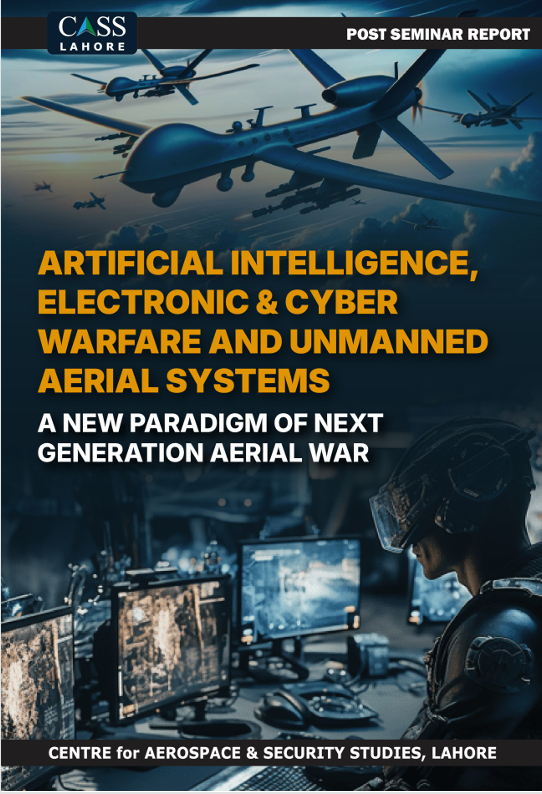
Artificial Intelligence, Electronic & Cyber Warfare and Unmanned Aerial Systems: A New Paradigm of Next Generation Aerial War
July 17, 2025
The complete PSR is available upon request. Please use the button below to submit your request.
president
Air Marshal Asim Suleiman (Retd)
SEMINAR COORDINATOR
Dr Air Commodore Naveed Khaliq Ansaree (Retd)
EDITOR
Dr Bilal Ghazanfar
RAPPORTEURS
Amjad Fraz & Ezba Walayat Khan
Executive Summary
The Centre for Aerospace & Security Studies (CASS), Lahore, hosted a seminar on 17 July 2025, addressing the convergence of Artificial Intelligence (AI), Cyber and Electronic Warfare (EW), and Unmanned Aerial Systems (UAS)—technologies that are rapidly redefining the modern aerial combat landscape.
Dr Ayaz opened the session with a deep dive into AI’s transformative role, aligning his insights with the broader context of the Fifth Industrial Revolution, which emphasises human-machine collaboration rather than complete autonomy. He explained how AI is now integrated into cockpit systems, command-and-control centres, and autonomous drones. AI not only reduces pilot workload but also anticipates threats, suggests optimal courses of action, and supports high-speed decision-making. He also discussed Manned-Unmanned Teaming (MUM-T), where drones act as “Loyal Wingmen” to human pilots, enhancing survivability and operational effectiveness. Dr Ayaz showcased a series of indigenous Pakistani innovations, demonstrating Pakistan’s growing foothold in AI-powered national security technologies.
The second speaker, Gp Capt Farhan Ahmad, delivered a talk on “Cyber Threats and Response Options for the PAF.” Addressing the critical role of cyber warfare in today’s multi-domain battlefield and the Pakistan Air Force’s strides in enhancing cyber capabilities, he argued that warfare has transitioned from a platform-versus-platform to a system-versus-system paradigm, where digital dominance defines operational success. Recalling a recent India-Pakistan conflict, he revealed that the PAF had led nearly 50% of Pakistan’s offensive cyber operations with great success. He added that the PAF had established a dedicated Cyber Command in 2023 under the direction of the Chief of Air Staff, comprising defensive and offensive units, an Open-Source Intelligence Centre, and a Cyber Security Operations Centre that monitors over 23,000 PAF assets. He also highlighted the integration of cyber operations with kinetic operations, noting that over 4,000 enemy systems had been targeted during recent engagements.
The final speaker, Air Cdre Raza Haider (Retd.), delivered a discourse on “Electronic Warfare & Unmanned Aerial Systems: A New Paradigm of the Next Generation Aerial War for Pakistan.” He focused on the strategic and operational impact of UAS and EW in modern and future warfare. Introducing the concept of techno-realism, he argued that technological sovereignty, rather than conventional military size, is now the primary indicator of state power. He emphasised that Pakistan must develop domestic capabilities in drones, AI, cyber tools, and EW systems to remain strategically relevant. He explained how UASs have evolved beyond surveillance to include loitering munitions (or “killer drones”) and swarm drones capable of coordinated saturation attacks. He also discussed Collaborative Combat Aircraft and the Loyal Wingman Doctrine, whereby unmanned drones operate alongside manned aircraft. In his discourse on Electronic Warfare, the speaker defined EW as the control and disruption of the electromagnetic spectrum (EMS), encompassing: Electronic Attack, Electronic Protection, and Electronic Support. He also emphasised that the convergence of EW with cyber enables hybrid attacks. In his concluding remarks, President CASS, Air Marshal (Retd) Asim Suleiman stated that modern air power is entering a new age where AI, cyber and electronic warfare, and unmanned systems form the foundations of dominance. He noted that in Marka-e-Haq, PAF effectively integrated these capabilities under the leadership of Air Chief Marshal Zaheer Ahmed Babar Sidhu, showcasing readiness for tomorrow’s battlespace. He stressed that future wars will be won not by the largest fleets, but by technological sovereignty, jointness, agility, and decisive leadership.
The seminar concluded with an interactive session, reinforcing the view that next-generation warfare will be shaped not by military size but by technological agility and strategic foresight. AI, cyber capabilities, EW, and UAS are no longer optional; they are essential components of future warfighting.
Key Takeaways
- Artificial Intelligence as a Strategic Asset
Artificial Intelligence has moved beyond supporting roles to become central in warfare. It enables faster decisions, sharper situational awareness, and operational autonomy, turning it into a true strategic asset rather than a mere tool.
- Hybrid Warfare Goes Data-Driven
The battlefield now spans cyber, space, air, and the information domain. Data-driven command-and-control systems synchronise these fronts in real time, making hybrid warfare more coordinated and unpredictable.
- Human–Machine Teaming
Manned–unmanned collaboration is reshaping airpower. Concepts like “Loyal Wingmen” and virtual copilots increase survivability, reduce costs, and allow Air Forces to scale combat power without relying solely on expensive manned fighters.
- Cyber Power as a Doctrine
Cyber has evolved from a support role into a doctrinal pillar of warfare. It delivers disproportionate effects, sometimes achieving more than kinetic strikes, making cyber warriors as vital as frontline troops.
- Drones and Swarms
Unmanned systems offer persistence, precision, and affordability. Swarm tactics and loitering munitions provide asymmetric options, allowing smaller states to deter larger adversaries effectively.
- Electronic Warfare as the Decisive Domain
Electronic Warfare has become a central pillar of modern conflict. By controlling the electromagnetic spectrum through jamming radars, disrupting communications, and blinding sensors, it dictates the tempo of battle and often determines the outcome before kinetic engagement begins.
- Techno-Realism in Power
Power in the 21st century rests on technological self-sufficiency. Nations that master Artificial Intelligence, cyber, and autonomous systems gain influence, while others risk dependency.
- Rise of Tech-Polar Blocs
The world is shifting into blocs defined by technological independence. States are aligning not just by ideology or geography, but by their access to Artificial Intelligence, cyber, and autonomous systems that guarantee sovereignty.
Policy Considerations
- Unified National AI & Cyber Doctrine
Institutionalise an integrated tri-service AI and cyber doctrine to define interoperability, ethical deployment, autonomous system governance, and multi-domain coordination across air, land, sea, space, and cyber domains.
- Zero-Trust Security Architecture
Adopt a Zero-Trust framework across defence networks, enforcing continuous verification, least-privilege access, and micro-segmentation to counter insider and persistent threats.
- Indigenous R&D for Strategic Autonomy
Scale up local R&D in AI, drones, and EW systems, investing in sovereign algorithms, secure hardware, and trusted supply chains to reduce reliance on foreign technologies.
- Civil-Military Innovation Ecosystems
Expand PAF-NASTP and NICAT to incubate dual-use innovations, fostering academia–military–industry partnerships for rapid battlefield and civilian applications.
- Cyber Threat Intelligence Fusion Centre
Establish a centralised national fusion centre to integrate tactical-to-strategic cyber intelligence, enabling early warning and cross-agency coordination during crises.
- AI-Enabled C4I & Digital Resilience
Accelerate AI-driven C4I infrastructure with edge/cloud computing for real-time threat detection, decision support, and operational continuity in hybrid or degraded environments.
- Drone Doctrine & Deterrence
Formulate a national drone doctrine treating cross-border incursions as strategic escalations, defining deterrence postures, ROEs, and response thresholds.
CASS LAhore

The Centre for Aerospace & Security Studies (CASS) was established in July 2021 to inform policymakers and the public about issues related to aerospace and security from an independent, non-partisan and future-centric analytical lens.
CASS Newsletter

- Home
- About Us
- Research Domains
- Publications
- Events
- Gallery
- Contact Us
@2021 - All Right Reserved. Designed and Developed by PenciDesign