



ROUNDTABLE DISCUSSIONS
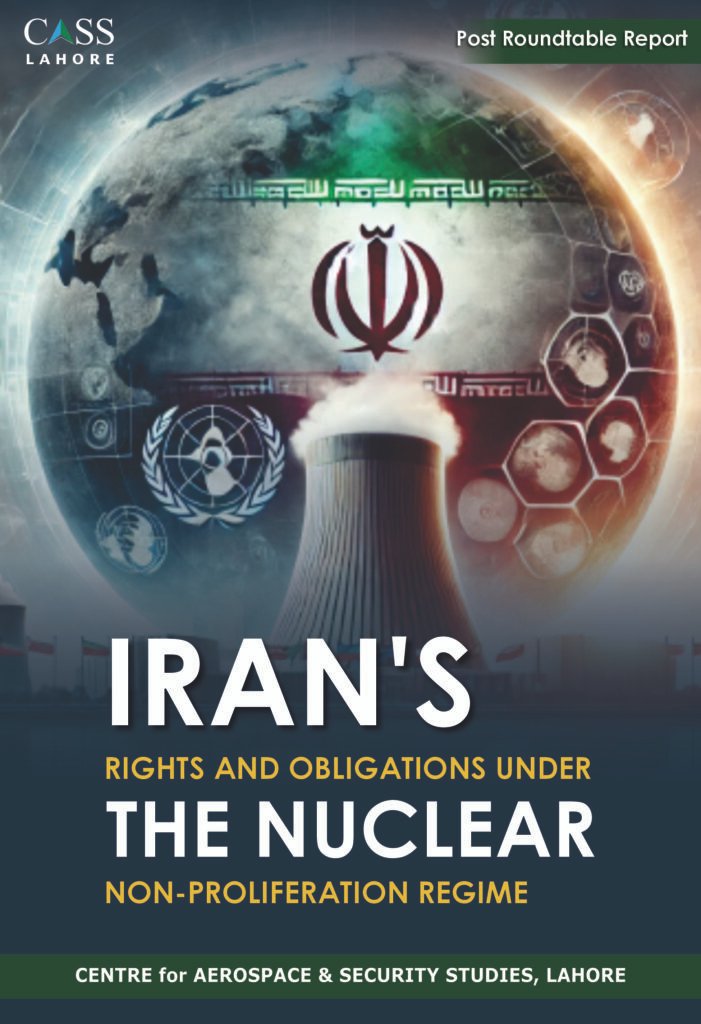
Iran’s Rights and Obligations Under the Nuclear Non-Proliferation Regime
November 19. 2025
The complete PRR is available upon request. Please click the button below to submit your request.
president
Air Marshal Asim Suleiman (Retd)
ROUNDTABLE COORDINATOR
Maheera Munir
EDITOR
Dr Zahid Khan
MASTER OF CEREMONY
Maheera Munir
REPPORTEURS
Maheera Munir, Amjad Fraz
Executive Summary
The Centre for Aerospace and Security Studies (CASS), Lahore, hosted a roundtable on 19 November 2025 titled “Iran’s Rights and Obligations Under the Nuclear Non-Proliferation Regime” to evaluate the shifting dynamics of Iran’s nuclear posture and its implications for global non-proliferation architecture. The discussion, led by Mr Sameer Ali Khan, a distinguished nuclear policy and strategic affairs expert, focused on Iran’s interpretation of its NPT commitments, the evolution of its enrichment programme, and the geopolitical pressures shaping its strategic choices. The discussion also assessed the impact of attacks on safeguarded nuclear sites, the erosion of trust, and the broader risks posed to regional and international stability.
In her opening remarks, Ms Maheera Munir, Research Assistant at CASS, stated that the global non-proliferation regime is facing severe strain, intensified by the June 2025 Iran-Israel war. She observed that strikes on safeguarded Iranian nuclear sites challenged established legal norms and raised doubts about the NPT’s credibility. While Iran’s programme was reportedly delayed by two years, Tehran asserted its sovereign right to enrichment, prompting deep concern over precedent and legality. She noted the IAEA’s limited response and Iran’s subsequent withdrawal from the JCPOA, warning that geopolitical instability has escalated. She concluded that safeguarding the future of nuclear governance demands renewed diplomacy and stronger multilateral mechanisms.
In his talk, Mr Sameer Ali Khan framed Iran as a test case for the future of the NPT, arguing that Tehran’s nuclear progress exposes contradictions within a regime built on trust, self-reporting, and selective enforcement. His presentation followed a thematic structure: Iran’s nuclear paradox, its exploitation of NPT ambiguities, the June 2025 strikes, the unresolved status of enriched uranium, and the implications for global non-proliferation. Mr Khan contended that the paradox lies in Iran being fully safeguarded under the NPT while simultaneously holding the technical capacity to rapidly build nuclear weapons. Iran legally accumulated approximately 400 kg of 60 per cent enriched uranium, enough for approximately ten bombs if taken to 90 per cent grade.
He stressed that Article IV grants Iran the right to peaceful enrichment but does not define permissible purity levels. This ambiguity allowed Iran to incrementally move from 3.5 per cent to 60 per cent while remaining technically compliant. The IAEA safeguards verify only what is declared, creating space for dual-track capability, where Iran maintained monitored facilities while developing covert ones. Post-1979, Iran’s nuclear programme shifted from civilian to strategic hedging, shaped by wartime insecurity and chemical attacks. Revelations of Natanz, Arak, and later Fordow deepened distrust. The JCPOA later became a damage-control mechanism rather than a rights-resolution framework, built to slow breakout time rather than dismantle capability. After US withdrawal, Iran escalated enrichment again.
Natanz served dual civilian/threshold roles, with one wing producing reactor fuel and the other enriching up to 60 per cent. Fordow, hardened under mountain rock, signalled strategic intent; its covert construction and fortification suggested preparation for a breakout scenario. Both remained under IAEA safeguards, yet their design and output were weapons-relevant in practice. US-Israeli strikes severely degraded facilities, but the fate of Iran’s 60 per cent stockpile remains unknown. Mr Khan highlighted that Iran’s silence since the attack could indicate crippling losses, quiet rebuilding, or strategic patience. Five months of inactivity provide clues but not answers.
He projected that the most likely diplomatic outcome is a limited arrangement, permitting around five per cent enrichment in exchange for partial sanctions relief. A full zero-enrichment outcome is unachievable, while a regional nuclear-weapon-free zone is politically impossible due to Israel’s undeclared arsenal. Thus, hedging may become institutionalised rather than eliminated. He concluded by highlighting the central contradiction: Iran followed safeguards, yet compliance did not protect it from military strikes that lacked UN authorisation. If transparency invites vulnerability while secrecy preserves deterrence, the NPT incentivises concealment, not cooperation. Selective enforcement, he argued, threatens the legitimacy of the non-proliferation order more than Iran itself.
The interactive session explored critical questions regarding Iran’s nuclear trajectory, its interpretation of NPT rights, and the evolving regional security environment. Participants questioned Iran’s continued pursuit of advanced enrichment capabilities. Mr Khan explained that Iran seeks threshold status rather than overt weaponisation, maintaining leverage while remaining formally compliant with the NPT. He argued that Israel, more than the US, acted as the primary spoiler in nuclear negotiations by targeting Iran’s nuclear infrastructure. Discussion highlighted Iran’s use of enrichment beyond reactor needs to strengthen bargaining power and the significance of ballistic missiles in recent conflict dynamics. The session also examined whether Iran missed its window for nuclearisation and whether its hedging behaviour could shift in response to sanctions and regional threats. Regional implications were assessed through potential Saudi nuclear ambitions, Pakistan-Saudi defence ties, and the influence of Russia and China.
In his concluding remarks, Air Marshal Asim Suleiman (Retd), President CASS Lahore, stated that the global nuclear non-proliferation regime, rooted in the NPT, remains central to international security but is increasingly under strain. He highlighted Iran as a key test case of this legitimacy crisis, noting that despite being an NPT signatory under IAEA safeguards, it has faced cyberattacks and direct military strikes, most recently in June 2025. Such actions, coupled with silence over Israel’s undeclared nuclear capability, weaken trust in the regime and encourage hedging behaviour among other states. He warned that the expiration of the JCPOA in 2025 marks a critical moment requiring urgent diplomatic renewal. Pakistan, he stated, advocates equal access to peaceful nuclear technology and stresses the need to protect safeguarded facilities and revive dialogue. For the NPT to remain viable, he argued, it must be enforced impartially, with diplomacy prioritised over coercive measures to prevent further regional proliferation.
Key Takeaways
- Ambiguity in the NPT
Article IV allows states to pursue peaceful nuclear technology but sets no explicit limits on uranium enrichment levels, creating a systemic ambiguity within the NPT framework.
- Iran’s Legal Rights Under the NPT
Iran has pursued uranium enrichment in line with its inalienable right to peaceful nuclear technology under Article IV of the NPT, and has carried out these activities under IAEA safeguards.
- Enforcement Paradox
The Iranian case demonstrates that adherence to the NPT does not guarantee protection from external military action, highlighting selective enforcement and systemic inconsistencies.
- Trust Deficit Drives Hedging
Long-standing suspicion and credibility gaps between Iran, the IAEA, and other states have incentivised Iran to maintain declared and covert nuclear capabilities as strategic hedges.
- Nuclear Latency and Compliance Dynamics
Iran’s experience highlights how states can develop advanced threshold capabilities, creating strategic leverage while remaining formally compliant with their NPT obligations.
Policy Considerations
- Equitable Enforcement of Norms
States and international bodies must exercise impartiality in the enforcement of nuclear norms as per the NPT and IAEA safeguards.
- Prohibition on Unilateral Strikes Against Nuclear Facilities
The international community must ensure that no state holds the unilateral right to attack nuclear installations operating under the NPT and IAEA safeguards.
- Augmenting Diplomatic Engagement
The international community must encourage negotiation-based solutions, which are essential to manage nuclear thresholds and reduce the likelihood of conflict.
- Protection of Legal Rights
The international community and the IAEA must ensure that Iran and other non-nuclear-weapon states under the NPT can continue to exercise their right to peaceful nuclear technology without risk of extra-legal intervention.
- Addressing the Trust Deficits
The IAEA must engage Iran in a sustained dialogue to reduce suspicion, clarify intentions, and avoid the emergence of covert or parallel nuclear programmes.
- Reforming the Global Non-Proliferation Regime
The international community must advocate for structural reforms in the NPT and related treaties to improve transparency in enforcement and strengthen the legitimacy of the global non-proliferation regime.
CASS LAhore

The Centre for Aerospace & Security Studies (CASS) was established in July 2021 to inform policymakers and the public about issues related to aerospace and security from an independent, non-partisan and future-centric analytical lens.
CASS Newsletter

- Home
- About Us
- Research Domains
- Publications
- Events
- Gallery
- Contact Us
@2021 - All Right Reserved. Designed and Developed by PenciDesign