



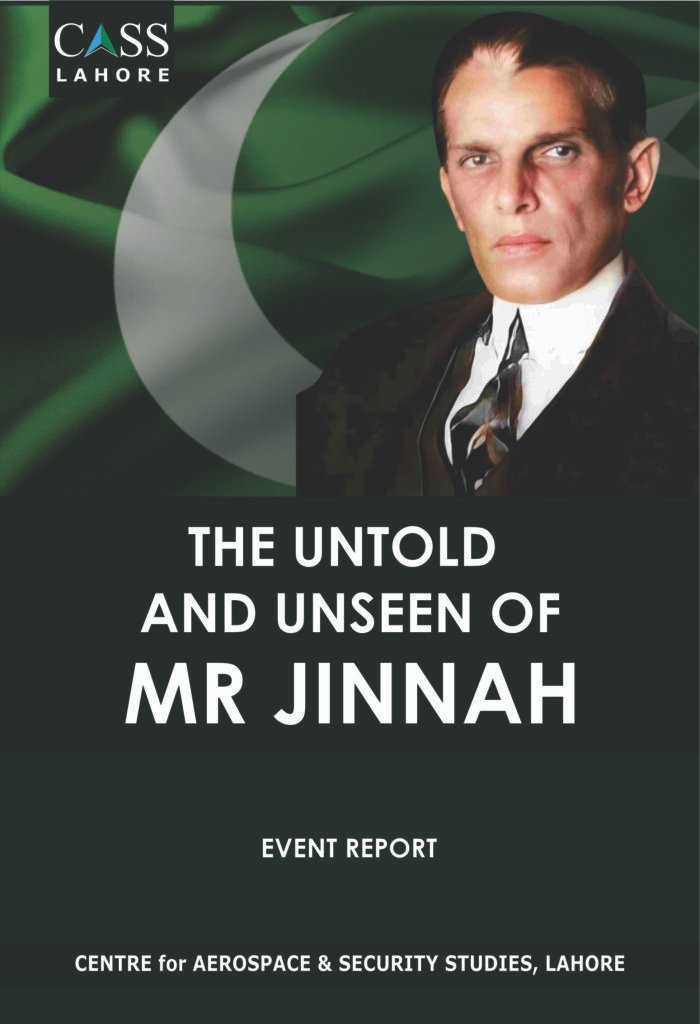
GUEST LECTURE
The Untold and Unseen of Mr. Jinnah
August 13, 2024
Air Commodore Khalid Chishti (Retd)
Complete Guest Lecture Report is available upon request. Please use the button below to submit your request.
president
Air Marshal Asim Suleiman (Retd)
EVENT COORDINATOR
Wing Commander Aamir Qayyum
EDITOR
Jawad Zulfiqar
MASTER OF CEREMONY
Faiza Abid
RAPPORTEURS
Naba Fatima & Ezba Walayat Khan
Executive Summary
On 13 August 2024, the Centre for Aerospace and Security Studies (CASS) Lahore hosted a thought-provoking guest lecture that delved into the lesser-known aspects of Quaid-e-Azam Muhammad Ali Jinnah’s life and leadership. The event aimed to uncover the untold and unseen dimensions of the legacy of Pakistan’s founding father.
Wing Commander Amir Qayyum, Deputy Director of Research at CASS, Lahore, delivered the introductory remarks, wherein he said that while Mr Jinnah is celebrated for his role in Pakistan’s creation, the session would delve into his struggles and influences beyond the well-documented events. He reflected on Mr Jinnah’s early intellectual achievements, his transformative period studying law in London, and his political career, emphasising that his leadership was marked by both strategic brilliance and deep personal sacrifice. He introduced the guest speaker, saying that his research would offer a deeper understanding of Mr Jinnah’s complex persona.
Air Commodore Khalid Chishti (Retd) delivered a guest lecture where he reflected on Quaid-e-Azam Muhammad Ali Jinnah’s leadership, highlighting his principled nature, vision for Pakistan, and significant role in the country’s formation. He emphasised Jinnah’s unwavering dedication to Pakistan, his integrity, and his ability to maintain a deep connection with the people. He also discussed Mr Jinnah’s foresight, particularly in the establishment of Pakistan’s military and his progressive views on women’s rights. Air Commodore Chishti further delved into Jinnah’s personal qualities, including his discipline, professional ethics, and commitment to simplicity and public service.
He recounted various instances that showcased Mr Jinnah’s sharp wit, strict adherence to principles, and empathy for the poor. The lecture also covered Mr Jinnah’s response to challenges, his legacy, and the global recognition of his contributions. Air Commodore Chishti concluded by reflecting on Mr Jinnah’s dedication to Pakistan, even in his final days, and the profound respect he commanded both nationally and internationally.
Following his talk, an engaging interactive session was held where attendees had the opportunity to delve deeper into Quaid-e-Azam’s life. During this session, participants asked about specific incidents and pivotal moments in Mr Jinnah’s journey. They also explored how Mr Jinnah’s principles and values could be applied in contemporary contexts to contribute to the betterment of Pakistan. The discussion offered a platform for examining how the foundational ideals of Mr Jinnah could guide current and future efforts to address the nation’s challenges.
Lastly, Air Marshal Asim Suleiman (Retd), President CASS, Lahore, delivered the concluding remarks, wherein he praised the compelling talk by Air Commodore Chishti on Quaid-e-Azam. He expressed admiration for Mr Jinnah’s exemplary character and integrity, noting that his unwavering principles, work ethic, and visionary outlook continue to inspire him. He highlighted Mr Jinnah’s significant role in history as a leader who embodied resolve, dialogue, and peaceful resolution. He admired Mr Jinnah’s confidence, meticulous organisation, and strategic acumen, which transformed Muslim aspirations into actionable proposals. The President concluded by reflecting on Mr Jinnah’s vision for a democratic, welfare state characterised by justice, equality, and peaceful coexistence, emphasising that his legacy remains a powerful source of inspiration.
Key Takeaways
- Two Nation Theory
Mr Jinnah’s resolute belief in the Two Nation Theory reflected his deep understanding of the cultural and political landscape of the subcontinent. His unwavering commitment to this vision and his strategic foresight allowed him to guide the creation of Pakistan, ensuring its sovereignty and protecting the rights of its people.
- Self-Sacrifice
His life was a testament to self-sacrifice in the pursuit of a higher purpose. He abandoned personal wealth and comfort to dedicate himself entirely to the cause of Pakistan. His declining health and personal tragedies did not deter him from continuing his struggle, exemplifying his relentless pursuit of self-determination for his people.
- Professional Integrity
Mr Jinnah was known for his uncompromising ethical standards, both in his professional and public life. His dedication to professional honesty was a cornerstone of his leadership, reinforcing the trust and respect he garnered throughout his career.
- Selfless Leadership
Perhaps one of the most striking qualities of Quaid-e-Azam’s leadership was his selflessness. He never sought personal gain or political glory; instead, his actions were always guided by a deep sense of duty towards his nation.
- Unyielding Commitment to Justice
Throughout his life, Mr Jinnah demonstrated an unyielding commitment to justice and truth. He believed that the foundation of a prosperous society was built upon fairness and transparency. His principled stance on justice not only defined his leadership but also strengthened his legacy as a man of unshakable moral values.
- Responsible Governance
Quaid-e-Azam’s leadership was marked by fiscal prudence and a keen sense of responsibility in governance. He understood that for a young nation like Pakistan, financial discipline was crucial. He meticulously managed public funds, ensuring that resources were used wisely and in the best interest of the nation.
- National Unity
His efforts to unite various ethnic, religious, and linguistic groups under a single national identity were a testament to his commitment to creating a strong, united Pakistan. His famous words, “Unity, Faith, Discipline,” continue to serve as a guiding principle for the country.
- Firm Believer in Education
Mr Jinnah was a staunch believer in the transformative power of education. He understood that the future of Pakistan depended on the intellectual growth of its people. To this end, he made significant contributions to educational institutions, ensuring that the youth of Pakistan had access to quality learning.
Policy Considerations
- Economic Independence
Achieving economic independence through industrialisation and self- reliance is crucial for building a strong and sustainable economy. To align with Quaid-e-Azam’s vision, policies must focus on stimulating growth across all sectors, ensuring balanced development that benefits every part of the nation.
- Modernising Defence Capabilities
Enhancing national security requires substantial investment in modernising defence capabilities, particularly in the Air Force. A robust and well-equipped defence system is important for safeguarding the sovereignty and ensuring the long-term security of nations.
- Accountability
Enforcing strict policies of accountability and transparency in government institutions is essential for building a responsible and ethical governance system. As envisioned by Quaid-e-Azam, public servants must be held to the highest standards of integrity to ensure public trust and effective governance.
- Ethical Leadership Development
Developing ethical leadership is key to national progress. Programmes focused on nurturing leaders with integrity, honesty, and a commitment to public service-rooted in Quaid-e-Azam’s principles will cultivate a generation of capable leaders who can steer the country towards a prosperous future.
- National Unity
Fostering a strong sense of national identity is essential for unity. By honouring the sacrifices made during the independence struggle and promoting shared values, initiatives can cultivate a collective sense of purpose and patriotism among citizens, helping to build a more cohesive and united society.
- Youth Development
Comprehensive programmes are needed to provide the skills, education, and resources necessary for success to the growing youth population. By preparing the youth to meet modern economic demands, their potential can be harnessed to build a prosperous nation as Quaid-e-Azam wanted it to be.
CASS LAhore

The Centre for Aerospace & Security Studies (CASS) was established in July 2021 to inform policymakers and the public about issues related to aerospace and security from an independent, non-partisan and future-centric analytical lens.
CASS Newsletter

- Home
- About Us
- Research Domains
- Publications
- Events
- Gallery
- Contact Us
@2021 - All Right Reserved. Designed and Developed by PenciDesign