



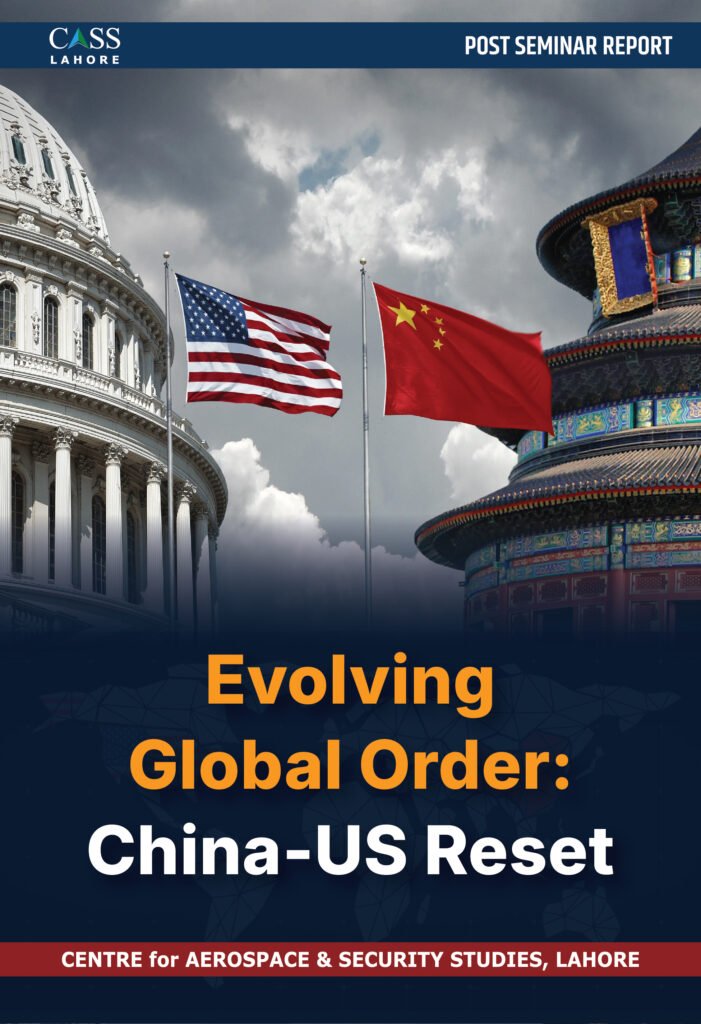
GUEST LECTURE
Evolving Global Order: China-US Reset
January 7, 2026
Mr Shahid Javed Burki
Complete Guest Lecture Report is available upon request. Please use the button below to submit your request.
president
Air Marshal Asim Suleiman (Retd)
EVENT COORDINATOR
Dr Ahsan Abbas
EDITOR
Dr Zahid Khan
MASTER OF CEREMONY
Mr Najam ul Hassan
RAPPORTEURS
Ms Sibra Waseem & Mr Abdul Wassay
Executive Summary
The Event “Evolving Global Order: China–US Reset,” organised by the Centre for Aerospace and Security Studies (CASS), Lahore, convened scholars, policymakers, and strategic analysts to examine the structural transformation of the international system amid intensifying rivalry between the US and China. The discussion focused on how shifting power balances, economic statecraft, and institutional contestation are reshaping global governance, with particular attention to the implications for middle powers and regional stability. Rather than treating China–US tensions as episodic or crisis-driven, the event approached them as a long-term systemic reset with enduring consequences for the emerging world order.
Mr Shahid Javed Burki, Chairman of the Burki Institute of Public Policy (BIPP) and former Vice President of the World Bank, provided the central analytical framework for the discussion by situating China’s rise within a historical and structural context. He argued that the international system is moving away from US-led unipolarity towards a contested bipolar configuration, where economic power, technology, and connectivity matter as much as military strength. China’s ascent was characterised by deliberate state-led development, sustained investment in human capital and infrastructure, and a pragmatic external engagement strategy that prioritises long-term partnerships over ideological alignment. Initiatives such as the Belt and Road, including the China–Pakistan Economic Corridor, were discussed as instruments that combine development objectives with strategic depth, offering alternative pathways of integration for developing economies.
The event contrasted this trajectory with the evolving US response, which increasingly relies on economic coercion, trade restrictions, technology controls, and political leverage within multilateral institutions. This approach was interpreted as reflecting structural anxiety over relative decline rather than a coherent accommodation strategy. As a result, global institutions that once underpinned liberal economic cooperation are facing politicisation, narrowing the policy space for developing states. The discussion highlighted how economic statecraft has become the primary arena of competition, with supply chains, critical minerals, energy routes, and financial systems emerging as central instruments of power in the China–US reset.
A significant portion of the deliberations addressed the implications for Pakistan and similar middle powers positioned at the intersection of competing strategic and economic systems. Pakistan was portrayed not as a passive arena for great-power rivalry but as a strategic fulcrum whose geography, demography and connectivity grant it agency, provided policy choices remain informed and calibrated. The event underscored the risks posed by information warfare and narrative contestation, noting how disinformation campaigns can undermine investor confidence, politicise development projects, and exacerbate domestic polarisation. At the same time, Pakistan’s youthful population was identified as a potential strategic asset, particularly in light of China’s ageing demographics, if effectively leveraged through skills development, technology transfer, and industrial integration.
In his concluding remarks, Air Marshal Asim Suleiman (Retd), President, CASS, Lahore, highlighted that the China-US relationship is the decisive factor reshaping the strategic, economic, and institutional contours of the twenty-first century. He observed that while strategic rivalry is structural and enduring, cooperation in areas of shared interest remains a practical necessity for global stability. He further noted that technology competition has emerged as a central fault line, requiring a balance between legitimate security concerns and the benefits of economic efficiency to avoid fragmenting the global economy.
Key Takeaways
- Shift towards a Contested Bipolar Global Order
The global order is transforming from US unipolarity to a continued China-US rivalry, placing Pakistan in a challenging position where great power competition increasingly shapes geoeconomic and security choices.
- China’s Structural Rise is Driven by Economic Progress
China’s state-driven and centralised economic system, sustained technological progress, connectivity strategy, and economic development demonstrate a long-term trajectory that Pakistan must engage with as an enduring feature of the global system rather than a transient phase.
- Multilateral Institutions are Geopoliticised
Global financial institutions are no longer insulated from great-power politics, constraining Pakistan’s policy space and reinforcing the need for diversified external economic partnerships.
- Inter-connectivity Serves as a Strategic Power
Projects such as CPEC illustrate how cross-country connectivity infrastructure now functions simultaneously as socio-economic development support and geopolitical leverage within the China-US reset and emerging global order.
- Economic Statecraft Dominates Rivalry
Tariffs, economic sanctions, export controls, and critical mineral access define contemporary competition between global powers, exposing Pakistan to supply-chain shocks and strategic pressure from both ends.
- Information Warfare is a Strategic Vulnerability
Narrative manipulation and disinformation campaigns targeting Pakistan-China strategic and economic cooperation adversely affect investor sentiments and amplify domestic instability and economic fragility.
- Demographic Dividend as a Strategic and Economic Asset
Pakistan’s youth may offer strategic value to China’s ageing population, but also pose governance risks if not properly utilised through skill development and employment opportunities, which remain underdeveloped.
- Pakistan is a Geostrategic Fulcrum, not a Bystander
Situated at the intersection of Chinese connectivity ambitions and Western market access, Pakistan occupies a pivotal global position, shaping the regional interface within the evolving global order.
Policy Considerations
- Institutionalising Strategic Non-alignment
Pakistan needs to normalise its relationship with global powers. This preserves geostrategic cooperation, enhancing access to China while maintaining economic relationships with the US and European markets.
- Strengthening CPEC Governance
Strengthening transparency, the regulatory framework, and the commercial approach in CPEC 2.0 is essential to attract diverse investment, sustain Chinese investment, and reduce external and domestic criticism.
- Protecting Policy Autonomy in Multilateral Engagements
Pakistan must build internal capacity to negotiate with international financial institutions without allowing geopolitical pressures to override developmental priorities.
- Enhancing State Capabilities in Information-Warfare
Developing credible strategic communication, media literacy, and regulatory mechanisms are required to shield Pakistan’s national interest and external engagements from narrative sabotage.
- Treating Critical Minerals as Strategic Economic Assets
Pakistan should integrate rare-earth and other mineral resources into a long-term industrial strategy aligned with China and the US.
- Leveraging Demographic Advantage with China
Structured skills training, technology transfer, and labour mobility arrangements can convert Pakistan’s youth bulge into a strategic and economic advantage within the China-US reset.
- Enhancing Regional Connectivity to Reduce Securitisation
Framing the CPEC 2.0 as a regional integration platform linking Central Asia and other regional counterparts can mitigate perceptions of exclusivity and geopolitical alignment.
- Embed Strategic Literacy in Decision-Making
Pakistan’s policymakers elite must prioritise long-term analysis, reading culture, and institutional memory to navigate the structural shifts of the emerging global order.
CASS LAhore

The Centre for Aerospace & Security Studies (CASS) was established in July 2021 to inform policymakers and the public about issues related to aerospace and security from an independent, non-partisan and future-centric analytical lens.
CASS Newsletter

- Home
- About Us
- Research Domains
- Publications
- Events
- Gallery
- Contact Us
@2021 - All Right Reserved. Designed and Developed by PenciDesign