



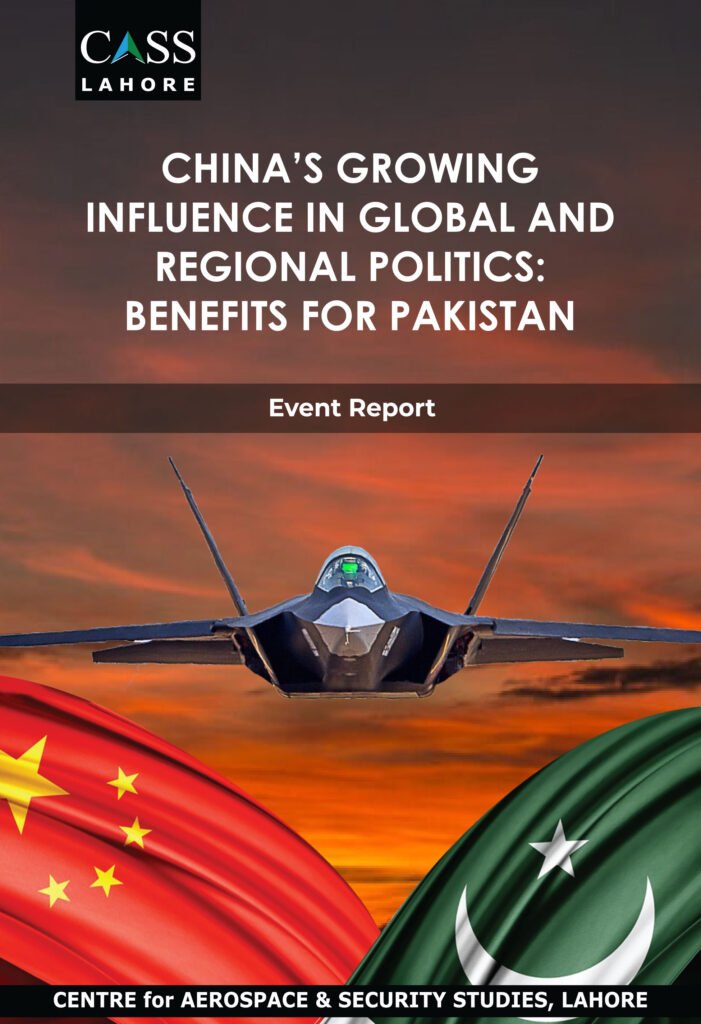
GUEST LECTURE
China’s Growing Influence in Global and Regional Politics: Benefits for Pakistan
June 13, 2024
Zhao Shiren
Complete Guest Lecture Report is available upon request. Please use the button below to submit your request.
president
Air Marshal Asim Suleiman (Retd)
EVENT COORDINATOR
Ameer Abdullah Khan
EDITOR
Jawad Zulfiqar
MASTER OF CEREMONY
Meher Azfar Rana
RAPPORTEURS
Naba Fatima & Maheera Munir
Executive Summary
Mr Zhao Shiren, Consul General, Peoples’ Republic of China in Lahore, China delivered a guest lecture at the Centre for Aerospace and Security Studies (CASS), Lahore on the topic “China’s Growing Influence in Global and Regional Politics: Benefits for Pakistan”. The lecture signified the longstanding friendship between China and Pakistan and the mutual benefits derived from their strategic collaboration, particularly through initiatives like the China-Pakistan Economic Corridor (CPEC) that drive infrastructural development and economic prosperity in Pakistan.
Mr Ameer Abdullah Khan, Senior Researcher at CASS Lahore, delivered the introductory note. He highlighted the deep-rooted relationship between Pakistan and China, characterised by trust, strategic alignment, and economic cooperation. He described the civilisational links between the two nations, which stretch back over 2000 years. He commended the Chinese people and their leadership for their remarkable journey of peaceful development and expressed a desire to learn from the Chinese experience.
In his address, Mr Zhao Shiren elucidated into China’s foreign policy objectives, emphasising the importance of mutual cooperation, economic development, and regional stability. He highlighted the transformative impact of the CPEC on Pakistan’s infrastructure, energy landscape, and socioeconomic development, showcasing tangible benefits such as enhanced connectivity, job creation, and economic growth. The Consul General stressed the strategic significance of the China-Pakistan partnership in fostering regional peace and prosperity.
Furthermore, Mr Shiren discussed the evolving multipolar world and the need for positive attitudes and pragmatic measures to navigate challenges and seize opportunities. He emphasised the importance of proactive diplomacy, constructive engagement, and inclusive stakeholder participation in shaping a more stable and prosperous global order.
Mr Shiren highlighted five initiatives by President Xi Jinping aimed at fostering international cooperation for peaceful development. He emphasised the potential benefits Pakistan can gain from China’s development, including cooperation in green technologies, space exploration, infrastructure development, agriculture, and industrial sectors. He reiterated support for Pakistan on the Kashmir cause and emphasised the significance of a two-state solution for achieving peace in the Middle East amid Israel’s actions in Gaza. The Consul General’s remarks underscored China’s commitment to promoting peace, cooperation, and shared development on the international stage, with a focus on building strong partnerships based on mutual respect and mutual benefit.
During the interactive session, the potential for trilateral summits involving China, India, and Pakistan was highlighted as a pathway to regional prosperity and stability. The Consul General reiterated the importance of sustained dialogue, economic cooperation, and strategic partnerships in addressing common challenges and advancing shared interests, stressing the need for continued collaboration to realise the full potential of the China-Pakistan relationship and contribute to regional peace and development.
Air Marshal Asim Suleiman (Retd), President CASS Lahore, concluded the event with a call for optimism, proactive diplomacy, and a focus on building a brighter future through collaboration and mutual understanding. He highlighted that the CPEC, under the Belt and Road Initiative (BRI), had significantly enhanced bilateral relations, focusing on energy, infrastructure, trade, investment, and technological cooperation. He stated that China’s expanding global influence, peaceful rise, and commitment to multilateralism bolster its role in regional stability. While highlighting the avenues for future cooperation, the President mentioned focus areas include developing Special Economic Zones, export strategies, agricultural modernisation, and science and technology cooperation.
Key Takeaways
- Lessons from History
China accentuates the importance of learning from the past to navigate present challenges, advocating for cooperation and dialogue to prevent conflicts and promote global stability which are a part of its DNA.
- Peaceful Rise of China
China emphasises a peaceful rise, avoiding competition with other nations and focusing on internal development rather than seeking dominance, as the age of dominance has passed.
- Advocacy for Multipolarity
China supports a multipolar world order over unipolarity or bipolarity, believing it fosters cooperation and stability, and provides more space to the developing nations.
- Respect for Current World Order
China has no desire to dominate the world, instead it advocates for modifications to the existing international order to address weaknesses and promote fairness.
- Preference for Partnerships
China believes in partnerships based on mutual respect and a shared desire for prosperity, emphasising cooperation and inclusivity in international relations instead of alliances.
- China’s Initiatives
President Xi Jinping has introduced five major initiatives: the Belt & Road Initiative, Global Development Initiative, Global Security Initiative, Global Civilisation Initiative, and Global Artificial Intelligence Governance Initiative. These initiatives aim to promote cooperation, development, and inclusivity and Pakistan can leverage the opportunities associated with these initiatives.
- Support for Kashmiri Freedom
China supports the Kashmiri people’s freedom struggle against India’s illegal occupation and stands with Pakistan on its legal and moral stance regarding the issue.
- Two States Solution for Palestine Issue
China condemns Israeli brutalities against the people of Gaza and reaffirms its support for the Two-State Solution as the only path to sustainable peace in the Middle East.
- Unwavering Support for Pakistan
As always, China has reaffirmed its policy of unwavering support for Pakistan, emphasising a long-standing partnership based on mutual trust, cooperation, and shared interests in regional stability and development.
Policy Considerations
- Prioritise Global Development
Pakistan needs to emphasise the importance of global engagement for social development and economic growth.
- Multipolarity & Inclusive Globalisation
Advocacy for a multipolar world order and inclusive economic globalisation is required. This includes actively promoting and engaging in initiatives that support a multipolar world order, fostering cooperation, diversity, and shared decision-making among nations.
- Non-Alignment for Peaceful Development
Pakistan should maintain a non-aligned stance in international relations for peaceful development, avoiding confrontation, hegemony, or interference, and promoting peace and development on the international stage.
- Embrace Green Initiatives
Green products and sustainable practices should be adopted by Pakistan by utilising opportunities offered by China to address energy transition and environmental sustainability.
- Dialogue for Security
Pakistan should prioritise communication, consultation, and dialogue with regional and global partners to enhance security cooperation, address common challenges, and build trust for a more secure and stable future.
- Security & Counterterrorism Cooperation
Security cooperation and counterterrorism partnerships should be enhanced with regional stakeholders, including China, to foster peace, security, and strategic equilibrium in the region.
- Engage in Global AI Governance
Pakistan can actively participate in the Global Artificial Intelligence Governance Initiative to shape ethical standards, regulations, and policies related to artificial intelligence, ensuring responsible and beneficial use of technology for society.
CASS LAhore

The Centre for Aerospace & Security Studies (CASS) was established in July 2021 to inform policymakers and the public about issues related to aerospace and security from an independent, non-partisan and future-centric analytical lens.
CASS Newsletter

- Home
- About Us
- Research Domains
- Publications
- Events
- Gallery
- Contact Us
@2021 - All Right Reserved. Designed and Developed by PenciDesign