
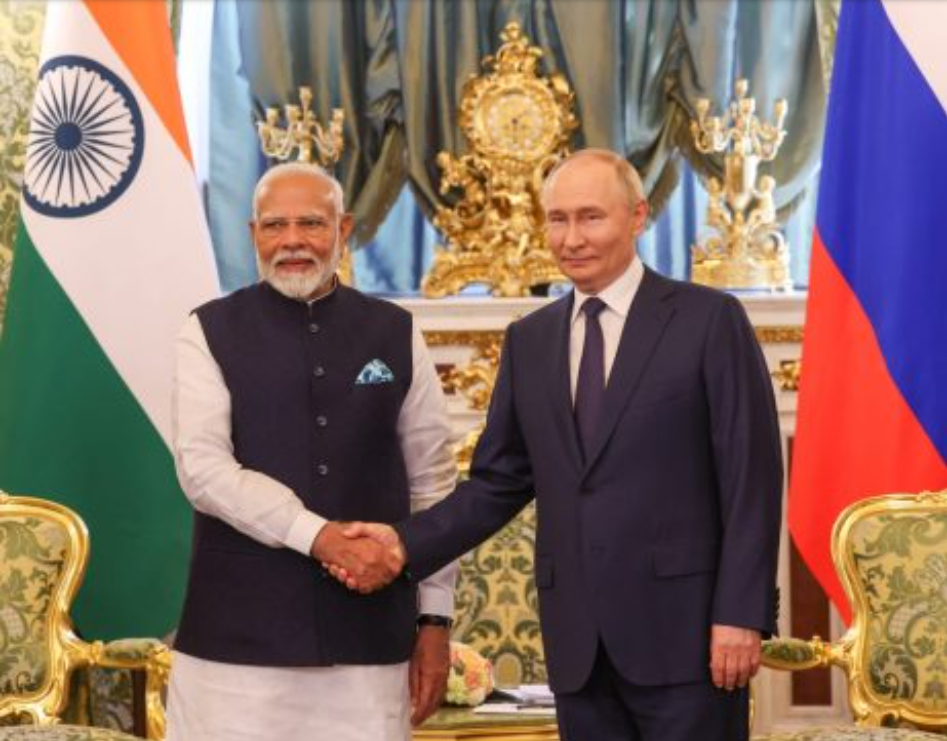


Russian President Vladimir Putin’s December 2025 visit to India was his first trip to New Delhi since the start of the war in Ukraine in 2022. News outlets from both sides celebrated the event as if the two states had forged a grand alliance capable of reshaping the global order and dealing a devastating blow to the United States (US) and the West. The reality, however, was far less dramatic. In effect, the summit was just a high-profile spectacle, and the outcome was mere showmanship, friendly gestures and broad statements.
The nature of pre-summit media coverage, along with the actual coverage, was filled with dramatic speculation. Observers claimed that India had been practically financing the Russian war in Ukraine by purchasing low-cost oil, which created the implication of a moral responsibility to support the aggression of President Putin. In Delhi, however, official rhetoric was more measured. The summit itself was staged for pageantry: Prime Minister (PM) Modi warmly embraced the Russian president on the tarmac, and President Putin received a ceremonial 21-gun salute. However, analysts noted that, beyond the optics, the summit primarily reaffirmed long-standing commitments, rather than new meaningful initiatives.
The Indian defence community expected the visit to yield concrete arms sale deals of weapons like additional S-400 ground-based air defence batteries, S-500 surface-to-air missile/anti-ballistic missile system, and Su-57 5th-generation aircraft. India had already received three S-400 systems under a USD 5 billion deal and was awaiting two more batteries. In the joint press release, the major defence focus was on support through spare parts, components, aggregates and other products for maintenance of Russian origin arms and defence equipment. Instead, the two leaders pledged only to “reshape” defence cooperation via joint research, co-production and local manufacture of components. This highlighted that big-ticket items were deliberately avoided. In practice, this meant India was hesitant to buy new Russian weapons, so the West was not provoked, particularly the US, which has already expressed its discontent over India-Russia ties.
Talks on trade and energy produced an ambitious long-term plan but few immediate gains. President Putin and PM Modi agreed on an economic cooperation programme through 2030, aiming to diversify trade and double annual trade to roughly USD 100 billion. In practice, however, the trade was already heavily tilted: India–Russia trade reached about USD 68.7 billion in 2024–25 (mostly oil, which is now declining due to US pressure), overwhelmingly favouring Moscow. In fact, the only concession from President Putin was a promise to ensure an uninterrupted flow of fuel to India, which critics noted was effectively a plea for India to defy US sanctions rather than a negotiated gain. India’s dependence on discounted Russian fuel remained essentially unchanged in the short term, and most of the economic deals merely built on existing links.
The summit gave a well-crafted yet cautious message of autonomy to the US. As President Trump had already doubled tariffs on Indian products linked to Russian oil imports, President Putin reportedly made his trip to challenge this diplomatic pressure, asking Indian television why India is not afforded the same right as the US to purchase Russian oil. India was not far behind, declaring the tariffs unwarranted and unreasonable, even as Reuters reported that Indian authorities were secretly negotiating a deal with Washington to reduce the duties. This strategy enabled India to maintain a defiant posture yet save the larger relationship, signalling an independent stance without a head-on conflict.
The reaction from Europe was openly critical. Days before the visit, the ambassadors of the United Kingdom (UK), France and Germany released a joint op-ed to implicitly criticise India on the hosting of the Russian president, citing recent Russian actions in Ukraine and that the visit will hurt the relationship between India and Europe. Indian officials rejected the action by European ambassadors as unnecessary. Yet this position further unsettled Western states, reinforcing concerns that the continued closeness of India to Moscow complicates its standing with key European states, especially on the Ukraine issue.
In conclusion, the 23rd India–Russia summit ultimately prioritised symbolism and presentation over substantive strategic outcomes. The media exaggerated the event, but the actual gains were mostly in optics, and the substance remained thin. In practical terms, nothing fundamental changed: India still ran a massive trade deficit with Russia and remained dependent on ageing Soviet-era weaponry. The summit did not alter these realities as India traded grand gestures for real progress. The summit underscored a concerning trend: symbolism was valued far above practical gains. Rather than yielding meaningful economic or security dividends, the visit served as a political theatre for domestic and international audiences.

Abdul Wassay
The writer is a Research Assistant at the Centre for Aerospace and Security Studies (CASS), Lahore.
Originally Published in Centre for Strategic and Contemporary Research (CSCR).
CASS LAhore

The Centre for Aerospace & Security Studies (CASS) was established in July 2021 to inform policymakers and the public about issues related to aerospace and security from an independent, non-partisan and future-centric analytical lens.
CASS Newsletter

@2025 – All Right Reserved with CASS Lahore.

- Home
- About Us
- Research Domains
- Publications
- Events
- Gallery
- Contact Us
@2021 - All Right Reserved. Designed and Developed by PenciDesign