
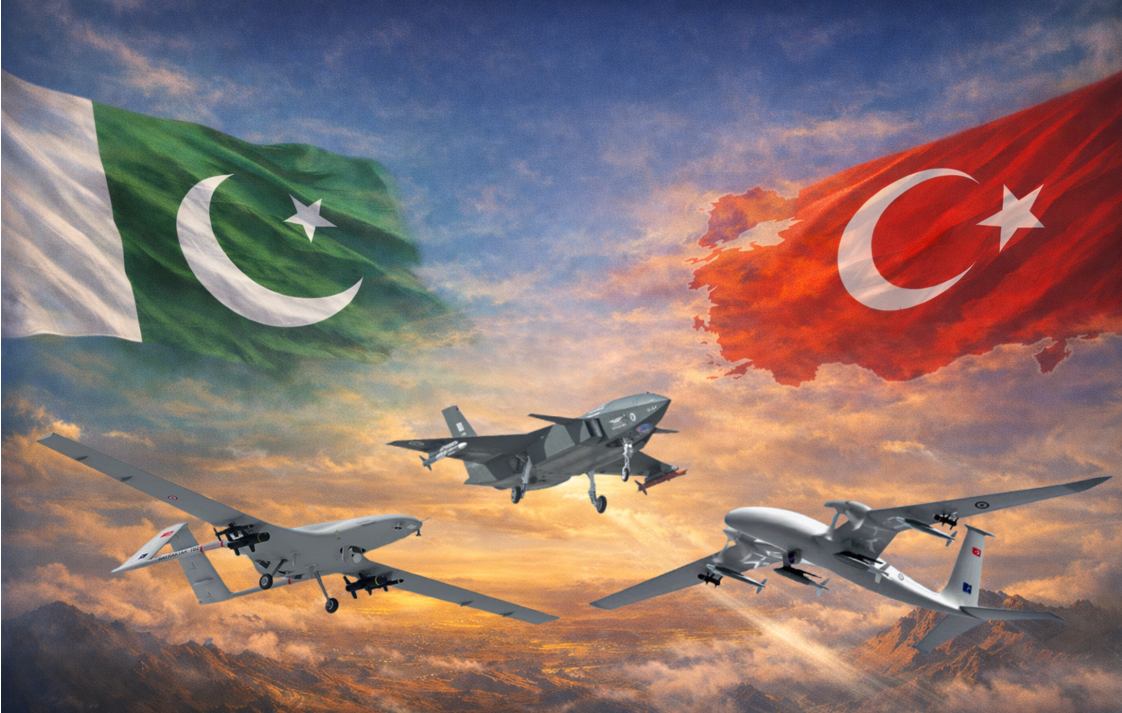


In the highly dynamic environment of twenty-first-century warfare, the “drone revolution” has shifted from an exclusive military resource to a critical component of modern defense planning and national security architecture. Pakistan-Turkey relations are long-standing and go beyond normal diplomatic ties, encompassing formalized defense cooperation, joint military training, research and development, and continued engagement in aerospace development. This alliance is taking a strategic flight in 2026. Recent reports indicate that Turkey is in advanced talks with Pakistan to establish a combat drone assembly facility, and in this process, long-endurance and stealth Unmanned Aerial Vehicles (UAVs) would be transferred and assembled in Pakistan. However, the specifications, technical details, and models to be assembled have not yet been made public.
The Pakistan-Turkey defense relationship was marked by periodic acquisitions and modernizations, but now the buyer-seller relationship is being shifted to a co-production and technology-transfer paradigm. The original equipment manufacturer (OEM) at the centre of the negotiations is said to be Baykar, which has already exported platforms such as the Bayraktar TB2 and Akinci to the Pakistan Air Force (PAF). Additionally, the Bayraktar Kizilelma stealth UAV, with comprehensive technology transfer provisions enabling local co-production, is in the pipeline. Pakistan is anticipated to get initial Kizilelma-A subsonic variants, with possible supersonic upgrades in future, following BVR tests in November 2025 off Turkey’s Sinop coast. Baykar is also engaged in a strategic joint R&D agreement with the National Aerospace Science and Technology Park (NASTP). It has also developed a domestic subsidiary, Baykar Technologies Pakistan, which is participating directly in the larger UAV and loitering munitions market.
As UAVs are influencing the modern battlefield, both countries are seeking to capitalise on their strategic alliance to build operational experience and strengthen industrial and technological capabilities. This collaboration is more relevant to the challenges of asymmetric warfare, in which states pursue strategic goals that fall below the threshold of traditional war but nevertheless influence the security environment.
For Pakistan, the strategic importance of UAVs has been strengthened by the operational lessons from the Pakistan-India May 2025 war. It was the first case when both countries used drones as a kinetic platform, highlighting their emergence as a critical force multiplier. India used drone swarms to target AD system in Pakistan. However, Pakistan responded effectively by using electronic warfare and coordinated air defence measures, neutralising threats without putting critical assets at risk. These events illustrate Pakistan’s operational maturity and the effectiveness of multi-domain integration, with drones playing an important role in achieving aerial dominance even under adverse conditions.
The proposed facility will further strengthen Pakistan’s indigenous expertise and industrial capacity and complement the PAF’s ongoing transformation under the visionary leadership of Air Chief Marshal Zaheer Ahmed Baber Sidhu, which includes the establishment of dedicated commands in both kinetic and non-kinetic domains, including the UAV Command. These are centrally operational commands that define how air power is planned, projected, and defended. Specifically, the UAV Command provides continuous surveillance of the target, rapid intelligence feedback, and precision strike capability at low cost and with minimal risk to personnel. This command would be supplemented by seamlessly integrating locally assembled Turkish platforms with the indigenous and other existing fleets of MALE and HALE drones, combat UAVs, and loitering munitions. This would enhance endurance, payload capacity, and operational versatility, thereby strengthening the capability to counter the full spectrum of UAV missions.
Besides this, the local assembly provides strategic, operational, and industrial benefits that are not immediately linked to platform deployment. In a region where drone fleets and counter-drones are growing rapidly, local production and assembly can ensure operational continuity, achieve rapid operational readiness, and maximize the integration of unmanned systems into overall air operations. All of these demonstrate an edge for Pakistan-Turkey in the development of unmanned capabilities, as well as provide a stabilising effect on the aerial deterrence in respective regions.
The industrial dynamics are also equally essential. UAV manufacturing involves high-tech engineering, advanced avionics, complicated software and composite material production. Therefore, setting up a domestic plant empowers Pakistan’s local supply chains, creates highly skilled jobs, and increases the diffusion of technology across key industries. The practical roles of engineers and technicians in assembly, systems integration, and maintenance foster the development of specialised skills that will facilitate the adaptation of the platform and the potential co-development with regard to Pakistan’s unique operational needs. Such consistent engagement in assembly would evolve into co-development opportunities, allowing Pakistan not only to preserve operational autonomy but also to actively participate in platform design and innovation. This will also contribute to the supply chain ecosystem, which will offer resilience against external supply limitations. From this collaborative engagement, Turkey can leverage Pakistan’s indigenous skills and operational experience to expand its industrial footprint in the UAV market.
In conclusion, the UAV alliance of Turkey and Pakistan has moved beyond episodic procurements to structural cooperation. The establishment of an assembly plant in Pakistan is the foundation of a new industrial structure which is more concerned about national production and technological expertise. As the nature of the battlefield shifts toward machine-paced attrition, whoever masters the industrial cycle of unmanned systems will have the strategic edge. The wings of the new alliance to Ankara and Islamabad are not only military resources but also tools for a common vision, creating a Mediterranean-South Asian axis of aerospace.

Ezba Walayat Khan
The writer is a Research Assistant at the Centre for Aerospace and Security Studies (CASS), Lahore, Pakistan.
Originally Published in Global Defense Insight.
CASS LAhore

The Centre for Aerospace & Security Studies (CASS) was established in July 2021 to inform policymakers and the public about issues related to aerospace and security from an independent, non-partisan and future-centric analytical lens.
CASS Newsletter

@2025 – All Right Reserved with CASS Lahore.

- Home
- About Us
- Research Domains
- Publications
- Events
- Gallery
- Contact Us
@2021 - All Right Reserved. Designed and Developed by PenciDesign