


Indian media’s reporting during the May 2025 Pakistan-India war has indubitably made it gain notoriety as a theatre of mendacity. In this context, headlines emerging from Pakistan’s eastern neighbour magnify small developments to project grandiosity. One such episode blown out of proportion is the Indian Prime Minister’s inauguration of an Emergency Landing Facility (ELF) on the Moran bypass in Assam on 14 February 2026.
During the ribbon-cutting of the 4.2-kilometre ELF, Prime Minister Narendra Modi was briefed by the IAF Air Chief, lauding the development as a supposed military achievement. This development has been reported by Indian news outlets as “historic” and deemed as phenomenal by Assam’s Chief Minister Himanta Biswa Sarma. In actuality, the Moran ELF is a representation of nothing but New Delhi’s apprehensions.
Extolled as Assam’s first of the five planned ELFs as part of developing a total of 28 such emergency air strips across India, it is important to realise the geography within which this dual-use infrastructure, putatively capable of handling transport aircraft and fighter aircraft take-off weight of 74 tonnes and 40 tonnes respectively, is situated. Assam is a part of India’s Northeastern region, commonly known as the seven sisters, which is connected to its mainland through a 22-kilometres-wide strip of land called the Siliguri Corridor, widely termed as the Chicken’s Neck.
The latter appellation is indicative of its vulnerability as a chokepoint because of its location between Bhutan, Bangladesh, Nepal, and China, meaning any instability or disruption in the corridor can effectively sever it from its heartland. Thus, the Moran ELF is a manifestation of India’s apprehension to protect its northeast, which has been marred by intractable restlessness, ethnic violence, and insurgency.
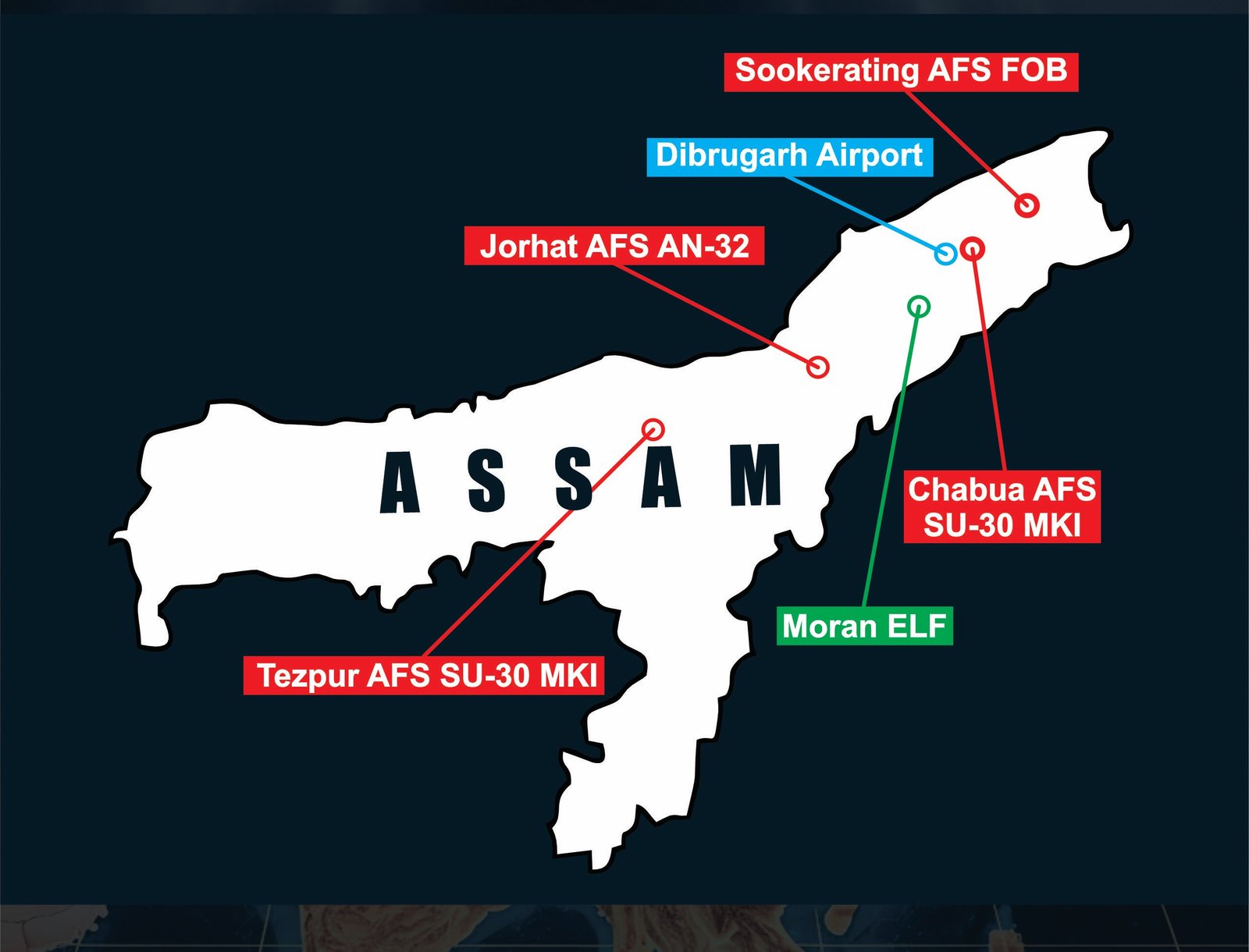
Moreover, taking a closer look at New Delhi’s military installations in its northeast reveals an attempt by the country to establish its potent presence in the region to secure the territory and make it independent lest the Chicken’s Neck gets trodden upon, whilst ensuring that internal and external support is available. To compensate for its geographic weakness, India has four bases: two SU-30 MKI Air Force Stations (AFS) in Assam at Tezpur (Salonibari) and Chabua, one transport AFS of the AN-32 aircraft at Jorhat, and another AFS functioning as a Forward Operating Base at Sookerating.
The Dibrugarh Airport is an additional infrastructural facility in the state. Therefore, within an area of 120 to 150 miles, five strategic assets exist. The Moran ELF is between the Chabua AFS and the Jorhat AFS. Existing between all the already operational military and aviation installations, the presence of the Moran ELF feels redundant. Nevertheless, the Indians have put forth arguments to justify this 10 million USD extortionate investment as a strategic asset for both disaster management and national defence.
Highlighting its dual purpose for take-off and landing of military and civil aircraft during crisis situation such as natural calamities like floods and landslides to help during HADR operations or war when conventional airports become non-functional, at a distance of approximately 186 miles from the Line of Actual Control with China, its strategic relevance is underscored vis-à-vis China’s expansion and upgrade of infrastructure such as airports, airbases, airfields, and support facilities in recent years across Tibet, Xinjiang, and near Arunachal Pradesh.
On India’s Republic Day, Chinese President Xi Jinping stated that Beijing and New Delhi are good neighbours, friends, and partners. In light of this statement, India’s China-centric reasonings regarding Moran ELF are nothing but a futile effort at veiling its jitters. Simultaneously, by negatively portraying China’s developments as targeted towards itself, New Delhi is spinning a web of paranoia and effectively getting trapped in it. New Delhi falsely believes in the need for indulging in so-called strategic signalling and posturing towards Beijing so that China does not thwart its already doomed hegemonic plans in the South Asian and Indian Ocean Region.
For an action to fall in the ambit of strategic signalling, it needs to influence the behaviour of another actor, which can also shape its threat perception; however, Google Earth shows that the Moran ELF is built on an existing road, which means that this infrastructural development is a glorified version of a road runway, rather than an independent facility.
In that regard, the idea of a road dually operating as a runway is not a novel concept. It exists all over the world, including Pakistan’s M-2 Motorway and others, with the concept finding its historical roots towards the end of the Second World War and Cold War to ensure redundancy of landing strips.
India’s newly opened Moran ELF can be interpreted as an anxiety-driven initiative, stemming from its geographic vulnerability in the Northeast. Rather than acting as a strategic signal towards Beijing, the ELF is an aggrandised and superfluous development in a territory already saturated with a number of operating surfaces in the region.

Arooba Younas
The writer is a Research Assistant at the Centre for Aerospace and Security Studies (CASS), Lahore.
Originally Published in Stratheia.
CASS LAhore

The Centre for Aerospace & Security Studies (CASS) was established in July 2021 to inform policymakers and the public about issues related to aerospace and security from an independent, non-partisan and future-centric analytical lens.
CASS Newsletter

@2025 – All Right Reserved with CASS Lahore.

- Home
- About Us
- Research Domains
- Publications
- Events
- Gallery
- Contact Us
@2021 - All Right Reserved. Designed and Developed by PenciDesign