


Multiple reports suggest that India’s accelerating induction and expansion of long-range air-to-surface missiles (LR-ASM) marks a shift in its military doctrine after the May 2025 war with Pakistan. While Indian officials frame this build-up as deterrence strengthening, the pattern raises deeper concerns. By favouring LR-ASMs, India appears to be preparing for deep strikes without risking aircrew. This doctrinal shift may disrupt the already fragile escalation ladder in South Asia and dangerously blur the lines between conventional and nuclear thresholds. This article examines how these missiles could reshape crisis dynamics and deterrence stability between India and Pakistan.
In May 2025, Pakistan shot down seven Indian warplanes, a claim backed by later reports. US sources confirmed Chinese-built J-10C fighters shot down Indian Rafales, and Pakistan’s Air Chief Zaheer Ahmed Babar Sidhu publicly tallied Indian fighters destroyed in combat. Multiple reports also identified wreckage of an Indian Rafale and Mirage-2000 at Pakistani strike sites, reinforcing Pakistan’s account. India provided no evidence to dispute these claims.
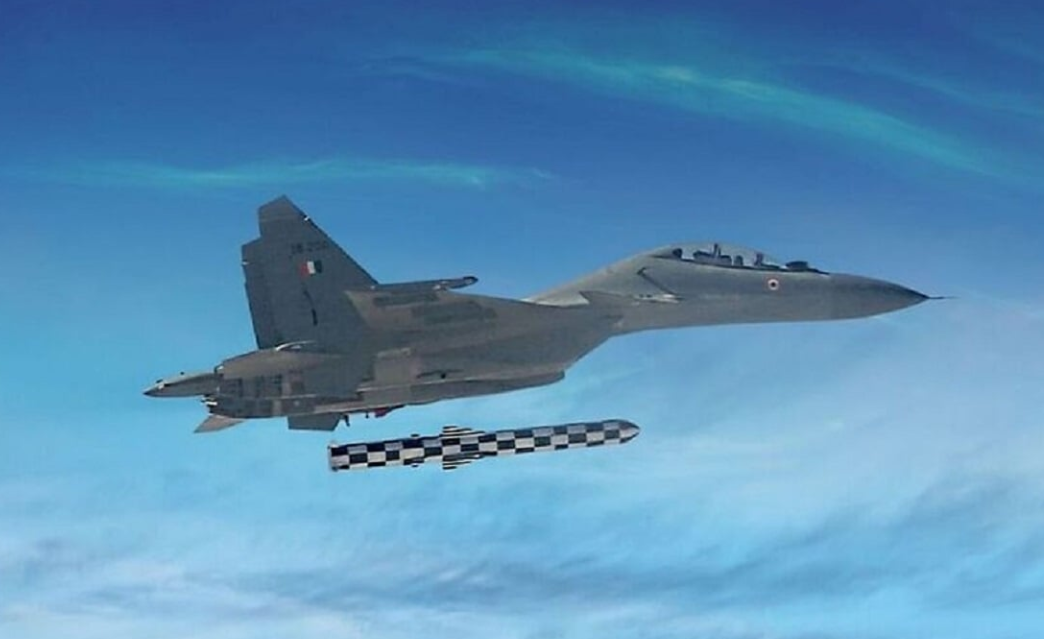
India’s response to those losses has been to extensively enlarge its LR-ASM arsenal. In the May war, the IAF used BrahMos supersonic cruise missiles, French SCALP/Storm Shadow and Rampage missiles to strike targets from its own territory. Now India openly seeks even longer reach. Reports say India is in talks for Air-LORA long-range missiles from Israel and is also field-testing an 800-km BrahMos. In fact, India has inked its largest-ever BrahMos procurement (220 missiles, approximately $2 billion) and approved 110 more air-launched BrahMos.
Longer-range missiles let Indian jets strike “from safe distances,” beyond Pakistan’s air defence zones, including advanced Pakistani air-to-air weapons like PL-15. Each new LR-ASM thus allows India to hit targets deep from its own soil. After the May war, India is changing its tactics: attack Pakistan without risking aircraft losses. Thus, this time Pakistan will also retaliate equally and this might take crisis into the higher rungs of escalation ladder. Every extra kilometre of range brings Pakistan’s “red lines” closer. For Islamabad, even a strike from hundreds of kilometres away could look indistinguishable from a major attack. Analysts note that with 800 km range missiles, virtually all Pakistani cities, from Islamabad to Karachi, lie within reach of Indian jets flying entirely from Indian territory. Some analysts warn there is now almost no conventional buffer: any use of these missiles could be conflated with a strategic attack.
The result is ‘a far more dangerous escalation ladder’. Pakistan’s doctrine of “full-spectrum deterrence” is designed to deter threats “at all rungs” of that ladder. In practice, using LR-ASM will make any deep Indian conventional counterforce strike against Pakistan more feasible, and this will be treated in Pakistan as an existential threat. These novel weapons will also cause an illusion of security in India since they will feel that they can launch attacks with no major reprisal by the Pakistani side or if there is any, then it will be countered. Due to this expansion, India has made limited strikes a more attractive coercive instrument and bargaining an increasingly risky game of brinkmanship. LR-ASM let an attacker impose rapid, precision costs on an adversary (targeting runways, command-nodes, air-defences, logistics) without risking pilots, so political leaders can credibly threaten or carry out deep strikes short of general war. This kind of weapon also compresses the decision-making time windows, though which India wishes to compel Pakistan’s actions and then shift the onus of responsibility of escalation onto Pakistan.
The consequences for deterrence are also stark. In effect, a limited conflict in future may have much higher probability of escalation. Modernisation and high-alert postures already leave “little margin for error” in South Asia. When India can hit sensitive targets from 800 km away, and Pakistan retaliate back via its quid-pro-quo-plus (QPQP) strategy, multiple rungs can be skipped potentially leading to a full-scale war. In such a scenario, Pakistan’s Army Rocket Force Command and the Pakistan Air Force’s long-range unmanned systems would form part of Islamabad’s broader retaliatory and signalling toolkit. Indian strategists may view a layered mix of BrahMos, Rampage, and Air-LORA as a route to “escalation dominance” by pressuring Pakistan while minimising their own vulnerabilities. Yet the May 2025 losses only deepen this appetite for so-called risk-reducing stand-off capabilities, even though classic Kahn–Schelling theory warns that such confidence in controllable escalation is often an illusion.
LR-ASM expansion after May 2025 war will generate an illusion of dominating escalation ladder in Indian psyche. This raises the possibility of a conventional strike which would compel both states to skip multiple rungs of the escalation ladder and reach higher levels of escalation. The May 2025 war demonstrated exactly how LR-ASM capabilities increased the dangers of escalation. In the absence of force posture transparency, plausible restraint signalling, and mechanism of crisis handling, the deterrence equilibrium will be more fragile in the region with major consequences for the nuclear overhang.

Abdul Wassay
The writer is a Research Assistant at the Centre for Aerospace and Security Studies (CASS), Lahore.
Originally Published in Global Defense Insight.
CASS LAhore

The Centre for Aerospace & Security Studies (CASS) was established in July 2021 to inform policymakers and the public about issues related to aerospace and security from an independent, non-partisan and future-centric analytical lens.
CASS Newsletter

@2025 – All Right Reserved with CASS Lahore.

- Home
- About Us
- Research Domains
- Publications
- Events
- Gallery
- Contact Us
@2021 - All Right Reserved. Designed and Developed by PenciDesign