
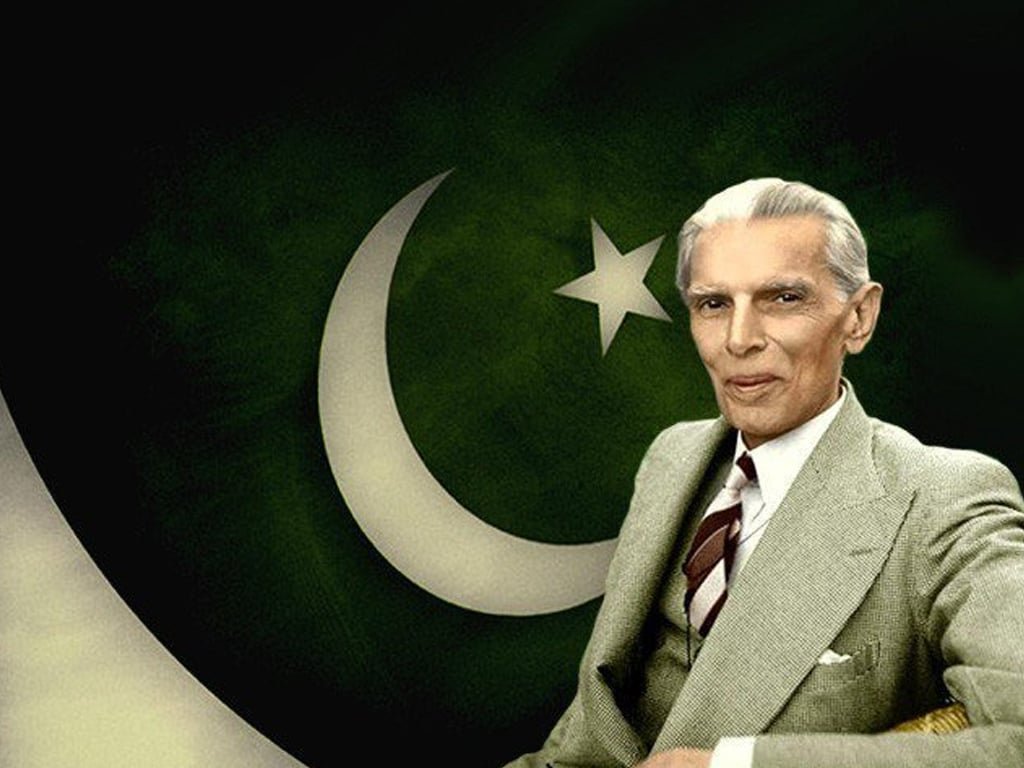


Pakistan pauses to remember the man who defied history’s odds and redrew its map every 25 December. Quaid-e-Azam Muhammad Ali Jinnah is not merely the founder of a nation; he is the architect of an idea, an idea whose relevance has only deepened with time. History has proven that his creation of Pakistan was not an act of division, but of preservation: of identity, dignity, and political justice. As the subcontinent again bristles with hostility, the logic of Jinnah’s vision stands right, not through triumphalism, but through tragic affirmation.
For Jinnah, Pakistan was never meant to be a monument to the past; it was meant to be a moral proposition to the future. He did not fight for partition as an act of separation, but as an act of principle. Jinnah believed that political freedom was meaningless without moral sovereignty, which is the right of a people to live by their conscience, secure in equality, and guided by justice. His belief in the “two-nation theory” was less about theology and more about dignity. He foresaw that when a state confuses the majority with morality, the rights of the few will always be the first casualty.
Seventy-eight years on, his logic feels freshly vindicated. The India of 2025 bears little resemblance to the pluralist republic its founders imagined. The walls between citizen and subject, Hindu and Muslim, majority and minority, are no longer political; they are constitutional. Laws that define belonging through belief, rhetoric that equates dissent with disloyalty, and policies that normalise exclusion have all become part of the state’s fabric. For anyone still asking whether Jinnah’s fears were justified, the answer is visible in every headline from across the border.
The Pahalgam incident earlier this year underlined how fragile that moral order has become. Within hours of the attack in Indian Illegally Occupied Jammu and Kashmir (IIOJK), the usual script unfolded: accusations against Islamabad, verdicts before evidence, noise before nuance. The execution of the ill-fated Operation Sindoor intended as retaliation was not a military operation, but a political theatre prior to elections. However, Pakistan’s response through Marka-e-Haq carried a very different message. It was not retribution; it was restraint. Our composure reaffirmed what Jinnah taught: actions, pursued from a position of principle, are the highest expression of strength.
This principle was exemplified by the PAF, reflecting Jinnah’s vision, who said during his 1948 visit to the PAF Academy, “Pakistan must build up her Air Force as quickly as possible. It must be an efficient Air Force, second to none.” This vision has been realised under the leadership of Air Chief Marshal Zaheer Ahmed Baber Sidhu, ultimately leading to India’s defeat and humiliation. The PAF successfully downed seven IAF aircraft and targeted 34 strategic sites, including 18 air bases, neutralising S-400 batteries, BrahMos storage facilities, supply depots, brigade headquarters, air defence systems, and an intelligence centre. The PAF continues to develop and modernise, sustaining its status as a premier force second to none across all operational domains.
Jinnah’s vision cannot be confined to the theatre of geopolitics. It was also a moral map for governance. His speech of 11 August 1947, remains one of the most radical statements ever made by a Muslim leader in the modern world: “You are free… to go to your temples, your mosques… that has nothing to do with the business of the State.” It was a call to build a nation where religion would inspire ethics, not dictate identity. Pakistan has witnessed periods of upheavals, but its story is not without accomplishments. The country Jinnah founded has endured what many thought it could not: wars, sanctions, terrorism, and internal crises. Yet it continues to stand, sometimes unsteadily, but always upright.
In 2025, there are flickers of hope towards the republic he imagined: the drive toward digital transparency, the expansion of social protection, expanding trade routes, and the growing demand among citizens, especially the young, for clean governance and merit. These are not symptoms of any disease, rather signs of recovery and growth.
Perhaps that is what one expects from younger nations: not always perfection, but persistence. This nation’s founder was a pragmatist who believed in moral ambition. He did not promise that Pakistan would be flawless, only that it would be free, free to define its own path, to learn from its mistakes, and to remain honest to its founding purpose. It is the youth, curious and unwilling to be silenced, who now hold that purpose in their hands. In their insistence on transparency, their desire for education, their rejection of cynicism, one faintly hears the voice of the man who once told them: “Build yourselves first before you build the nation.”
Thus, this Quaid-e-Azam Day, the question is not whether we remember him, but whether we are still capable of recognising the republic he envisioned. His politics were of discipline, not disorder; of reason, not rage. In a time when noise so often passes for strength, Jinnah’s quiet certainty feels revolutionary. As we gather to pay homage, let us remember that he gave us not a slogan, but a standard. The real tribute to Jinnah is not to speak in his name, but to act in his image, with integrity, restraint, and an unshakeable belief that a nation’s strength lies not in power, but in principle.

Ezba Walayat Khan
The writer is a Research Assistant at the Centre for Aerospace and Security Studies (CASS), Lahore.
Originally Published in Daily Times.
CASS LAhore

The Centre for Aerospace & Security Studies (CASS) was established in July 2021 to inform policymakers and the public about issues related to aerospace and security from an independent, non-partisan and future-centric analytical lens.
CASS Newsletter

@2025 – All Right Reserved with CASS Lahore.

- Home
- About Us
- Research Domains
- Publications
- Events
- Gallery
- Contact Us
@2021 - All Right Reserved. Designed and Developed by PenciDesign