
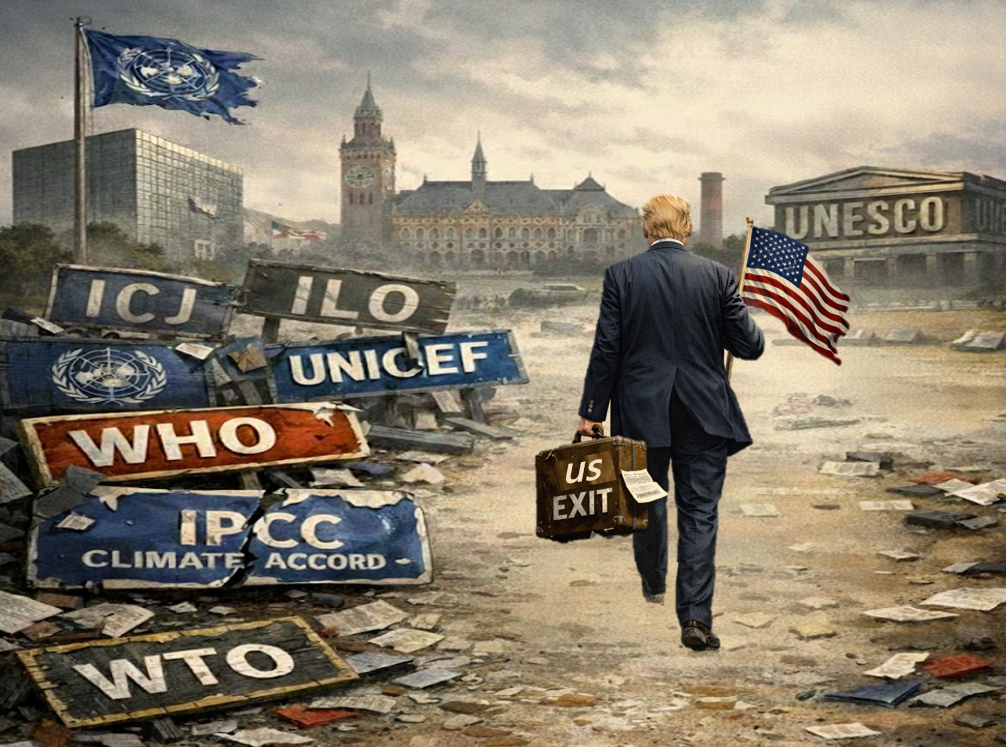


Continuing his dramatic reshaping of the US foreign policy, President Trump recently announced US withdrawal from sixty-six international organisations, including UN-backed bodies and climate agreements. This marks one of the most extensive US retreats from its multilateral engagements in recent history.
The rationale being presented by the White House is that these bodies were contrary to the interests of the US and as such a waste of taxpayer dollars and inimical to national interest. While this move may help consolidate power at home, it exposes a growing disassociation of the Trump administration from the international rules-based order, which the US has been championing for three-quarters of a century.
Following the end of WW-II, the US not only supported the post-war efforts for a new international order; it shaped and sustained it. American preferences for open markets, cooperative security and rule-based dispute resolution are all reflected in the network of human agencies, climate treaties, human rights forums and technical bodies that form the current institutional architecture at the global level. While this system was not perfectly liberal, as it was meant to be, or universally benign, as it should have been, it did create expectations of predictability and accountability which ultimately underpinned global stability.
The very phrase ‘rules-based international order’ implied a degree of commitment and leadership; however, the US withdrawal from many of these treaties shows a contradiction between what the US practices and what it preaches. It also marks a historic first that the very state which formulated the global order, is now withdrawing from it. Thus, while the US is technically supposed to be a status quo power in the current system, it is instead acting as a revisionist one.
Recent US actions clearly signal that it no longer sees itself as the foremost champion of this system. The fact sheet released by the White House announcing these withdrawals makes an explicit mention that these efforts are being done to protect American interests from globalist bureaucrats and agendas which it deems hostile.
This policy shift highlights a paradox: at a time when the US is investing in domestic consolidation by prioritising national sovereignty, economic autonomy, and internal political cohesion, it is simultaneously diminishing its standing and efficiency abroad.
This erosion of American authority is also evident in Europe, where Washington’s increasingly ambivalent attitude towards European security is raising concerns about the credibility and reliability of the US as a trusted military partner under the NATO framework.
Repeated signalling t hat the US defence commitments are conditional, not automatic, has led to a rethink in the European psyche that their ally’s central guarantees may no longer be sacrosanct. In this light, Europe has already begun a recalibration with renewed debates around strategic autonomy, increased defence spending and reliance on trusted European partners rather than a fickle transatlantic one.
With the US now showing the same ambivalence towards its multilateral commitments, it’s only a matter of time until the global power structure also recalibrates. While the international system remains anarchic with no central authority, this does not mean it is rudderless.
Since the advent of the Westphalian system, there has always been a dominant power at the top, as the International political system abhors a vacuum. In the absence of US leadership, other states are likely to step for ward to fill this void, whether through desire or inevitability.
China, for example, is already expanding its international footprint within the economic sector as well as through infrastructure developments and regional rule-making frameworks. European states are likewise reclaiming their international space in light of American unpredictability.
This growing emphasis on alternative leadership is not inherently problematic, since plural leadership in a multipolar world is a plausible reality. What it does impact is the traditional American role in the international liberal order.
With the US now choosing to deliberately disengage from international organisations that nurture cooperation on important issues like migration, labour standards or environmental protection, it cannot later chastise others for exercising influence in these very arenas. The notion that the absence of a dominant power would lead to a benign equilibrium is a theoretical convenience. In reality, realignment and reassessment of the great power politics are likely to fill the void left behind.
The ultimate implication of this US foreign policy shift is not about the immediate realignment or redefinition of Washington’s role in global governance. The question which needs to be addressed is that if the US no longer chooses to be an anchor of global governance, then what moral authority does it have to dictate who takes its place and how they choose to steer the trajectory of global politics. The answer to this would define the next few decades of international order.
Disclaimer: The opinions expressed in this article a

Nidaa Shahid
The writer is an Associate Director at Centre for Aerospace and Security Studies (CASS), Lahore.
Originally Published in Stratheia.
CASS LAhore

The Centre for Aerospace & Security Studies (CASS) was established in July 2021 to inform policymakers and the public about issues related to aerospace and security from an independent, non-partisan and future-centric analytical lens.
CASS Newsletter

@2025 – All Right Reserved with CASS Lahore.

- Home
- About Us
- Research Domains
- Publications
- Events
- Gallery
- Contact Us
@2021 - All Right Reserved. Designed and Developed by PenciDesign