
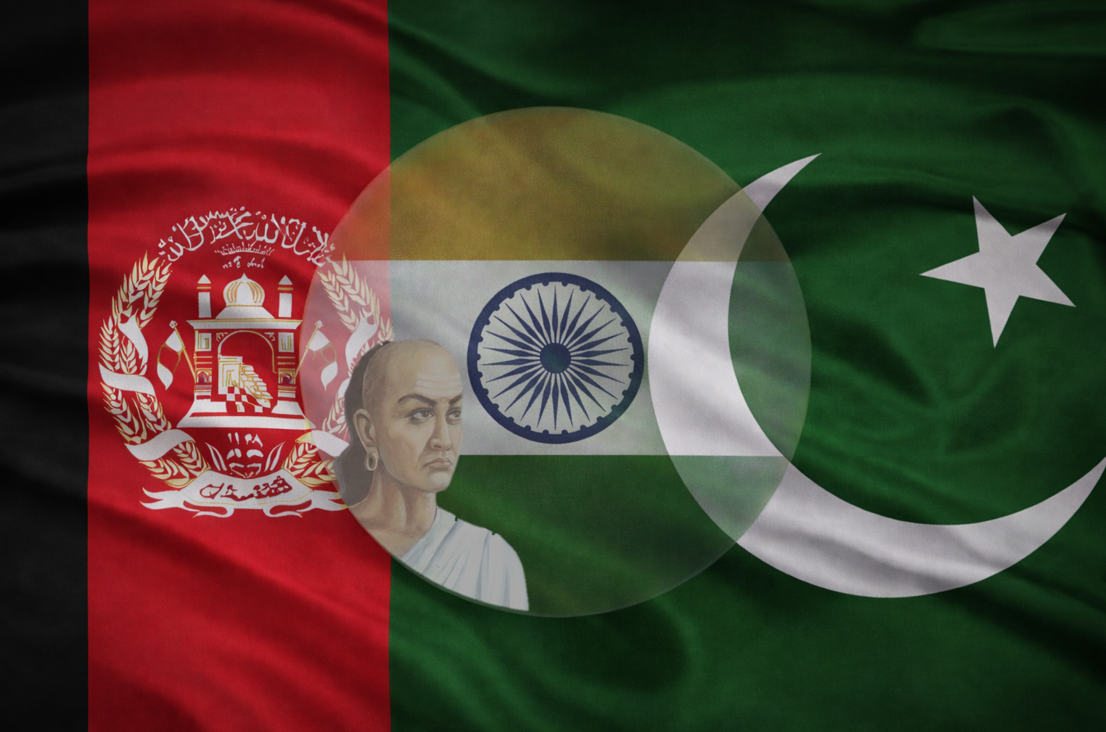


The universal truth that you cannot choose your neighbours represents an immutable reality for Pakistan and Afghanistan, two countries bound historically, linguistically, and culturally. Yet shared geography cannot become an excuse for Islamabad to tolerate Kabul’s unfulfilled commitments, allowing India to foment unrest within Pakistan through terrorism by using its soil. Afghanistan does not realise that it is a pawn in India’s strategy guided by the Indian strategist Chanakya’s maxim of befriending an enemy’s neighbour and exploiting them to their advantage. This has led to increased cosying between India and Afghanistan, signalled by New Delhi’s decision to reopen its embassy in Kabul and Amir Muttaqi’s visit to India, during which he issued a joint statement against Pakistan by referring to Kashmir as part of India.
Acting on India’s behalf by supporting and providing sanctuaries to Fitna al-Khawarij and Fitna al-Hindustan, terrorist organisations maiming and claiming innocent Pakistani lives, has not done Afghanistan any favours, as neither its sovereignty has been strengthened, nor its regional standing has improved. Moreover, Afghanistan and India cannot have a robust relationship because of their divergent ideologies and values. Kabul’s behaviour, working against Islamabad’s interests, strikingly contrasts with Pakistan’s historical approach of strategic restraint and accommodation, exemplified by hosting millions of Afghan refugees, facilitating trade and transit, and providing humanitarian and developmental aid.
Exasperated by the Taliban’s hollow reassurances that the Afghan territory is not used for terrorism against any country and after exhausting incentives and economic pressure with no tangible results, Pakistan’s patience reached its limit. Pakistan resorted to limited punitive measures in self defence, carrying out airstrikes against the infrastructure and leadership of Fitna al Khawarij in October 2025. This action came after Pakistan’s requests to the Afghan Taliban to rein in its support for terrorist organisations remained unheeded. In the aftermath, a ceasefire was agreed upon with the mediation of Turkiye and Qatar. However, the negotiating process laid bare the Afghan Taliban’s capriciousness and intransigence as they consistently hesitated to take verifiable action against militant safe havens, despite Pakistan presenting photographic and documentary evidence of operations originating from there.
Even though the relations between Pakistan and its Western neighbour have soured, Islamabad has repeatedly invested in reducing tensions through dialogue. Amongst recent examples is the closed-door round of talks held in Riyadh early December 2025, which concluded without a substantive outcome. The Afghan Taliban turned down dialogue in mid- December 2025 when Tehran hosted regional envoys on developments related to Afghanistan. This is another demonstration of the Afghan Taliban’s unmet reciprocity, contrary to Pakistan’s eagerness for brotherly relations sans the terrorist bonhomie. Such prudence is essential for regional stability, as the net effect of these strained relations will culminate in economic instability, discouraging investments and disrupting trade corridors. The repercussions will be felt by both states, but more severely by Afghanistan, which is already confronted with severe multidimensional poverty. More than 64 per cent of Afghans live in multidimensional poverty, while rampant food insecurity persists, with 17 million people facing acute hunger.
Distress and lost livelihood will increase manifold after Taliban’s First Deputy Prime Minister for Economic Affairs, Mulla Abdul Ghani Baradar, issued a strongly-worded directive against maintaining trading relationships with Pakistan in mid-November 2025. He further announced terminating all trading contracts with Pakistan in three months’ time, asking traders to explore other avenues of trade. It should be noted that alternatives in the form of Iranian trade routes prompt consideration of their feasibility. Tehran will not tolerate the Taliban’s present attitude, defined by diplomacy of terror, as Iran has nothing to gain from such engagement. This contrasts with Pakistan, where established trade corridors and CPEC offer tangible economic and connectivity dividends, strengthening Islamabad’s regional integration incentives.
Such actions taken bythe Afghan Taliban are revealing their duplicitous behaviour, a rhetoric that has to be adopted when they have continuously demonstrated their inability to keep their word. It should not be forgotten that Pakistan has paid, and is still paying, a steep price for helping Afghanistan. The decades of conflict, which Afghanistan was marred by, have had a spillover effect in the Pakistani society as illicit and informal economies became further entrenched, unbridled smuggling, pernicious Kalashnikov culture, and proliferation of drug usage distorted social norms.
It must be emphatically noted that Pakistan has always demonstrated restraint in its engagement with Afghanistan. It was the first time that Pakistan became stern in its approach with Kabul, making it clear that concrete corrective actions are required for normalisation of bilateral relations, rather than following India’s playbook dictated by Chanakya. It is high time that the Afghan Taliban understand that the suspension of trade by Pakistan is not a temporary pressure tactic but a measure likely to endure. It is increasingly evident that unless Afghanistan puts its own house in order, provides Pakistan with the assurances it rightfully demands, and shows tangible progress on Pakistan’s security concerns, its options will remain constrained, making improvement in relations a necessity rather than a choice.

Air Marshal Asim Suleiman (Retd)
The writer is President at the Centre for Aerospace and Security Studies (CASS), Lahore.
Originally Published in The Nation.
CASS LAhore

The Centre for Aerospace & Security Studies (CASS) was established in July 2021 to inform policymakers and the public about issues related to aerospace and security from an independent, non-partisan and future-centric analytical lens.
CASS Newsletter

@2025 – All Right Reserved with CASS Lahore.

- Home
- About Us
- Research Domains
- Publications
- Events
- Gallery
- Contact Us
@2021 - All Right Reserved. Designed and Developed by PenciDesign