
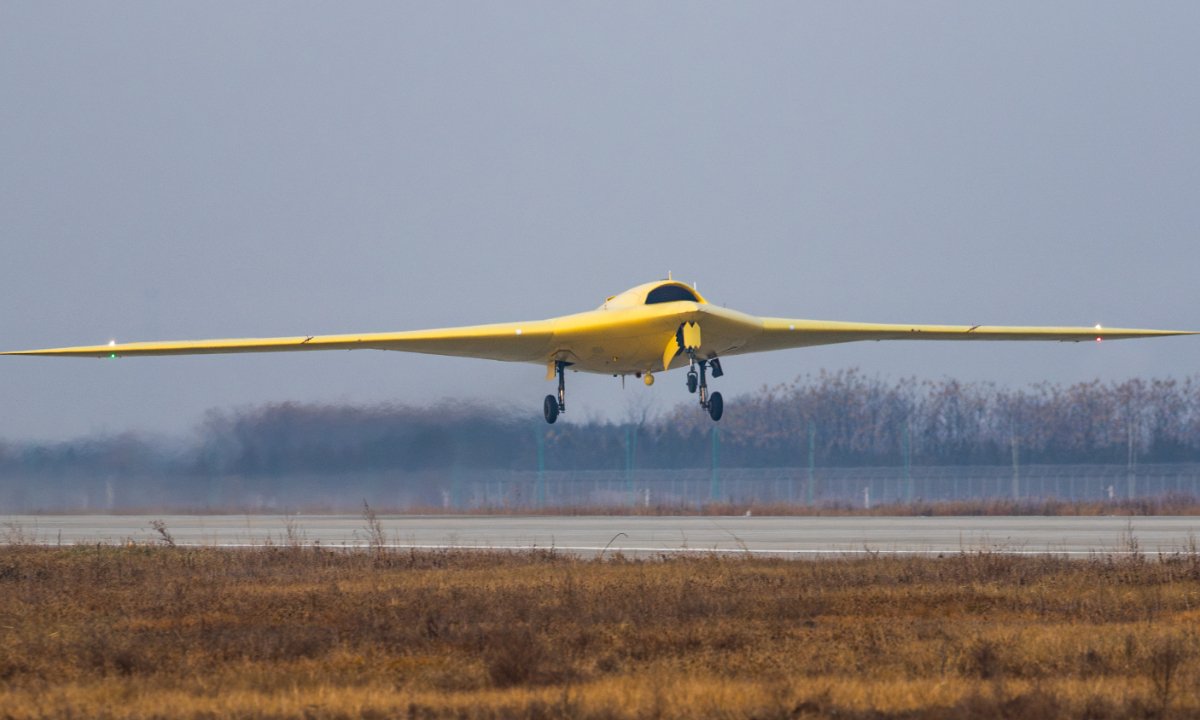


In the emerging age of sixth-generation warfare, military engagement has become more network-centric and informational superiority has taken centre stage. In this environment, the use of Unmanned Aerial Vehicles (UAVs) by the military has evolved from supporting tools into core contributors for feeding information. Within this context, the debut of China’s CH-7 (Caihong-7) drone signals a strategic evolution in the employment of pilotless planes, as the bird is highly survivable in contested environments.
The CH-7 is a High-Altitude, Long-Endurance (HALE) drone developed by the China Aerospace Science and Technology Corporation. It can fly at an altitude above 13,000 metres with a speed of 920 kilometres per hour. Its operational radius is 2000 kilometres and carries anti-radiation missiles. It can intercept radar electronic signals while simultaneously detecting high-value targets. With a high-ratio of body-wing configuration, and radar-absorbing material on edges, it carries maximum stealth. The semi-concealed engine exhaust nozzles reduce the IR signature, giving CH-7 the capability of 15 hours of loiter time.
The drone successfully completed its maiden flight on 15 December 2025. The test marks a watershed moment in the evolution of survivable unmanned intelligence, surveillance, and reconnaissance (ISR) systems. It does not introduce a new category of capability, but illustrates how unmanned systems are being adapted to fit more mature doctrines of air warfare, where survivability and persistence matter.
The West and Israel have employed unmanned ISR platforms for decades. The US has been operating high-altitude drones like the RQ-4 Global Hawk and stealth-oriented unmanned platforms such as RQ-170. Israel has also long dominated the Medium-Altitude Long-Endurance (MALE) ISR space. What sets CH-7 apart from most existing unmanned systems is its emphasis on survivability in contested airspace and its ability to penetrate modern integrated air-defence systems. The Global Hawk is powerful but not stealthy, while RQ-170 remains tightly controlled, but the CH-7, equipped with optical and infrared sensors, offers stealth survivability at high altitudes. While Turkey’s ANKA-3 has comparable features and purpose, the CH-7 offers more loiter time compared to ANKA’s 10 hours, with a top speed of 920 kilometres per hour.
The strategic logic behind this development is the sixth-generation airpower logic. Information and system-of-systems framing has become a decisive element on the modern battlefield. The CH-7 is represented as a networked sensor mode intended to operate alongside other systems. This follows contemporary military doctrine emphasising the kill chain, which hinges on rapid detection, accurate tracking, timely decision-making, and precise engagement. The unmanned ISR systems, hence, become critical nodes in this network.
From a technical perspective, the CH-7 also reflects a maturing of autonomous flight control. Flying-wing designs are inherently unstable and require advanced flight-control systems to maintain stable flight without conventional vertical and horizontal tails. Successful autonomous taxiing, take-off, trajectory control and landing during the maiden flight show that the developers have achieved a meaningful degree of integration between aerodynamic design and digital control systems.
This development reflects broader global trends where militaries worldwide are investing heavily in unmanned systems that can operate with autonomy, persistence and reduced risk to human operators. Only a few nations have publicly demonstrated efforts to combine long endurance with stealth and autonomy for contested airspace operations. For the US, Russia, and others, equivalent systems are either under development or remain closely guarded. The CH-7’s public flight testing thus serves not only a technical purpose but also a strategic signalling function in showing that China is capable of producing unmanned ISR platforms.
Early official reports indicate that rather than being a multirole unmanned platform, the CH-7 will be solely used for reconnaissance missions. It suggests that the CH-7’s value lies in contested environments where the PLA wants persistent ISR. Moreover, the core capabilities “first-look, first-track, first-target” of the drone will help the PLA with a scout-and-strike military tactic. The maritime theatre and the island chains around China, hence, become a relevant theatre for the platform. It offers persistent wide-area ISR and cueing for missiles and aircraft over the Taiwan Strait, and stand-off sensing around Taiwan’s air and naval routes. Additionally, the platform offers targeting support to PLAF around the Senkaku Islands.
Furthermore, the unusually open nature of the CH-7 testing suggests that the UAV will be offered for export. Currently, no other country is pitching such advanced capabilities on arms market. There are unconfirmed reports that Pakistan is likely to procure this tailless drone.
By combining endurance, autonomy and survivability, such platforms promise to extend the reach of intelligence gathering deep into contested environments. In sum, the flight test of CH-7 suggests a fundamental shift in unmanned ISR where existing concepts in low observability and autonomous control are being brought together in a more deliberate way.

Zunaira Sarfraz
The writer is a Research Assistant at the Centre for Aerospace and Security Studies (CASS), Lahore.
Originally Published in Global Defense Insight.
CASS LAhore

The Centre for Aerospace & Security Studies (CASS) was established in July 2021 to inform policymakers and the public about issues related to aerospace and security from an independent, non-partisan and future-centric analytical lens.
CASS Newsletter

@2025 – All Right Reserved with CASS Lahore.

- Home
- About Us
- Research Domains
- Publications
- Events
- Gallery
- Contact Us
@2021 - All Right Reserved. Designed and Developed by PenciDesign