
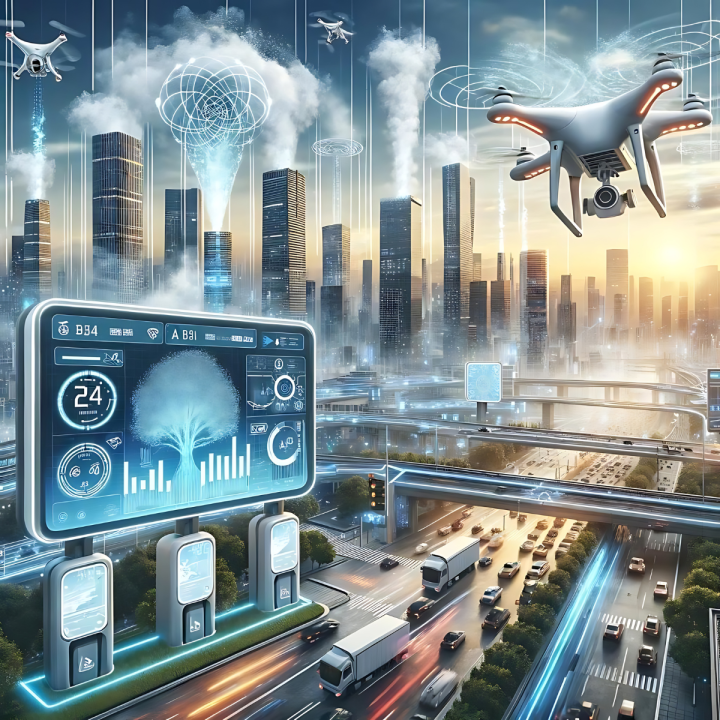


The ubiquity of Artificial Intelligence (AI) is indubitable and undeniable. The AI boom has witnessed its percolation into a multitude of sectors, ranging from medicine to marketing. This has been attributed to the capability of AI to detect patterns in data, such as anomalies and similarities, which has made environmental management one of the most exciting prospects for its uses. In conjunction with the use of historic knowledge, AI can help predict future outcomes and can tackle the environmental crises bemoaning the planet. Yet similar to other transformative and disruptive technologies, AI has a dual nature, bringing in concurrent benefits and harm.
Air pollution is one avenue where AI’s double-edge is most prominent. According to WHO data, 99 per cent of the global population breathes air laden with high levels of pollutants, exceeding the WHO guideline limits, severely impacting the most vulnerable in the population, including children. To understand this invisible threat, countries around the world are leveraging AI. For example, Laos has installed 148 real-time air quality monitoring sensors in schools. These sensors track PM2.5 to provide real-time air pollution data using open-source AI-based technology. Pollution patterns can also be predicted by a machine learning model, which is fed with data from ground-level sources and satellites. The public accessibility of this information helps relevant stakeholders take action. In another example, research is underway in the UK where cheaper electrochemical sensors powered by AI were found to deliver accurate, real-time air quality measurements. This can offer insights for policy decisions and emergency measures.
The impact of air pollution is disproportionately high in low- and middle-income countries. In Southeast Asia, particularly Pakistan, smog has become the fifth season, blanketing major cities like Lahore and bringing with it a plethora of respiratory problems. To effectively combat smog, the Government of Punjab has added AI to its arsenal to build a proactive and data-driven response. At the behest of Punjab’s Chief Minister, South Asia’s most technologically advanced AI-based clean-air programmes have been put in place to forecast pollution and cross-border smog. Monitoring is also done through 100 AI-powered air quality monitoring stations across Punjab, which are unceasingly analysing pollution data using machine-learning algorithms. The information collected is fed to the centralised Smog War Room, which is connected to the Punjab Information Technology Board, and has been operating as a real-time climate intelligence hub by integrating ground sensors, satellite feeds, and international databases. It is ensured that when emission spikes are detected by sensors, the newly unveiled Environmental Protection Force, digitally connected with the AI command centre, gets dispatched for verification of violations and to seal the non-compliant sites generating pollution.
Putting AI systems at the centre of forecasting, monitoring, and enforcement when it comes to the environment has borne fruit. A record consistent improvement in Lahore’s Air Quality Index (AQI) was observed compared to last year, according to an Analysis Comparison report produced by the Environment Protection and Climate Change Department. As per the report, an overall improvement of 58 points was observed in Lahore’s AQI from October 2025 to 10 January 2026. Thanks to this interlinked system, with AI at its heart, the Punjab Government has declared success in lowering stubble burning by 65 per cent and increasing the proportion of factories operating under emission-control systems to 95 per cent. However, experts consider AI-based solutions to be a band-aid, which does not redress the underlying causes of smog: outdated industrial practices, vehicular emissions, and burning of low-quality coal in brick kilns.
Notwithstanding the apparent successes of AI, it is important to understand the repercussions of its voraciousness for energy and unquenchable thirst. AI systems have an exorbitantly high carbon footprint. It is estimated that between 32.6 and 79.7 million tonnes of carbon dioxide were released in 2025 due to fossil fuel-based electricity infrastructure utilised by data centres. Additionally, AI’s exponentially high water footprint could be equivalent to the global annual consumption of bottled water. Therefore, a paradox emerges: though AI can help respond to environmental problems, it also adds to and exacerbates environmental issues.
Nonetheless, to be able to harness AI responsibly for pollution control, the AI policy documents need to take into consideration both its sustainable uses and environmental repercussions. While the environment is touched upon under the Ethical Use of AI in Pakistan’s National Artificial Intelligence Policy, it needs to be treated as a central pillar rather than a cursory reference.
To conclude, although AI has had a dramatic impact on human and planetary life, it is crucial to understand it holistically, rather than viewing it from a singular lens. For Pakistan in particular, the potential to leverage AI for curbing air pollution remains immense, but that must not overshadow its responsible use and coordinated integration into national policies.

Arooba Younas
The writer is a Research Assistant at the Centre for Aerospace and Security Studies (CASS), Lahore.
Originally Published in Medium.
CASS LAhore

The Centre for Aerospace & Security Studies (CASS) was established in July 2021 to inform policymakers and the public about issues related to aerospace and security from an independent, non-partisan and future-centric analytical lens.
CASS Newsletter

@2025 – All Right Reserved with CASS Lahore.

- Home
- About Us
- Research Domains
- Publications
- Events
- Gallery
- Contact Us
@2021 - All Right Reserved. Designed and Developed by PenciDesign