
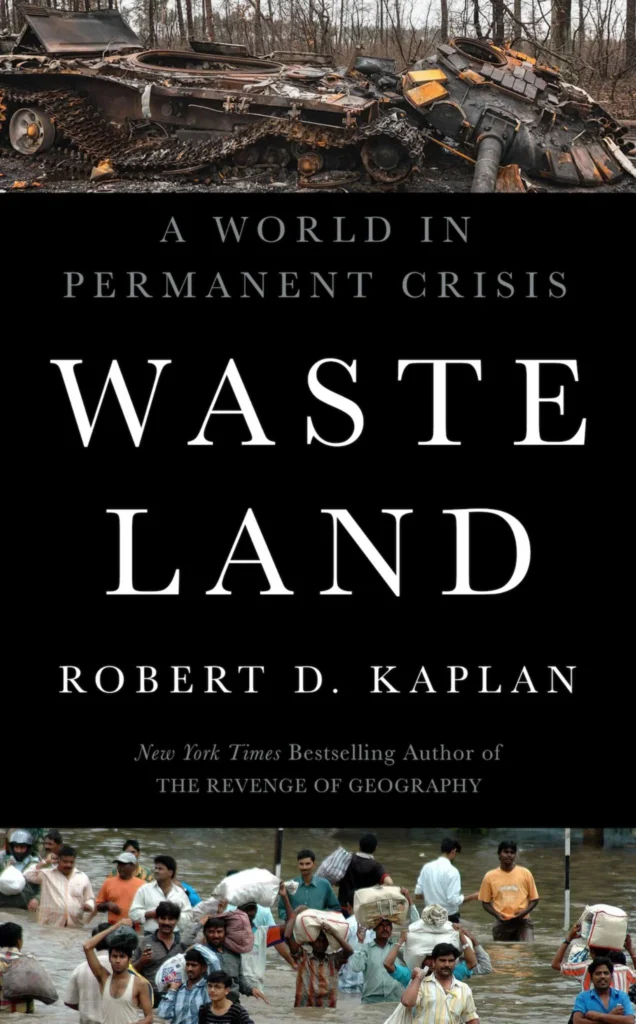


T.S. Eliot’s “The Waste Land” opens not with spring’s promise but its betrayal: “April is the cruellest month.” The latest work by Robert D. Kaplan transforms the modernist despair expressed by Eliot into an accurate prophecy. He applies the Weimar-style breakdown to the current crises in the claustrophobic world. These crises are unravelling from within and are recognised by political exhaustion, skewed performativity and everlasting instability. Kaplan reimagines the twenty-first century as a tragic interregnum that echoes Spengler’s The Decline of the West and Canetti’s frenzied crowds.
Such authority suits no one better than Kaplan. With extensive reporting experience from over a hundred countries, Kaplan has written twenty-three books and provided valuable global strategy advice to US strategists. His works, from Balkan Ghosts to The Coming Anarchy, have mapped chaos before it arrives. This veteran of US strategic boards, now performing his role as the Robert Strausz-Hupé Chair in Geopolitics, has returned as a chronicler of civilisational vertigo. Waste Land is his warning flare!
Kaplan uses three essays to explore the Permanent Crisis, where each catalogue unique markers of civilisational collapse. The central theme that the modern world rests on foundations no sturdier than those of the Weimar Republic threads through all three essays. Kaplan stresses that Weimar serves as a warning for our present circumstances: it is a “global mood.” The world is “interconnected,” he writes, but this closeness breeds neither fraternity nor stability.
Time and space compression create an environment where multiple vulnerabilities are reproduced beyond borders. The Weimar analogy is not used as a moral panic, but as structural insight: “Everyone was hanging on for dear life, unaware of where they were going.” “A heap of broken images,” Eliot once wrote; and Kaplan finds these shards not only in culture and politics, but in geopolitics itself.
The initial essay, “Weimar Goes Global,” describes contemporary events from the perspective of the defunct German Republic during the interwar period through its fundamental essence rather than superficial aspects. Weimar experienced a flourishing cultural energy and artistic liberties, but masked these achievements with severe political turbulence (assassinations and coups) and economic turmoil (hyperinflation and recession), further compounded by the gradual growth of extremist ideologies. Communism on the left and fascism on the right; and most notably, National Socialism (Nazism) peaked paving the way for Hitler.
Kaplan theorises that monarchies and authoritarianism before WWI erected order within states, but the modern plethora of ideological offshoots complicated by unbridled media power has deepened the crises globally. Today’s equivalents, from climate crises to the Ukraine war and digital mobs, trigger global emergencies. Kaplan warns that the illusion of control (by digital interconnectedness) has replaced real stability, indicating that political independence needs both internal cohesion and structured governance to flourish. The danger, Kaplan insists, lies not in collapse itself, but in the complacency that assumes collapse is impossible.
In his second essay, “The Great Powers in Decline,” he redefines power not as a European relic, but as a global condition. His principal argument focuses on culture rather than exclusively on geopolitical matters. Through his examination of the US, China, and Russia, he identifies signs of decline. For the US, it is a “subtle and qualitative” erosion: not territorial collapse. It constitutes the tattering of civic culture and the hollowing out of seriousness in public life. He contrasts Eisenhower, a general and statesman, with Trump, “the epitome of self-centred, emotional impulses,” symptomatic of a political class shaped by media spectacle, not strategy.
Russia, by contrast, exhibits what Kaplan calls “a far more advanced state of rot.” He describes it as a country where militarism cloaks institutional decay, and nationalist fervour fills the vacuum left by the lost empire (the USSR). China, meanwhile, under Xi Jinping, is ruled by “nothing if not a Leninist ideologue,” reverting to Maoist authoritarianism behind the facade of technological advancement. Kaplan sees all three as converging toward late-stage autocracy. He defines it as a political condition in which leaders serve no succession plans, no public correction, and no safe exit. Kaplan extensively uses the ideas of Solzhenitsyn and Kissinger, stating that political frameworks fail to absorb errors because they lead to their exponential growth.
The third and most compelling essay, “Crowds and Chaos,” follows the ideological decline which results from urban overpopulation, digital crowd formation, and the waning of cultural traditions. He uses The Decline of the West by Oswald Spengler and Crowds and Power by Elias Canetti to demonstrate how modern cities; sterilised by surveillance, numbed by hyper-consumption, and emptied of spiritual cohesion; create a new political mindset. They have become the hubs of psychological conformity and volatile emotions. In contrast to physical mobs, the digital ones are disembodied but omnipresent. They operate through viral outrage and algorithmic coercion. He identifies this phenomenon across Western media censorship operations, in Eastern authoritarian regimes and within the global algorithmic intelligence.
Kaplan identifies the new urban mass as a modern “questioner” crowd in Canetti’s sense: demanding confession, not truth. “I will show you fear in a handful of dust,” Eliot wrote. Kaplan too precisely does that. He cites that Bennet and Dao lost their positions, as the New York Times editors in 2020, after Senator Tom Cotton’s opinion piece not because of state censorship, but due to online ideological purging. According to his recall, the George Floyd protests evolved from justified anger and morphed into a chaotic spectacle. He tracks the liberal erosion from Ivy League campuses, where dissent is branded heresy; and in public demonstrations, where protesters perform ideology and resurrect their rule by public shaming. These outcomes precipitate moral absolutism under which a crowd capitalises on words like “justice” to justify their non-pluralistic behaviour.
Kaplan’s grand-historical sweep leans heavily on analogy, yet by stretching the Weimar metaphor to a planetary scale, he risks what political scientists term a category error. Comparing the collapse of a single inter-war German republic with today’s far more diverse international order obscures the empirical variation that sound comparison demands. Consequently, the panorama of the twenty-first century is compressed into a single declinist storyline that sidelines counter-examples such as South East Asia’s relatively successful pandemic governance and the Eurozone’s post-2012 reform record.
Much the same applies to Kaplan’s downward trajectory for Russia, China and the US: it is built largely from literary flourish and selective vignette, with scant reference to hard indicators of state capacity, innovative performance or alliance resilience. Kaplan’s prose is undeniably evocative, but his diagnosis remains impressionistic, offering a striking allegory rather than a falsifiable argument.
When Kaplan shifts from diagnosis to prescription, his analysis thins still further. His plea for “vigilance before liberty” recalls Canetti’s fear of the crowd and Spengler’s anxiety about cultural exhaustion, yet it is delivered as an aphorism rather than a strategy. Branding digital “cancel culture” as “Stalinism without gulags” is historical hyperbole that blurs the crucial distinction between reputational damage and state violence. Structural drivers of unrest, sky-high urban rents, widening Gini coefficients and pandemic-era precarity receive only cursory attention, as do the gendered and class-inflected dynamics of mass mobilisation identified by urban scholars.
Kaplan’s near-exclusive focus on Euro-Atlantic and Sino-Russian trajectories also sidelines the agency of middle powers such as Tokyo, New Delhi and Brasília, underestimating the buffers that already moderate great-power shocks. The outcome is a portrait of “permanent crisis” painted almost entirely in chiaroscuro: compelling to behold, yet too stark to guide policy or capture the full spectrum of twenty-first-century resilience.
The Waste Land fits into philosophical geopolitical studies of societal breakdown. This literary piece serves those who think about policy, control military activities and lead the academics through cultural psychology to grasp worldwide turmoil better. Through his essayistic approach, Kaplan combines geopolitical analysis with civilisational critique and historical analogy. He creates a literary map to examine the downfall of nations by avoiding statistical evaluations. He uses broken phrases to explain events and refuses to propose answers even though he controls his writing. Still, Kaplan’s refusal to offer easy fixes is part of his philosophical honesty.
Waste Land reads not as a policy brief, but as a tragic map of erosion; thus, the value of the book lies in what it provokes. Like Eliot’s poem, it leaves us with fragments, but also with eyes wide open.
Originally Published in Stratheia
CASS LAhore

The Centre for Aerospace & Security Studies (CASS) was established in July 2021 to inform policymakers and the public about issues related to aerospace and security from an independent, non-partisan and future-centric analytical lens.
CASS Newsletter

@2025 – All Right Reserved with CASS Lahore.

- Home
- About Us
- Research Domains
- Publications
- Events
- Gallery
- Contact Us
@2021 - All Right Reserved. Designed and Developed by PenciDesign