
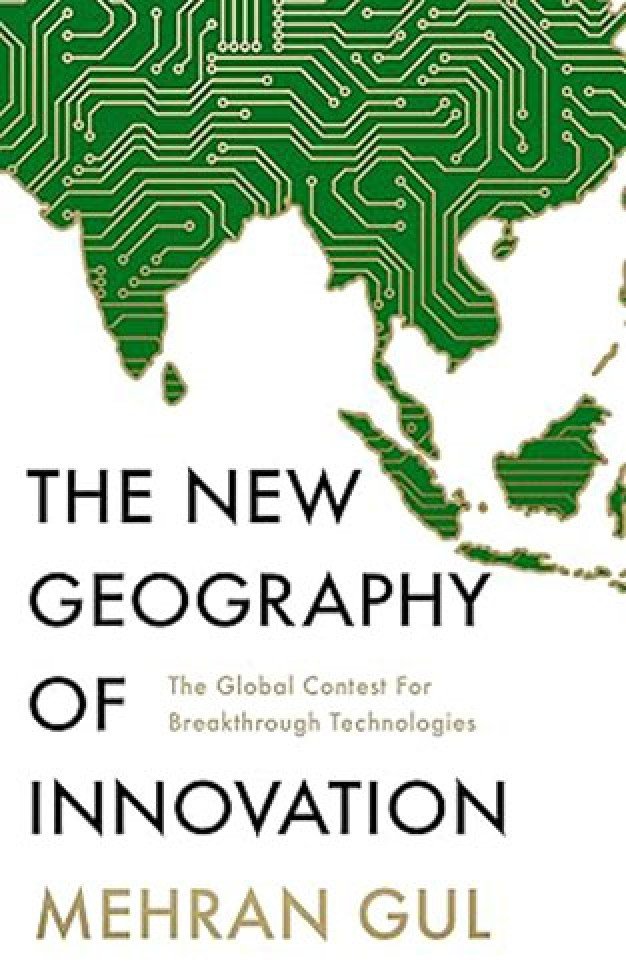


Why did the Industrial Revolution start in Western Europe and not anywhere else? More recently, why have technological breakthroughs been concentrated within a handful of American cities? Prompted by the undeniable evidence that some small islands of excellence are more innovative than the rest of the world, Mehran Gul’s book The New Geography of Innovation seeks to explain this elusive riddle. Focusing on industries in a startup context as the site of technological innovation, Mehran Gul investigates why some places outpace others, regardless of the measure employed. Geographically organised, this book provides a detailed account of hubs of innovation in eight countries across North America, Europe, and East Asia, drawing on interviews with around 200 prominent figures in technology.
The author, Mehran Gul, undertook graduate studies at Yale and is a visiting scholar at Jawaharlal Nehru University (JNU). Additionally, his professional experience of leading digitisation across industries at the World Economic Forum (WEF) and as an expert on higher education, entrepreneurship, and industrial policy at the United Nations Industrial Development Organisation confer on him the credibility to write successfully at the intersection of society and technology.
The author starts his investigation with the rise of China. It mirrors the trajectory of Tencent (a Chinese multinational technology conglomerate), which started as a small startup focused on desktop messaging and has today become ubiquitous in the everyday life of the Chinese, with tremendous investments abroad. The Chinese economy followed an identical trend, given that the outgoing direct investment now far exceeds the investment coming into China, in stark contrast to the case a few decades ago. The role of the US-China partnership, characterised by significant knowledge, cannot be discounted in this economic revolution. Take Microsoft Research Asia (MSRA), for example, which produced the most cited computer science paper ever in 2025. However, all four co-authors were educated in China and had never worked in the US. Similarly, Tsinghua University was born out of the Sino-US relationship, which has played a crucial role in nurturing the country’s scientific talent pool. The author also acknowledges the capacity of the Chinese state to isolate economic zones such as Shenzhen, to pilot test their market-driven initiatives. He declares that the US is ahead of China in research and development. But concedes that China leads in execution and deployment, particularly because Chinese society is more conducive to change. This is reflected in the advanced payment systems, automation of their industries, EVs on their roads, and their clean energy production capacity.
Tiny Singapore, called “smart nation” in the book, is not much different from the Chinese story. It is the initiatives of the government of this small city-state, such as generous funding for startups through the “Technopreneurship Innovation Fund” and the highest ease of doing business in the world, that attract not only foreign companies but also human resources. A case in point is Xiaodong Li, a Chinese national who moved to Singapore in 2006 after his MBA at Stanford to found Garena, the parent company of the popular mobile game Free Fire. Singapore also became successful in relocating Grab, a famous ride-sharing venture, from Malaysia. Overall, the entire ASEAN region is emerging as a technological sweet spot for companies looking to diversify out of the US-China trade war.
The story of South Korea is a unique one where technological breakthroughs perpetuated the politico-economic structures rather than changing them. It was the military dictator Park Chung-hee who pushed the country’s “chaebols”, family-controlled conglomerates, to deliver on his slogan of “rich country, strong army”. The hold of chaebols has remained intact as they moved from low-tech mass manufacturing towards high-end electronics. Today, Samsung is so well-rooted in South Korean society that one can live from cradle to grave just using Samsung products and Services.
In an attempt to support his contention that the golden days of Silicon Valley are not yet over, the author cites Anna Lee Saxenian’s doctoral work, which ascribes the valley’s ability to adapt to change to its culture, which is relatively open compared to, say, Boston. This allows for rapid job switching, leading to cross-pollination of ideas; cashing out equity (the ability to raise money by selling shares on a stock exchange), leading to new startups; and failing without stigma. At the same time, Sebastian Mallaby, a leading journalist, attributes this adaptability to the rise of venture capital, which increased the Valley’s risk tolerance and allowed it to attempt moonshots.
Contrary to the examples of Asia, where the role of government weighs heavily in technological success, the chapters on the West foreground the importance of culture. The case of Switzerland is pertinent as it occupies the first space on the Global Innovation Index (GII), which can be counterintuitive if one measures innovation only by unicorn startups (private companies valued at over $1 billion). The author looks at their almost completely clean energy-powered, fully electrified rail system and research institutes like ETH Zurich as unparalleled examples of innovation standards. Another of their technological marvels is the “Large Hadron Collider” (LHC), the largest particle accelerator in the world (a massive machine used to study physics by colliding subatomic particles at high speeds). This unique way of doing things extends to almost everything, including their political culture, where a council of seven, rather than a president, heads the state.
In Germany, the family-owned small to medium-sized businesses make up the backbone of the economy and innovation, termed “Mittelstand”. Their competitiveness is predicated on their ability to build unmatchable expertise in a niche field. While this drives innovation, it also prevents scaling because of a lack of public equity options. Meanwhile, the author has attributed the emerging tech sector in Canada, primarily in AI, to three research scientists whom the Canadian University ecosystem and government funding successfully attracted. These were all immigrants, an open secret to Canada’s technological ecosystem. However, the author warns that these policies could be subverted by popular demands.
The author concludes by answering the questions raised at the onset. He does not propose any grand theory, but instead attributes the high innovation of certain cities to structural and cultural factors. Some of these are government-provided stable public goods like quality education, investment in research and healthcare, openness to immigration, and ease of doing business. While others are the presence of venture capital inculcating risk tolerance, risk taking, and a defiant culture to encourage startups, distribution of wealth through equity sharing, and cross-pollination of ideas. He notes that while startups can be built anywhere, they still prefer to move to Silicon Valley after taking off. He remarks that only China is competing with the US in scale, which has all of the aforementioned attributes and retains the first position in tech.
The book deserves appreciation on more than one account. Its greatest strength is readability. Reader retention is high due to its engaging storytelling of disparate businesses and inclusion of historic titbits, making it a pleasant read. Furthermore, its language is accessible with limited to no technical jargon. The author’s simple yet impactful writing style is commendable.
For a novice reader in the technological business world, the book presents a wealth of information as it provides a bird’s-eye view of the tech landscape across the globe, while featuring interviews with big names.
With that said, the book could improve a few aspects. The greatest lacuna is the scarcity of non-Western interviewees. A Chinese interviewee born and working in China was hardly found throughout the book. The interviewee pool consisted of Westerners working in the West or in China, Asians working in the West, and those who worked in the West and returned to their home countries. This could lead the reader to be cautious about buying into the author’s argument and evidence, and dispute it as partial.
The book, despite having a wealth of qualitative data, could have used some quantitative measures in tandem to further bolster its argument. Another related limitation, as acknowledged by the author in the introduction, is the explicit focus on tech startups as the locus of investigation. This leads the author to ignore other metrics, for instance, the number of universities and publications, as well as patents coming out of the Chinese ecosystem, which are not mentioned. A quantitative analysis of these metrics would have provided a brief but useful context, broadening the scope of the study and increasing the analytical breadth of exposition. The book also looks at different variables and causal elements for successful technology ecosystems for different countries, which affects the internal validity (how reliably a study establishes a cause-and-effect relationship) of the study.
In summation, despite its flaws, The New Geography of Innovation is indeed a worthwhile and timely account of the changing geography of innovation, a highly important subject to not only business people but political scientists, economists, sociologists and historians alike. The book is recommended as an interesting read for those looking to ground their understanding of the global spread of technological ecosystems and their unique qualities.
Originally Published in Stratheia
CASS LAhore

The Centre for Aerospace & Security Studies (CASS) was established in July 2021 to inform policymakers and the public about issues related to aerospace and security from an independent, non-partisan and future-centric analytical lens.
CASS Newsletter

@2025 – All Right Reserved with CASS Lahore.

- Home
- About Us
- Research Domains
- Publications
- Events
- Gallery
- Contact Us
@2021 - All Right Reserved. Designed and Developed by PenciDesign