
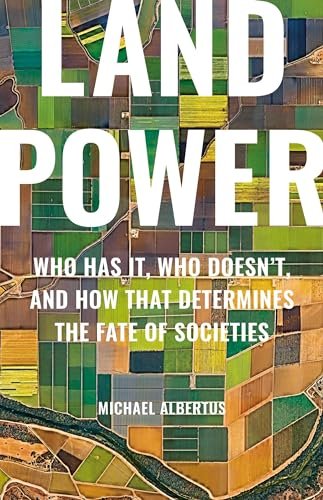


“Land Power: Who Has It, Who Doesn’t, and How That Determines the Fate of Societies” by Michael Albertus is a comprehensive account of the political economy of land power. Michael Albertus is a political scientist; his research focuses on inequality and redistribution, democracy and dictatorship, property rights, and civil conflict. With four books on similar themes, Albertus attempts to reshape global discourse on justice and societal equality in the context of land ownership and property rights in Land Power.
In the introductory chapter, the author states that who owns the land determines whether a society will be equal or unequal, whether it will develop or decline, and whether it will safeguard or sacrifice its environment. This statement underscores the central thesis and analytical rigour of the book, resting on the claim that the fate of societies rests in the hands of those who own the land. Albertus introduces the concept of the “Great Reshuffle” to describe how land reallocation across the globe in the past two centuries has led to significant shifts in land ownership. The author argues that while the land holds the power to propel a state onto the path of development, its unjust control and distribution have planted the roots of racism, gender inequality, poverty, and eventually, climate vulnerability.
On a massive scale, the land was unjustly acquired from indigenous people to grant it to settlers, from peasants to political elites, and from public owners to private institutions. This issue, like many other contemporary problems of the world, is rooted in colonialism and imperialist designs of hegemonic powers. Be it the Indigenous population of America itself in the 1850s, the Black people of South Africa under apartheid or Latin American and East Asian populations, the forced displacement of Indigenous people had a singular aim: unjust land acquisition for excessive power and control to create unequal power relations, a struggle that continues to date.
The author argues that systemic marginalisation of racial groups has caused disparities. Statistical data show that Native Americans have a higher death rate due to diabetes, heart diseases, drug consumption, and mental health problems – the root causes of which can be traced back to unequal healthcare access and historical traumas linked to forced displacements and land dispossession. Similarly, the author extends his argument to the relationship between land dispossession and gender inequalities. In states like Canada, El Salvador, and Bangladesh, legislative actions during the colonial period transferred land ownership to men, prohibiting women from claiming any land.
Furthermore, the author highlights how land settlements and reallocations have caused significant damage to the ecology and natural environment. Following the communist revolution in China, actions such as land collectivisation and de-collectivisation, soil erosion, large-scale deforestation, and groundwater pollution all posed huge threats to the environment. Similarly, ecological collapse took a new form as Brazil opened up the Amazon rainforest for settlements in the 1960s.
This way, Albertus is not wrong in asserting that land has been the oldest tool of power and gave birth to the “Four Horsemen of modern social maladies”: racial hierarchies, gender discrimination, economic inequalities, and environmental degradation. The book highlights the interdisciplinary approach of the author as he brings together history, political economy, gender studies, and environmental studies.
In its last section, the book takes an interesting turn from pessimism to optimism. The author provides contemporary case studies, where successful land reforms have helped address the historical grievances of Indigenous people and reduce structural inequalities. This pattern has been observed in Latin America, with Peru’s property rights legislation, Colombia and Bolivia granting land ownership to women, and Chile undertaking a climate conservation initiative in the southern part of the country through a public-private partnership. Moreover, similar reforms are underway in South Africa and Australia for land restitution and reallocation to the indigenous people who are rightful owners.
Thus, the book adopts a policy-oriented approach, not fixating on the problem at hand but delving into policies and strategies that can undo centuries of injustice and allow the return of the land to historically marginalised people through legal channels. While these redistributive strategies are bold and land reallocation has not been fully successful anywhere across the globe, they suggest that economic and racial justice in its true sense can only begin when the question of land control is addressed.
However, it can be argued that with economic inequalities and racial discrimination entrenched in the structural setting of modern societies, addressing decades-old cases of property rights around the world is a very utopian thought. While it can be the first step to curb racial, gender and economic marginalisation, the political will is nowhere to be found. Those who hold power never give it up willingly.
Moreover, the author’s emphasis on land as the single causal variable for racial, gender, and economic inequalities is unrealistic. While the book successfully highlights the importance of land in governing power relations, it is imperative to note here that several other complementary and interdependent variables, such as labour laws, educational policies, healthcare policies, human capital, and law and order, also contribute to societal inequalities and underdevelopment.
For instance, the author argues that South Korea underwent successful land reforms, which were a determining factor in its economic development and reduced marginalisation. However, it is important to bear in mind that, along with land reforms, South Korea heavily invested in education, industrialisation, institutional reforms, and technology to change the trajectory of its society. This way, the book often appears to be influenced by theoretical assumptions of economic determinism, classifying land as the root variable.
Furthermore, while land was a central instrument of power in historic colonial settings where most state economies were agrarian, it does not hold for the contemporary era. Time and innovations have redefined tools of domination; the power now resides with financial markets, corporate giants, military-industrial complexes, and technological enterprises. With global supply chains, the current power structures have transcended land ownership. So, while Albertus’s argument that land reallocation can “unwind inequality” is thought-provoking, it is not practical.
Also, with the world increasingly moving towards urbanisation, governments now face bigger challenges in cities to accommodate growing populations and shape modern capitalist societies. Shifting attention to rural areas for land reallocation and redistribution is difficult to prioritise.
This brings into question the primacy that the author assigns to the land. In today’s world of AI and remote infrastructure, wealth generation does not come from lands with agricultural output but from technological advancements, talent, and algorithms. In this context, the book appears to be a product of a thought process anchored in history and not the present world.
The ground realities are now different, as are today’s frontiers. According to Albertus, when another Great Reshuffle comes, it is our responsibility to do it right this time. The book ends on a hopeful but ambiguous note, especially considering how the current political-economic order stands largely indifferent to land and property rights. Awakening a global revolution for land restitution and reallocation might only be a political scientist’s far-fetched dream.
In evaluating the Land Power’s contemporary relevance, while the book has touched upon the case study of Bangladesh in South Asia, its main assumptions also hold well for Pakistan. Since its independence, Pakistan has been struggling with land reallocation, and in several areas, land grabbing has paved the way for injustice and marginalisation. Despite several laws such as the Land Revenue Act 1967 and the Illegal Dispossession Act 2005, etc. Pakistan remains seriously vulnerable to land ownership issues, a problem that can largely be attributed to its colonial past.
Overall, Land Power is Michael Albertus’s unconventional effort to reposition land at the centre of political economy and reinforce it as the axis of power. However, while the book offers an interdisciplinary analysis, the emphasis on land as a single causal variable fails to unfold the complexities of global inequality in this modern capitalist world. For scholars of political economy, the book offers a worthwhile read to delve into debates of development, property rights, and justice, and for policymakers to learn from successful case studies and implement redistribution strategies to steer land reallocation at the local level.
Originally Published in Stratheia
CASS LAhore

The Centre for Aerospace & Security Studies (CASS) was established in July 2021 to inform policymakers and the public about issues related to aerospace and security from an independent, non-partisan and future-centric analytical lens.
CASS Newsletter

@2025 – All Right Reserved with CASS Lahore.

- Home
- About Us
- Research Domains
- Publications
- Events
- Gallery
- Contact Us
@2021 - All Right Reserved. Designed and Developed by PenciDesign