
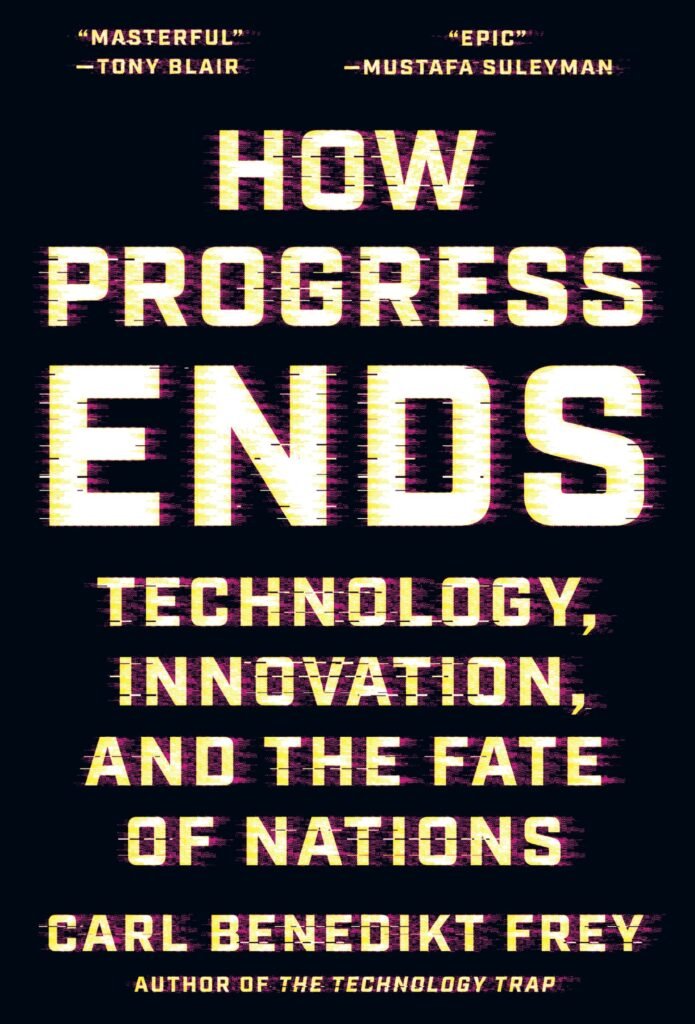


Innovation drives economic growth and decides the destiny of nations. But whether states can leverage technological innovation for economic progress relies solely on the prevailing system of institutions. The book How Progress Ends: Technology, Innovation, and the Fate of Nations by Carl Benedikt Frey is part historical, part institutional diagnosis of what causes stagnation in growth. In this book, Frey addresses the correlation between institutional structures and progress.
As a leading scholar of technological change, economic history and labour markets, the author produces influential research on how innovation reshapes societies, work and development trajectories, which makes him one of the foremost authorities to provide an intellectually stimulating analysis of technological innovation and progress. Carl Benedict Frey is a Swedish-German economic historian. He is an associate professor of Artificial Intelligence & Work at the Oxford Internet Institute and a fellow of Mansfield College and Oxford Martin School. He is the author of four books, including this recent book, which is shortlisted for the Financial Times and Schroders Business Book of the Year Award.
In this book, Frey’s key argument revolves around addressing the question of progress. He contends that progress is neither natural nor purely technological; progress, instead, is a socio-political phenomenon. It is the institutional and cultural factors which explain sustained progress: decentralisation brings out innovation, while a centralised system scales up the application of innovation. A long-term economic progress needs a delicate balancing of these two forces: decentralised social and political systems for exploring new ideas and centralised ones for harnessing economic benefits from the latter by scaling and standardising successful discoveries.
Progress, hence, requires alternating regimes: exploration as a path to novelty and innovation, and exploitation to turn promising innovations into mass-impact technologies. The institutional capture and solidification of one system and its inability to adapt to the needs of the developmental stage leads to technological and economic stagnation, and this, according to Frey, explains how progress ends.
In support of the thesis that an optimal institutional balance is required to ensure sustained progress, the book wades through history to provide case studies of nations. The historical case studies trace how societies generated bursts of innovation, but capped their long-term benefits because of institutional entrenchment or incentives which favoured rent-seeking over discovery.
Frey contrasts China’s technological sophistication, which declined due to vested political interests, with Europe’s industrial revolution, driven by competitive polities and rivalries, which loosened incumbent interests and allowed heterodox ideas to emerge. Prussia caught up when competitive pressures combined with state coordination and investment in railroads and education. In France, revolutionary bureaucracy created capacity, while in Britain, an open and competitive market birthed and scaled up innovation. These comparative examples favoured Frey’s central claim that institutions drive progress as much as technological innovation because it is the political structure which determines who can bet and turn innovation into widespread adoption.
Similarly, a sustained section of the book examines the twentieth-century experience of two world powers with progress. The US’s decentralised entrepreneurship and corporate sector explain its rapid growth. The Soviet Union’s journey is particularly instructive for the author to support the main thesis of the book. Enormous talent in the presence of state resources produced breakthroughs in technology. The momentum, however, declined when bureaucratic ties captured innovation by patronage networks.
The strength of this book lies in providing an alternative explanation for the phenomenon of wealth and poverty. Conventional theories, citing geography, institutions and culture as the factors explaining the trajectory of progress in one society, and the lack of it in another, struggle to explain economic reversals. Frey provides a convincing analysis of progress by citing institutional and political reasons.
Rather than choosing a particular market or institutional system, as is often the norm, the author provides a nuanced view, which stands on rationality. He neither denounces decentralised nor centralised systems, but rather selects the positive attributes of each system, which can favour long-term progress. In doing so, the author has avoided bias towards one, which suggests that he remained committed to the core elements of his thesis.
The book not only provides historical insight but also cites recent examples to illuminate how exploration and exploitation interact today. The making of an mRNA vaccine to combat COVID-19 is one such case cited in the book. Underfunded research ignored by mainstream funders created an exploratory pool of knowledge that industry, alongside the government, exploited against the backdrop of the COVID crisis. The case is a manifestation of a phenomenon where decentralised persistence of research produced a platform that led to centralised programs upscaling it.
While the book provides a rich historical framework, beginning with Zhou dynasty in 1046 BC and traversing through Industrial Revolution of Europe to today’s Artificial Intelligence (AI) revolution, it fell short in providing a holistic view. It overlooked feats of progression in other regions of the world i.e. civilisational progress of Greeks, and the economic and scientific flourishing during the period of Islam’s Golden age, making his work ethnocentric.
Additionally, the author weaves together empirical research with historical narratives in analysing how past waves of innovation inform the contemporary era of automation. In doing so, the book makes a prognosis about how to leverage current waves of innovation for progress. Frey is sceptical of the view that the latest AI wave alone will naturally herald a new age of progress, in the absence of suitable political institutions.
Instead, he argues that relevant political institutions are required to ensure that AI remains decentralised. The concentration of AI capability in a few firms risks turning technology into a tool for efficiency gains, when it should rather be a tool for creative experimentation. His argument gets credence when he invokes Moravec’s Paradox to contend that humans have skills that computers fail to adopt, and hence, the intervention of the human mind in AI technology still remains relevant.
Moreover, the book speaks directly to the contemporary concerns of humanity today. AI is a breakthrough innovation of the current era. However, solely relying on large language models to produce scientific discovery is a fool’s play. Frey suggests that to ensure long-term progress, the concentration of AI capability in a few hands should be stopped. The current developmental stage, suggests Frey, calls for dynamism in innovation, and not centralisation of ideas.
The actionable thread persistent in the book reflects policy suggestions for states to adopt. It calls out states to build such institutions that fund even risky work and ensure academic freedom, and ensure competitive markets. Moreover, it assigns states the responsibility to scale successful ideas, reduce barriers to labour mobility and guard against regulatory measures.
However, the book sometimes reads as if decline is the default end-state unless major changes are introduced in the system. But history has such examples where institutional interventions reshaped a decelerating growth trajectory, with regulatory measures. Institutional reforms, without a major overhaul, attend to the policy needs of the economy, such as the role of antitrust laws in opening software markets.
The book asserts that centralised systems choke decentralised discovery and innovation. Frey’s causal thesis gets challenged with case studies from East Asia. The scholars of developmental states cite the East Asian Miracle to argue that well-designed industrial policy and strong state guidance were central to the industrial boom in the region. The political economist, Alice Amsden, provides an account of South Korea to emphasise that durable growth can be achieved by the state’s complementary role in the right context to market signals. The state’s active role in targeting industries, enforcing export discipline and supporting experimentation in cases like South Korea, Taiwan and Japan proves an alternative view that state-led approaches can produce durable growth, and not merely short-term progress.
Another aspect which weakens the organisational thesis of Frey is the institutionalist perspective, which argues that the decisive factor in the trajectory of progress is not the organisational form of institutions but their nature: whether they are inclusive or extractive. An inclusive institutional culture required for broad-based innovation can flourish even in centralised systems, while decelerating in otherwise decentralised systems. Post-war Japan is one such example where centralised administrative and economic system ensured open access to economic opportunities and sustainable growth.
On the whole, Frey’s How Progress Ends provides a timely diagnosis against the context of geopolitical rivalry, productivity slowdowns and rapid platform concentration. It is neither an overly optimistic nor a pessimistic peek into the future about how technology and progress interact; the book reads as a corrective to both. Progress is seen more as a result of social and political architectures which generate and nurture ideas, and never because ideas are exhausted. The historical sweep, complemented by modern examples, informs that progress is fragile but it is also recoverable. The right institutional balance can be achieved, even while it has once faltered.
Originally Published in Stratheia
CASS LAhore

The Centre for Aerospace & Security Studies (CASS) was established in July 2021 to inform policymakers and the public about issues related to aerospace and security from an independent, non-partisan and future-centric analytical lens.
CASS Newsletter

@2025 – All Right Reserved with CASS Lahore.

- Home
- About Us
- Research Domains
- Publications
- Events
- Gallery
- Contact Us
@2021 - All Right Reserved. Designed and Developed by PenciDesign