
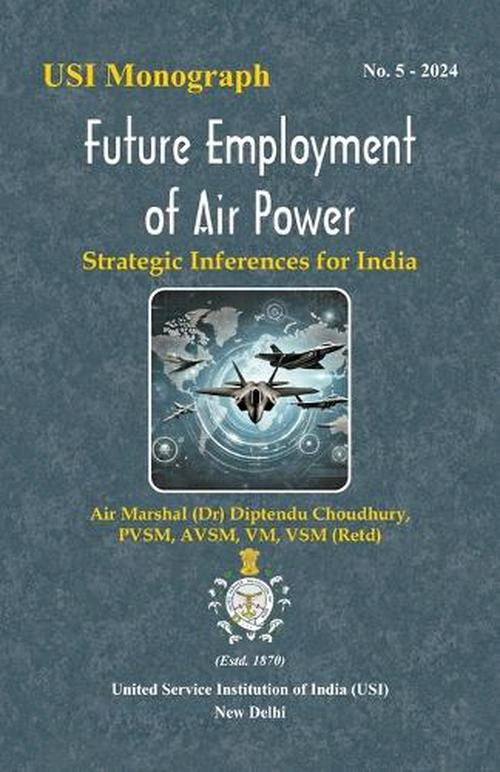


Future Employment of Air Power: Strategic Inferences for India (Vij Books, 2024), by Air Marshal (Dr) Diptendu Choudhury, is a timely intervention in the long-running debate over the role of air power in South Asia. Coming out at a time when Sino-Indian rivalry is heating up and India is still locked in a struggle with Pakistan, the book proposes a bold agenda: to make air power the fulcrum of India’s national security strategy in the 21st century. In doing this, it combines the lessons of operations conducted in Ukraine, Syria and other theatres and makes a case for integrating offensive. defensive and aerospace capabilities
The three main propositions of the book are as follows. First, air control is the crucial precondition to combined actions in both conventional and sub-conventional wars. Second, India has to modernise at a very fast rate, investing in fifth-and sixth-generation aircraft, unmanned systems, and integrated aerospace defence to stay abreast with its opponents. Third, national security demands a multi-domain architecture with air and space power as the foundation of deterrence and warfighting
The book is thorough in its scope and provides a critical survey of the changing nature of modern air warfare. However, it is also an institutional product. It is written by a retired Air Marshal and reflects the doctrinal preferences of the Indian Air Force (IAF) and its long-standing focus on technology and acquisition. The issue is that recent history, especially the war between Pakistan and India in May 2025, demonstrated serious drawbacks of the same paradigm that Choudhury advocates. This review thus appraises the contributions of the book and examines its blind spots in the context of that crisis.
Choudhury is correct in suggesting that air control is a prerequisite to success in contemporary warfare. From the World Wars to the war in Ukraine, the belligerent that has control of the skies has always had the advantage of operational freedom. The Pakistan-India war of 2025 showed that the IAF was unable to attain operational freedom in the skies even with its vast numbers and technologically advanced inventory.
India carried out Operation Sindoor with considerable fanfare, using Rafales, Su-30s and Israeli drones against civilian and strategic targets in Pakistan. In a matter of hours, however, the Pakistan Air Force (PAF) not only repelled the incursion but also shot down at least seven IAF aircraft, including four Rafales, which are the very platform Choudhury touts as a symbol of India’s leap in capability. Far from being able to exert control of the air, India was unable to operate freely even along its own borders while the PAF was able to impose what military analysts described as the largest beyond-visual-range (BVR) battle in modem history
This brings up a serious contradiction. The book emphasises that joint operations cannot be conducted without localised air superiority, even on a temporary basis. However, in reality, India failed to achieve that objective. The problem was not the hardware but the inability to translate technological resources into operational results. The author recognises the dangers of disputed airspaces with China but does not consider Pakistan as much of a problem. Zarb-e-Karrar disproved that belief, showing that the investment in training, discipline and integrated command systems made up the deficit in fleet size. The IAF had overemphasised the use of optics and acquisition at the expense of other factors.
The book suggests that India urgently needs modernisation: Rafales, the Tejas programme, and the future Advanced Medium Combat Aircraft (AMCA) project are presented as necessary to maintain an edge. Unless it closes the capability gap, argues Choudhury, India is in danger of being outpaced. Yet the 2025 war showed that equating acquisition with capability simply created more risks. Indian Prime Minister Narendra Modi has on several occasions indicated that Rafales could have changed the outcome of the Balakot crisis in 2019. However, in the recent war, several Rafales were shot down by the PAF within a matter of minutes, puncturing the myth of an invincible technology.
This is where the book falters. Choudhury is valid in indicating the weaknesses of drone warfare and constraints of stand-off weapons, yet he is too casual with the risk of over-diversity of fleets and the maintenance burdens of imported acquisitions. The IAF flies a patchwork of MiGs, Mirages, Su-30s, Jaguars and Rafales, all with different logistics chains. It is reported that Rafale fighters in India were generally never fully combat-ready at any given time before the 2025 war. A force structure that looks formidable on paper thus collapses under the weight of poor serviceability and inadequate pilot training. Pakistan showed that capability cannot be imported but must be developed. The PAF had rigorously trained and disciplined pilots who had clarity of mission and realistic confidence in systems. Zarb-e-Karrar revealed the irony: costly Indian sites performed poorly compared with the less glamorous but better-integrated Pakistani force.
Another pillar of the argument put forward by Choudhury is the need for offensive strategic air operations, namely deep strikes on the logistics, energy networks, and reserves, made possible with extended integrated air defence (EIAD). He criticises air denial as a weak man’s strategy and asks India to move on towards offensive dominance. India adopted this strategy when it launched Operation Sindoor against Pakistan, yet it failed to achieve any sort of dominance.
The appeal by Choudhury that India should shift its air defence to aerospace defence is ambitious. He sees a system that encompasses air, missile and space, incorporating Al-enabled sensors, anti-satellite and space-based ISR. This kind of architecture is reflective of the US, Russian and Chinese trajectories.
The feasibility of such a project seems doubtful in the case of India. Defence budgets are already strained, and the proliferation of platforms has resulted in debilitating maintenance costs. More importantly, the 2025 war demonstrated that India has yet to learn how to coordinate baseline integrated air defence against Pakistan, much less develop the capability to secure near-space. The PAF neutralised swarms of Israeli drones, revealing gaps in Indian radar coverage while also successfully incorporating real-time data into its BVR tactics.
With a state that is still grappling with accident-prone helicopters and low levels of readiness in its fighter inventory, the jump to aerospace defence can become a rhetorical ideal instead of a practical policy. Although Choudhury is rather progressive in his prescriptions, they are not based on the institutional capacity and track record of the operating institutions in India. Ultimately, the May 2025 war highlighted the main critique of the book: the Indian air power discourse is obsessed with procurement and technological aspiration while underestimating the significance of training, integration, and strategic discipline. The resoluteness and restraint demonstrated by the PAF proved that victory in the air is not determined by flashy platforms but by the clarity of the doctrine, cohesion of command, and readiness of the personnel.
The war also undid the myth of Indian superiority in the air. Even after decades of acquisitions, its mixed fleet was cumbersome, its pilots were ill-equipped to fight for large-scale BVR combat, and its leadership was split on how to explain its failure. Pakistan, on the contrary, leveraged its smaller and more integrated force to secure local superiority at decisive points, succeeding in restoring deterrence without provoking escalation. These ground realities contradict the main thesis of the book. Air power is indeed decisive, as long as it is integrated into a coherent national strategy that takes into consideration political limitations, investments in training, and discipline in maintenance. The book risks reinforcing the gaps that were revealed in 2025 by overemphasising platforms and underemphasising these systemic factors.
Future Employment of Air Power is an authoritative articulation of IAF doctrine at a point of strategic transition. The focus on multi-domain integration, unmanned systems, and aerospace defence is an actual trend in the world. The book provides an insight into the Indian military establishment’s conceptions about the future of air power. However, there is a considerable gap between doctrine and practice, as was shown in the 2025 war. The fact that India has been unable to translate advanced acquisitions into operational effectiveness casts doubts as to whether the prescriptions by Choudhury do, in fact, tackle the actual sources of vulnerability.
Choudhury, in the final analysis, is right in asserting that air power will define the strategic future of the South Asia region. The victory of the PAF demonstrated that adherence to discipline, preparedness, and coherent strategy outweighs the allure of costly acquisitions. Unless India confronts these structural flaws, the vision of aerospace dominance outlined in this book will remain, at best, a doctrine in search of credibility.
Originally Published in Stratheia
CASS LAhore

The Centre for Aerospace & Security Studies (CASS) was established in July 2021 to inform policymakers and the public about issues related to aerospace and security from an independent, non-partisan and future-centric analytical lens.
CASS Newsletter

@2025 – All Right Reserved with CASS Lahore.

- Home
- About Us
- Research Domains
- Publications
- Events
- Gallery
- Contact Us
@2021 - All Right Reserved. Designed and Developed by PenciDesign