
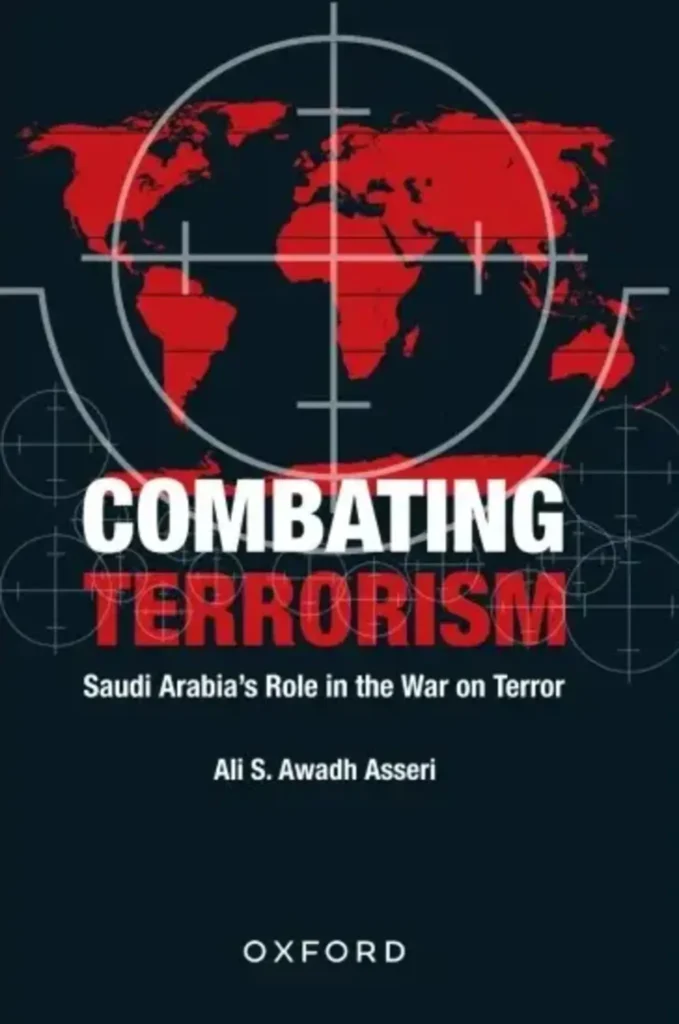


From the aftermath of 9/11 to the persistent global struggle against violent extremism, the world has been grappling with the question of which strategy to adopt to deal with terrorism: use of military force, judicial enforcement, ideological contestation, or even an amalgamation of the three. Ali Saeed Awadh Asseri, in his work Combating Terrorism: Saudi Arabia’s Role in the War on Terror, provides a powerful and holistic blueprint for countering terrorism that surpasses the narrow security paradigm. The book is not just an account of policies, but it provides a conceptual and practical framework based on religious legitimacy, societal reformation, economic regulation, and global cooperation. The ambition of the book lies in reimagining counter-terrorism as a long-term, multi-dimensional project, as opposed to a short-term security reaction.
With a long career in Saudi security and diplomatic institutions, Asseri is not an accidental authority on the subject. He climbed the internal security hierarchy, led the Diplomatic Security Department, handled crisis and ambassadorial security assignments, and also served as Saudi ambassador to Pakistan (2001-2009) and Lebanon (2009-2016). His investigations into terrorist attacks and diplomatic-security incidents provided him with first-hand experience of the operational and strategic dynamics of terrorism and counter-terrorism. This background, coupled with academic training on international relations and government administration, enables him to blend practical experience with institutional memory and scholarly rigour, providing the author with an invaluable perspective for a work of this sort.
At the core of the book is a redefinition of terrorism. According to Asseri, terrorism is best perceived as a strategy, an intentional tool of violence and control, instead of a designation applied to non-state groups or a classification of certain religions, ethnicities, or geographies. He traces the term to the period of Revolutionary France and the Reign of Terror, reminds the readers about the past and modern state atrocities, and juxtaposes them with non-state violent movements today. This analysis of the historical background underscores an important point: violence against civilians is a human rights concern and a political matter, irrespective of who employs what form of violence, whether non-state or state actors themselves.
The author’s handling of religion is also very significant. Asseri emphasises that the Quran prohibits aggressiveness, orders the protection of non-combatants, and promotes sanctity of life; the greater jihad is a spiritual and social one, but not a military one. He dismisses literalist or out-of-context interpretations of “sword verses”, demonstrating that most modern excuses to commit terror disregard the very commands of mercy, peace, and restraint found in the Quran. Therefore, by offering this theological counter-narrative, Asseri aims to de-legitimise extremist interpretations within the faith tradition, a strategic and highly moral move.
The author’s third and most practically consequential argument is the Saudi Prevention-Care-Cure model. Asseri explains that following the 1979 seizure of the Grand Mosque, bombings in 1995-96 in Riyadh and Khobah, and most prominently, Riyadh suicide-bombings in 2003, the Kingdom employed a multi-dimensional approach to security combining legal, ideological, social, and financial reforms. For example, rehabilitation and integration were executed via the al-Munasaha wa al-Islah programme, where the detainees were subjected to religious counselling, psychological assessment, family outreach, and social support. The book indicates that over a thousand people went through this programme, and the recidivism rate was at 3-5 per cent.
Religious reforms were also introduced to revise school curricula, train religious teachers and imams, evict unqualified individuals from the mosque, publish moderate religious literature, and employ media to broadcast religious sermons denouncing extremism. Even the religious police (mutawwa’in) were educated on contemporary disciplines, including psychology, to detect and suppress radicalisation more effectively, proving that security policy did not merely confine the professionals to brute force, but encompassed social and intellectual change.
A particularly compelling section of the book discusses Saudi Arabia’s international and diplomatic role, where Asseri manages to persuade the readers that the Kingdom has not only presented itself as the target in the arena, but also as an active global partner and a leader in shaping counter-terrorism norms. The book highlights not only the depth of Saudi involvement but also the institutional complexity in its work against terrorism, detailing cooperation with the US through a 2003 Joint Task Force against terrorist financing, joint submissions to the UN 1267 sanctions committee, and cooperation with Interpol and its neighbours to arrest, extradite, or neutralise terrorists. This debate is beyond reportage, where Saudi actions are placed in the context of state legitimacy, soft power, and normative leadership, thereby supporting Asseri’s overall argument that an effective counter-terrorism strategy means harmonising domestic and international actions.
Asseri also analyses the generalisability of the Saudi model by giving practical examples of its applicability in various settings. In Indonesia, after the 2002 Bali bombings and the subsequent Jemaah Islamiyah attacks, the Indonesian authorities introduced an elite police force, engaged in the rehabilitative efforts of former militants, placed special emphasis on transparent trials, and established counter-terrorism as a national policy. The author deems such practices as akin to Saudi ideas of state ownership, professional law enforcement, and formal social reintegration. Although the cases corroborate the transferability of the model in terms of theory, implicitly, the book raises critical questions about contextual constraints, including institutional capacity, political will, and socio-economic conditions, which might restrict the success of such adaptations. Asseri could have mentioned these aspects more explicitly to enhance the analytical rigour of his argument.
The distinctive aspect of this book is its comprehensiveness and strong empirical foundation. There is almost no literature that presents spirituality, law, security, socio-economic policy, and international diplomacy in a unified framework of counter-terrorism. Asseri’s position as an insider also lends credibility to his arguments, and the fact that he does not dismiss religion as an illegitimate tenet makes his work a significant corrective to defensive secularist and extremist religious expression.
In addition, the book is a model demonstration of the best-practice thinking in modern counter-extremism discourse. The Saudi Prevention-Cure-Care model acknowledges that the issue of radicalisation is not just a security concern, but also a social disease, which must be cured through education, rehabilitation, and social care. Its cross-national approach and comparative orientation enable the reader to step out of Saudi-centred discourse. Finally, the moral clarity of the book, which is rooted in the ethics of Islam and universal humanitarian values, provides a strong narrative against violent extremism, capable of resonating not only with the Islamic world but also with other settings where faith, identity, and politics may be intertwined.
However, the book is not totally devoid of limitations. Due to its foundation on the Saudi institutional experience and policy, there is a consistent risk of institutional bias. The narrative does have a tendency to highlight successes, such as low recidivism rates in rehabilitation programmes and shutting down suspicious charities, without delving into in-depth coverage of critical external reports on the civil liberties issue. As an example, Human Rights Watch and Amnesty International have expressed reservations regarding how the Kingdom has been using its wide counter-terror laws to censor political opposition, arrest its critics, and restrict the freedom of expression.
Furthermore, factors such as political grievances, foreign interventions, and social deprivation are given second priority over ideological or religious factors. In most of the conflict-stricken or economically marginalised societies, radicalisation is fuelled by poverty, marginalisation, foreign occupation, or political injustice, rather than by religious misinterpretation. Indicatively, research studies carried out on Boko Haram in Nigeria and Taliban in Afghanistan have shown that political marginalisation of localities, poverty, and state dysfunction are the main drivers in recruitment, often overshadowing doctrinal arguments. Therefore, religious doctrine might not suffice without major political, social, and economic reforms.
In conclusion, Combating Terrorism: Saudi Arabia’s Role in the War on Terror is an insightful and thorough contribution to current literature on counter-terrorism. Though not an ultimate roadmap, especially with its dependence solely on Saudi official accounts, transparency concerns, and the challenge of replicating the Saudi model, the book is still a precious resource to those who want to find a realistic and ethically sound approach to counteracting terrorism. Amidst a resurgence of regional conflicts, sectarian violence, and rejuvenated recruitment campaigns by extremist ideologues in fragile states in 2025, the book remains uniquely relevant. It questions the dichotomy of force versus ideology, demonstrating that both, and more, are necessary, as successful counter-terrorism should equally be a matter of hearts and minds as of intelligence and military strength
Originally Published in Stratheia
CASS LAhore

The Centre for Aerospace & Security Studies (CASS) was established in July 2021 to inform policymakers and the public about issues related to aerospace and security from an independent, non-partisan and future-centric analytical lens.
CASS Newsletter

@2025 – All Right Reserved with CASS Lahore.

- Home
- About Us
- Research Domains
- Publications
- Events
- Gallery
- Contact Us
@2021 - All Right Reserved. Designed and Developed by PenciDesign