
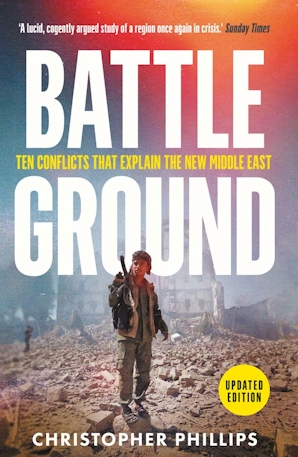


The remarkable book written by Christopher Phillips and titled “Battleground: 10 conflicts that explain the New Middle East” is a deep exploration of the complex geo-political landscape that has defined the region in the past 15 years.
Christopher Phillips, an experienced professor of international relations and currently an associate fellow working on the Syrian conflict and its impact on the neighbouring states and the wider Middle East, is based at the Middle East and North Africa Programme at Chatham House. He has adopted a concentrated approach by dissecting ten pivotal places in the Middle East, exposing the complex role of internal and external forces, which have shaped the conflict and volatility of the region.
Phillips begins with the word “Middle East”, and criticises the term’s failure because it was a term assigned by the British and has still not been grasped by people of the region. He also explains a new term in the book i.e., the “New Middle East” referring to how the numerous conflicts have shaped the current geo-political structure of the region. He further emphasises that the struggle in the Middle East is not only vested in ancient rivalry or religious differences, but is also influenced by historical heritage, political conflicts, economic interests and foreign interventions.
Moving on 10 significant regions and conflicts, Phillips offers a detailed analysis of the Horn of Syria, Libya, Yemen, Palestine, Iraq, Egypt, Lebanon, Kurdistan, Gulf states and Africa. Each chapter provides a historical reference and examines recent developments showing how these crises are interconnected. For example, the Syrian conflict is central to Phillips’ analysis, as he investigates how it began as a domestic uprising and developed into a devastating civil war with significant international participation.
A recurring theme in the “Battleground” is the role of external powers in shaping the Middle Eastern conflicts. Phillips argues that Western intervention, especially by the US, has often increased volatility rather than solving it. He criticises American policies for their short-sightedness and highlights how a vacuum was filled by other actors like Russia and Turkey when it was created by the involvement of the US within the region.
Similarly, the descent into the chaos in Libya is another focal point of how foreign powers such as Turkey and Russia have exploited Libya’s instability to expand their influence after the collapse of Muammar Gaddafi. He connects Libya’s struggles with broad regional trends, including proxy wars and resource competition.
Similarly, Phillips also explores the impact of American intervention and policies which have not only destabilised Iraq, but also changed the power dynamics in neighbouring countries such as Iran and Syria. This approach helps readers to understand how the struggle in one region had far-reaching implications for the whole Middle East.
Apart from the external intervention, the author also explores how the regional instabilities have fuelled conflicts such as Egypt’s decline in regional influence, which is attributed to political instability and dependence on foreign aid after the Arab spring. Phillips explained how these factors have weakened Egypt’s ability to assert itself as a leader in the Egyptian Arab world.
Lebanon’s communal politics are also analysed by actors like Iran and Israel through external manipulation. He also discussed the role of Hezbollah both as a domestic political force and a proxy for Iranian interests.
Similarly, the shift in power dynamics has changed the regional influence. Saudi Arabia and Qatar have become stronger due to their resources and funding, while Egypt has seen its power diminish due to internal turmoil. Lebanon remains divided, while external actors have exploited these fissures for their own benefit. The author also highlights how non-state actors have gained prominence by complicating traditional state-centric power structures such as groups like ISIS which has exploited the governance vacuum to establish their stronger footings, even after their regional control has diminished, playing a role as a regional destabiliser.
Moreover, the Kurdish struggle for autonomy is investigated within a comprehensive context of state fragmentation in Iraq and Syria. Phillips highlights how Kurdish aspirations have been shaped by both regional dynamics and international neglect. The author explains that how resource money has enabled countries like Saudi Arabia, Qatar and Turkey to expand their influence within the important regions or segments such as the Kurds, or within the issue of Syria, taking advantage of their funds to shape conflicts in the entire region. Similarly, Phillips also extends his analysis to include conflicts in the Horn of Africa, seeking to expand the role of regional actors and their impact in strategically important fields. This broad attitude helps readers to understand the mutual nature of the regional actors in taking advantage of strategically important areas and segments of the Middle East and beyond.
The author further discusses the ongoing developments that will continue to shape the future of the region. While ISIS has lost its regional stronghold, it remains a security threat. The resolution of Qatar blockade in 2021 has reduced tension within the GCC, but it has not eliminated rivalry between Saudi Arabia and Iran. Struggles in Libya and Yemen are unresolved, with serious consequences for citizens. The Israeli-Palestinian conflict continues, affirming how political deadlock increases human suffering. Similarly, lessened American involvement has allowed other states to claim more influence through both direct and indirect interventions.
However, one of the greatest strengths of the book is its avoidance of oversimplified narratives. Phillips adopts a multi-causal approach that considers economic, political, and historical factors. His clear and accessible writing style helps readers understand complex geopolitical issues without oversimplification. Despite its strengths, the book also has some minor shortcomings. For instance, some chapters lack a clear chronological structure, which can make it challenging for the readers to follow the progress of some conflicts in a chronological order. Additionally, references to historical events such as the Treaty of Sèvres are not fully explained.
The book is an essential read for someone in search of a deep understanding of Middle Eastern Geopolitics. The author’s careful exploration of the historical context and contemporary analysis distinguishes this book from other accounts of regional conflicts. Apart from the minor structural flaws, it delivers valuable insight into how local conflicts are shaped by broader global trends. By dissecting ten important flashpoints, Phillips explains the complex interplay of historical heritage, political rivalry, economic interests and foreign interventions that define the modern Middle East, serving as a valuable source for both scholars and students interested in the Middle East.
To sum up, the book titled “Battleground: 10 conflicts that explain the new Middle East” is an important and thoughtful analysis of the modern geopolitical landscape of the Middle East. The author’s ability to connect local conflicts with broader regional and global trends is one of the book’s standout features. Whether investigating Syrian’s destructive civil war, Libya’s post-Gaddafi chaos, or the Israel-Palestine conflict, he highlights that external powers and regional actors have played an important role in fueling conflicts within the region. Regardless of the slight shortcomings, the clear writing style and the balanced analysis of Western interventions, regional rivals and the rise of non-state actors today provides a valuable insight into the forces shaping the New Middle East.
CASS LAhore

The Centre for Aerospace & Security Studies (CASS) was established in July 2021 to inform policymakers and the public about issues related to aerospace and security from an independent, non-partisan and future-centric analytical lens.
CASS Newsletter

@2025 – All Right Reserved with CASS Lahore.

- Home
- About Us
- Research Domains
- Publications
- Events
- Gallery
- Contact Us
@2021 - All Right Reserved. Designed and Developed by PenciDesign