



SEMINAR
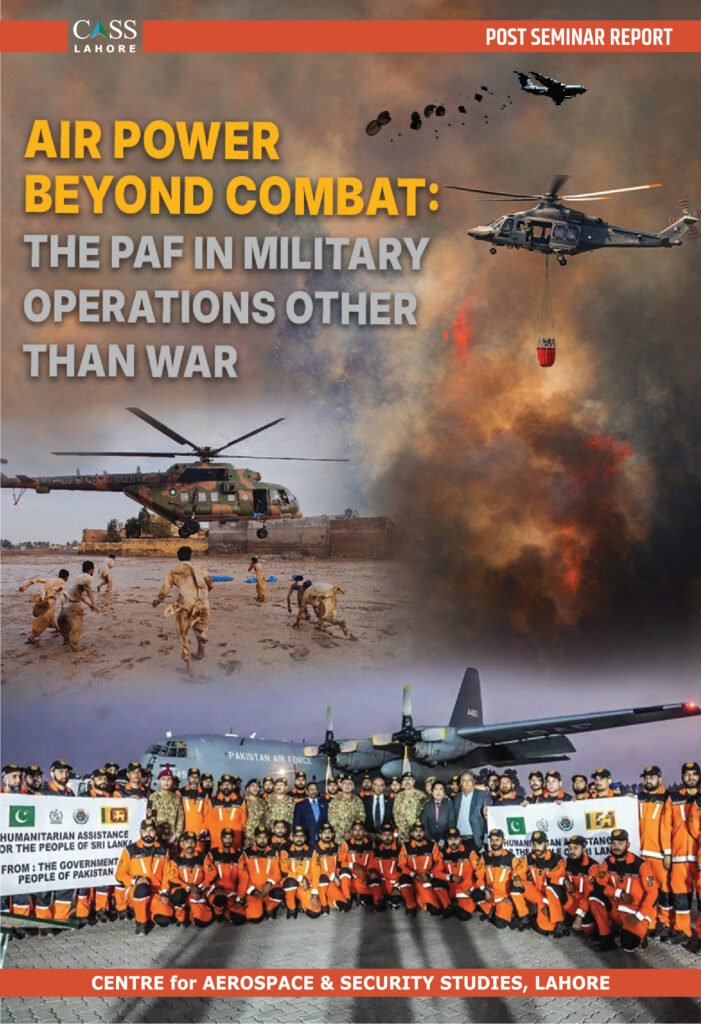
Air Power Beyond Combat: The PAF in Military Operations Other Than War
February 12, 2026
The complete PSR is available upon request. Please use the button below to submit your request.
president
Air Marshal Asim Suleiman (Retd)
SEMINAR COORDINATOR
Mr Ameer Abdullah Khan
EDITOR
Dr Zahid Khan
RAPPORTEURS
Mr Abdul Wassay & Mr Najam Ul Hassan
Executive Summary
The seminar “Air Power Beyond Combat: The Role of PAF in Military Operations Other Than War” examined the expanding relevance of air power in security environments shaped by climate disasters, humanitarian crises, and systemic emergencies. While traditionally associated with combat and deterrence, evolving threats have structurally broadened its role. In Pakistan, recurrent disasters and infrastructure fragility have repeatedly placed the Pakistan Air Force (PAF) at the centre of national response, prompting a reconceptualisation of Military Operations Other Than War (MOOTW) as an integral element of contemporary air power employment rather than a peripheral function.
Mr Ameer Abdullah Khan, Senior Research Associate at CASS Lahore, delivered opening remarks. He noted that the seminar aimed to bridge the disconnect between academic hesitation and operational reality. He further stated that while military involvement in non-war domains is often considered conceptually uncomfortable in scholarship, practice demonstrates that air power has long served as a primary instrument of crisis response. He asserted that the objective was not to celebrate capability or redefine air forces as humanitarian actors, but to examine institutional adaptation within a security environment no longer defined solely by war.
Air Marshal Asim Suleiman (Retd), President CASS Lahore, delivered the keynote address. He stated that while air power remains the primary instrument for kinetic operations, contemporary threat environments have structurally expanded its role into MOOTW. He further noted that climate change, disasters and internal crises have made non-combat missions strategically embedded rather than exceptional. He identified four drivers of this shift: the urgency of decision-making in crises, infrastructure vulnerability, the growing centrality of information dominance, and climate change as a direct security stressor. He highlighted that air and space capabilities, characterised by speed, reach, and situational awareness, position air forces as indispensable enablers in time-sensitive humanitarian environments.
President CASS Lahore emphasised that human security broadens rather than dilutes state security, noting that protecting citizens strengthens legitimacy and resilience. Air power contributes across economic, health, environmental, and political dimensions by sustaining access, enabling evacuation, and delivering relief in moments of crisis. He stated that doctrinal adaptation is necessary, as traditional combat frameworks offer limited guidance for politically sensitive humanitarian missions. Referring to United Nations peace operations, he emphasised that air power’s effectiveness depends not only on capability but on political consent, access, and clarity of mandate.
In outlining PAF’s role, Air Marshal Suleiman stated that Pakistan’s geography and recurrent disasters repeatedly make air power the most reliable instrument of access when ground systems fail. He highlighted PAF’s medical and air mobility capabilities, noting that sustained Humanitarian Assistance and Disaster Relief (HADR) commitments pose a dual challenge: preserving combat readiness while responding to frequent emergencies. He also highlighted the PAF’s institutional adaptation vis-à-vis MOOTW under the leadership of Air Chief Marshal Zaheer Ahmed Baber Sidhu through capability development and training. He concluded by recommending doctrinal revision, prioritised HADR training, capacity enhancement, flexible dual-use capability development, strengthened interoperability, forward-looking risk assessment, and enhanced international coordination.
Professor Dr Shaheen Akhtar of the National Defence University provided the conceptual foundation for the seminar. She stated that security is historically contingent and evolves in response to structural shocks. She argued that traditional realist frameworks, centred on adversarial threats and military power, initially resisted integrating climate and environmental risks into security discourse. She observed that climate adaptation within militaries emerged primarily from operational necessity rather than environmental ideology, as extreme weather and infrastructure vulnerability began directly affecting military readiness.
Dr Akhtar further argued that climate stress has increasingly produced traditional security consequences through food insecurity, displacement, governance strain, instability, and conflict. She stated that military engagement with non-traditional security did not emerge through theoretical persuasion but through practice, particularly via Humanitarian Assistance and Disaster Relief and other MOOTW functions. She introduced the concept of climatisation to describe pragmatic institutional adaptation aimed at sustaining operational effectiveness under environmental stress. She cautioned that expanding military involvement in non-traditional domains carries governance risks, including blurring of mandates and erosion of civilian primacy, and emphasised the importance of structured legal frameworks and interagency coordination.
Air Vice Marshal Nasser Ul Haq Wyne (Retd), Director at CASS Islamabad, presented a decade-wise operational assessment of PAF’s humanitarian engagements. He stated that HADR is embedded within PAF’s institutional DNA rather than improvised in moments of crisis. He highlighted the 2005 earthquake as a strategic turning point, noting that large-scale air operations and multinational coordination transformed PAF into a central humanitarian logistics node. He further argued that the 2010 floods demonstrated sustained national-scale air mobility under conditions of infrastructure collapse, while the COVID-19 pandemic expanded HADR into public health logistics, reinforcing the role of air mobility in systemic emergencies.
AVM Wyne stated that recent operations reflect technology-enabled evolution, including enhanced meteorological forecasting, secure digital communications, satellite imagery integration, and improved air-ground synchronisation. He emphasised decentralised decision-making, logistics endurance, and interoperability as operational imperatives. He recommended formal articulation of HADR policy, institutionalised training frameworks, annual reporting mechanisms, and sustained investment in predictive and simulation-based systems.
The interactive session clarified the boundaries between traditional military operations and MOOTW, reaffirming that counter-terrorism and information warfare remain core combat functions. Discussions focused on preserving civilian primacy within coordinated disaster frameworks, strengthening anticipatory capacity through AI and integrated early warning systems, and addressing reliance on military assets, climate adaptation, and pragmatic approaches to military greening in response to escalating climate stress.
Seminar Chair, Air Marshal Asim Suleiman (Retd), concluded the event by stating that air power beyond combat is neither a temporary adjustment nor a dilution of military identity. He argued that climate stress and humanitarian crises have forced convergence between traditional and non-traditional security logics. He emphasised that the central policy challenge lies in carefully governing this adaptation. Air power must remain combat-ready while embedding MOOTW within doctrine, preserving civilian primacy, strengthening interoperability, and investing in predictive capability.
The seminar positioned the PAF not only as an instrument of deterrence and national defence, but also as an important pillar of national resilience alongside the army and navy, in an era in which security is increasingly defined by both armed conflict and environmental stress.
Key Takeaways
- Beyond Kinetic Warfighting
Air power remains a weapon of choice in modern warfare. Yet, in a contemporary threat environment increasingly shaped by non-military challenges, the non-combat role of militaries has structurally expanded. These challenges include environmental risks, governance strain, and the military’s own exposure to climatic stresses.
- Air Power as an Enabler of Human Security
Air power’s speed, reach, situational awareness, and integration with satellite, ISR, and communication systems position it as a critical enabler of human security. Consequently, air forces worldwide are embedding Military Operations Other Than War (MOOTW) and Humanitarian Assistance and Disaster Relief (HADR) into doctrine, training cycles, and command frameworks because human security complements state security.
- Institutionalisation of PAF’s HADR Role
Successive national emergencies, including the 2005 earthquake, 2010 floods, and the COVID-19 pandemic, as well as international HADR campaigns, transformed PAF into a mature humanitarian logistics actor. HADR is embedded within the institutional DNA and operational ethos of the PAF.
- Structural Drivers of Non-Combat Relevance
Urgent decision-making, infrastructure collapse, information dominance, and escalating climate stress explain why air forces are often the first and sometimes only viable responders in crises.
- Air Power in UN Peace Operations
United Nations missions have historically relied heavily on air power. However, effectiveness in multilateral contexts depends less on capability and more on access, political consent, and clarity of mandate.
- Effectiveness of Air Power in MOOTW
Air Power’s operational effectiveness in MOOTW depends on rapid coordination, decentralised decision-making, interoperable communication systems, and sustained logistics. International deployments further require a high level of interoperability and diplomatic credibility.
Policy Considerations
- Doctrinal Integration and Revision
Military Operations Other Than War and HADR may be formally integrated into national security and air power doctrine. Clear objectives, command relationships, and engagement thresholds could be defined and periodically reviewed to prevent ambiguity and mission creep.
- Shift from Reaction to Anticipation
Disaster governance could gradually transition toward anticipatory management. Integrated early warning systems, satellite and UAV-supported forecasting, and decentralised alert mechanisms may extend response windows and lessen dependence on post-crisis mobilisation.
- Institutionalise Training and Interoperability
HADR competencies could be mainstreamed across operational units and reinforced through regular joint exercises with NDMA, provincial authorities, other services, and international partners. Shared protocols and communication systems remain central to effective multi-actor coordination.
- Establish Structured Learning and Reporting Mechanisms
The PAF may like to maintain a record of HADR missions, assets utilised, and lessons learnt. This would enhance institutional memory, transparency, and the refinement of evidence-based capabilities.
- Invest in Advanced Technology and Predictive Systems
Sustained investment by civilian authorities in forecasting tools, ISR integration, predictive analytics, secure digital networks, and simulation-based training would strengthen the management of increasingly complex non-military emergencies. Such efforts are ideally anchored in civilian authority under a clear legal framework. The PAF’s capabilities and operational experience can serve as a complementary factor.
- Pursue Pragmatic Military Greening
While full aviation decarbonisation remains distant, phased improvements in energy efficiency, renewable integration, and exploration of alternative fuels can be advanced without compromising operational readiness.
CASS LAhore

The Centre for Aerospace & Security Studies (CASS) was established in July 2021 to inform policymakers and the public about issues related to aerospace and security from an independent, non-partisan and future-centric analytical lens.
CASS Newsletter

- Home
- About Us
- Research Domains
- Publications
- Events
- Gallery
- Contact Us
@2021 - All Right Reserved. Designed and Developed by PenciDesign