



ROUNDTABLE DISCUSSIONS
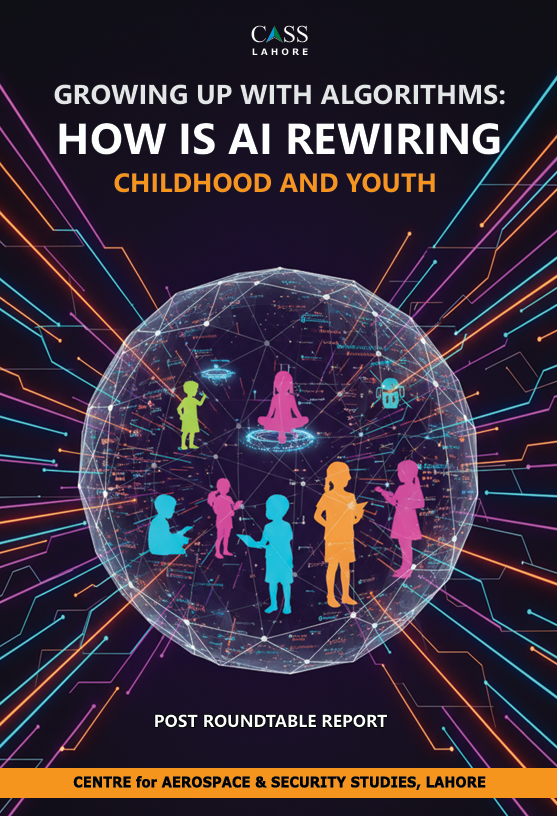
Growing up with Algorithms: How AI is Rewiring Childhood and Youth
February 04, 2026
The complete PRR is available upon request. Please click the button below to submit your request.
president
Air Marshal Asim Suleiman (Retd)
ROUNDTABLE COORDINATOR
Ms Faiza Abid
EDITOR
Dr Zahid Khan
MASTER OF CEREMONY
Ms Faiza Abid
REPPORTEURS
Ms Faiza Abid & Mr Amjad Fraz
Executive Summary
The Centre for Aerospace and Security Studies (CASS), Lahore, convened a roundtable on 4 February 2026, titled “Growing Up with Algorithms: How AI Is Rewiring Childhood and Youth”, to examine the profound ways in which artificial intelligence is reshaping the social, cognitive, and emotional landscapes of childhood and adolescence. The discussion assessed the growing embeddedness of AI systems in education, communication, and entertainment, and their influence on how young people learn, interact, and form their sense of identity.
In her opening remarks, Ms Faiza Abid, Research Assistant at CASS, underscored AI’s transformative role in shaping contemporary childhood and youth experiences, noting that algorithmic systems increasingly mediate learning, social interaction, and access to knowledge. While these technologies offer avenues for creativity, engagement, and connectivity, they also exert subtle pressures on attention, decision-making, and identity formation, raising important questions about cognitive, emotional, and social development. Ms Abid emphasised the ethical and developmental responsibilities of parents, educators, and society, and outlined the roundtable’s goal of fostering dialogue on strategies to ensure AI supports healthy development, curiosity, and well-being among young people.
In the first session, Dr Ibrar Hussain framed AI as an invisible infrastructural layer shaping children’s learning, play, and social experiences. He argued that AI should no longer be seen merely as a tool, but as an agent actively structuring cognitive development, mediating engagement, and reconfiguring exploration. Emphasising that AI must serve as a thought partner rather than a thought leader, he highlighted the dangers of overreliance on algorithmic outputs and the importance of human guidance in AI interactions. Dr Hussain stressed that responsible AI use requires deliberate prompt engineering and contextual understanding, particularly in educational and recreational settings.
He illustrated his points with examples of AI-driven games, adaptive learning platforms, and interactive classroom systems, showing how personalised technologies can enhance focus, engagement, and skill acquisition while integrating learning across home and school. Simultaneously, he stressed that human empathy and communication remain essential, as children’s social skills, creativity, and emotional understanding develop through sustained interaction with caring adults. He concluded by framing children as future strategists and cognitive assets, emphasising that AI integration must balance safety, data security, and holistic development.
In the second session, Dr Shazia Hasan examined the foundational role of early childhood experiences and social environments in shaping identity, cognition, and agency. She noted that children’s minds are initially structured through interactions with caregivers, peers, and educators, as well as sensory experiences and social learning. Identity, she explained, develops across biological, psychological, and narrative continuities, influenced by family, society, and culture. In the contemporary digital context, AI has become a pervasive influence, shaping children’s perceptions of themselves and the world, with developmental opportunities alongside risks of distorted self-perception.
Dr Hasan highlighted AI’s impact on agency, autonomy, and cognitive development, emphasising that while AI can facilitate personalised learning, global knowledge access, and social simulations, it cannot replace human judgement, empathy, or independent thought. Over-reliance on AI, she warned, may foster confusion, cognitive dependence, and skewed beliefs about identity and decision-making. Parents, educators, and mentors therefore carry a critical responsibility: to nurture self-efficacy, resilience, and critical thinking, guiding children to engage with AI as a supportive tool while retaining control over their choices, creativity, and ethical reasoning.
During the interactive session, both speakers explored the practical, ethical, and developmental challenges of AI integration. Dr Hussain emphasised that AI must act as a co-pilot, not a thought leader, urging users to critically engage with outputs rather than accept them uncritically. Dr Hasan drew attention to the influence of family legacies, attachment, and intergenerational dynamics on children’s interaction with AI, shaping creativity, confidence, and moral judgment. The speakers agreed that while younger generations naturally integrate digital realities into daily life, guidance from parents, educators, and policymakers is essential to cultivate agency, resilience, and ethical discernment.
In his concluding remarks, Air Marshal Asim Suleiman (Retd) emphasised that AI is no longer a distant concept but a formative influence on everyday life, shaping how children learn, relate to others, and understand themselves. He noted that AI subtly guides attention, behaviour, and social interactions, often without conscious awareness, making guidance from families, educators, and communities indispensable. He stressed the importance of safe spaces where children can explore identity, values, and online responsibility, while adults model ethical and reflective technology use to foster autonomy and confidence. Furthermore, he highlighted the role of policy, governance, and multi-stakeholder collaboration in ensuring AI remains human-centred. Decisions made today, he concluded, will shape how future generations think, act, and thrive in AI-driven environments, underlining the need for shared responsibility, ethical awareness, and long-term thinking.
Key Takeaways
- AI as a Thought Partner, not a Thought Leader
AI augments human decision-making rather than replacing it, ensuring children’s learning and development remain guided by human context, values, and direction.
- Human Empathy and Social Skills Are Irreplaceable
Emotional depth, empathy, and relational nuance cannot be replicated by AI. Maintaining human interaction is essential for developing leadership, social competence, and ethics.
- Personalised, Adaptive Learning through AI
AI enables tailored educational experiences, adjusting to attention, cognition, and emotion, enhancing engagement, comprehension, and skill development through adaptive platforms, smart toys, and AI tutors.
- Children as a Cognitive Security Asset
Children interacting with AI are the future strategists and decision-makers, making their cognitive development a matter of national and societal security. Responsible AI use must balance enhancement with mitigation of bias, dependency, and skill erosion.
- Identity is Multidimensional and Socially Shaped
Identity develops through biological, psychological, and narrative continuity, and is continuously influenced by family, culture, social structures, and self-reflection, highlighting the interplay between environment and self-concept.
- AI Shapes Beliefs and Self-Perception
Children increasingly trust AI for guidance, which can positively expand knowledge and learning opportunities but also carries risks of cognitive dependence.
- Human Agency Must Be Preserved and Cultivated
Agency, the capacity to direct one’s own thinking and choices, remains fundamentally human in the age of AI. AI should serve as a tool to support children’s learning, not replace their independent reasoning and decision-making.
- Feedback, Labels, and Narratives Shape Cognitive Schemas
External feedback and societal labels shape mental schemas that influence self-concept, confidence, and behaviour, highlighting the ethical responsibility of caregivers, educators, and AI designers in shaping identity and cognition.
Policy Considerations
- AI Literacy and Model-Specific Training
AI literacy programmes covering system logic, limitations, and critical evaluation with model-specific training and certification demonstrating domain-specific foundational knowledge need to be completed by students and professionals before AI tool access.
- Age-Appropriate AI Access and Supervision
Age-stratified guidelines should be governing AI use, requiring direct parental or educator supervision for younger learners, with periodic updates based on locally relevant cultural and societal content on cognitive and ethical readiness.
- Promote Agency-Centred AI Use in Education
Independent thinking and decision-making need to be cultivated through education policies to ensure that AI operates only as a supportive tool and never replaces human reasoning.
- Integrate Identity and Cognitive Awareness into Curricula
Educational frameworks are to be developed to teach children to reflect on biological, psychological, and narrative aspects of identity, fostering self-understanding alongside digital literacy and critical thinking.
- Evidence-Based Mental Health and Cognitive Safeguards
AI-related policies can be informed by longitudinal research assessing AI’s impact on youth mental health, social development, and cognition, guiding interventions for safe, balanced, and developmentally appropriate AI engagement.
- Intergenerational Digital Literacy and Mentorship
A structured dialogue among youth, parents, and educators, alongside mentorship initiatives to be facilitated through community and educational programmes to strengthen ethical reasoning, critical thinking, and informed decision-making.
CASS LAhore

The Centre for Aerospace & Security Studies (CASS) was established in July 2021 to inform policymakers and the public about issues related to aerospace and security from an independent, non-partisan and future-centric analytical lens.
CASS Newsletter

- Home
- About Us
- Research Domains
- Publications
- Events
- Gallery
- Contact Us
@2021 - All Right Reserved. Designed and Developed by PenciDesign