
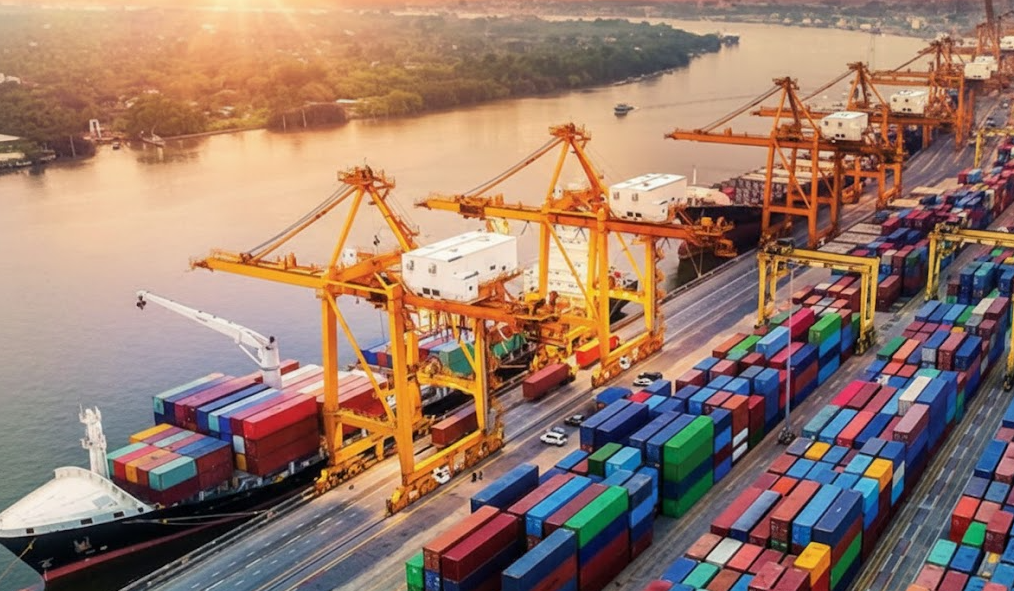


In December 2025, Kyrgyz President Sadyr Japarov visited Pakistan on a two-day maiden trip. In their joint statement, one line stood out: Pakistan offered Kyrgyzstan access to its seaports at Karachi, Port Qasim and Gwadar, giving a landlocked state a potential route to the Arabian Sea. Behind this offer sits a bigger idea: Pakistan could act as a maritime gateway for Central Asian countries that have no direct access to open waters.
Central Asia is landlocked and relies on routes through Russia, China, and increasingly through Iran, to reach open seas. These corridors are long, exposed to sanctions, and prone to political shocks. For instance, in 2019, sanctions on Iran created political and transaction-processing disruptions at the Bandar Abbas port for Central Asian states.
Similarly, during the Taliban’s takeover in 2021, Iran suspended trade with Afghanistan at key crossings. In this setting, an overland connection to Pakistani ports gives the region another path, which is valuable precisely because it introduces stability and choice.
For Central Asian countries, the economic incentive in using Pakistani ports is evident. Moving goods through western China and down into northern Pakistan means a noticeably shorter journey than sending them all the way to Baltic or Black Sea ports.
There is already a legal and infrastructural base for connecting Central Asia to these ports. In 1995, Pakistan, China, Kazakhstan and Kyrgyzstan signed the Quadrilateral Traffic in Transit Agreement (QTTA) to facilitate the movement of cargo along the Karakoram Highway to Pakistani harbours. In parallel, CPEC has upgraded roads and motorways from the Khunjerab Pass down to the Arabian Sea.
Taken together, QTTA and CPEC can create a strong North-South spine if the policy needs are met with infrastructure that carries Kazakh wheat, Uzbek-manufactured goods, or Tajik minerals to Karachi or Gwadar. Moreover, these platforms bypass Afghanistan, which, although is a natural and more feasible route from Central Asia to Pakistan, but remains volatile.
The economic upside for Pakistan is monumental. Transit trade means port fees, warehousing income, trucking and rail revenue, and demand for services from insurance to finance. Karachi and Port Qasim already handle most of Pakistan’s external trade. Work on Gwadar’s deep-water berths and the opening of a new international airport in 2025 have improved its capacity and profile as well.
If Central Asian exporters begin to route even a modest share of their goods through Pakistan, that would support jobs in Balochistan and along the north-south corridor, and strengthen the case for further upgrades in roads, railways and dry ports.
Pakistan would also gain strategically by playing this gateway role. At the moment, Central Asia is an arena where Russia, China, Iran, Turkey and Western countries all compete for influence. China has deepened its economic presence through the BRI. Iran and India are promoting the International North-South Transport Corridor and the Chabahar route.
If Pakistan provides a stable and cost-effective corridor to the sea, it becomes a connector in this web instead of remaining a side player. That can give Islamabad more weight inside forums such as the Shanghai Cooperation Organisation and in its bilateral dealings with Central Asian capitals.
There are sector-specific opportunities as well. Central Asia holds large oil, gas and uranium reserves, and has growing hydropower sectors in Kyrgyzstan and Tajikistan. Pakistan is already linked to the region through the CASA-1000 hydropower project on paper. Better overland links to Pakistani ports would make it easier to design gas pipelines, electricity lines, fibre-optic cables and mineral supply chains that run between Central Asia and South Asia.
While the geographical advantages are undeniable, if Central Asian states are to use Pakistani ports, they will look not only at maps but also at the record of how Pakistan has handled transit in the past. Therefore, for Pakistan to utilise its natural geographical advantage and act as a dependable gateway, it would need to address continued security and institutional problems.
There are concrete steps Pakistan must take to augment its potential in this regard. As a first step, there is a need to fully operationalise QTTA by streamlining customs, using modern transit systems such as the TIR Convention, a UN-backed global customs transit system, and harmonising rules with China and Central Asian partners. Under CPEC, road infrastructure in Pakistan has improved significantly with motorway links and upgraded highways.
However, the current physical infrastructure would need further development to cater for the increasing trade volumes from the landlocked region. Additionally, Pakistan should upgrade key rail links from the ports to the north, so that containers do not depend only on trucks. Moreover, it can fix predictable tariffs and processing times for foreign cargo and set up one-window mechanisms at dry ports and border crossings.
The idea of Pakistan as a maritime bridge for Central Asia has been placed on the table as a proposal. If Pakistan can match its geography with consistent policy, reliable security and serious trade facilitation, it can turn this moment into a wider corridor choice for Kyrgyzstan and its neighbours.

Zunaira Sarfraz
The writer is a Research Assistant at the Center for Aerospace and Security Studies (CASS), Lahore.
Originally Published in Stratheia.
CASS LAhore

The Centre for Aerospace & Security Studies (CASS) was established in July 2021 to inform policymakers and the public about issues related to aerospace and security from an independent, non-partisan and future-centric analytical lens.
CASS Newsletter

@2025 – All Right Reserved with CASS Lahore.

- Home
- About Us
- Research Domains
- Publications
- Events
- Gallery
- Contact Us
@2021 - All Right Reserved. Designed and Developed by PenciDesign