
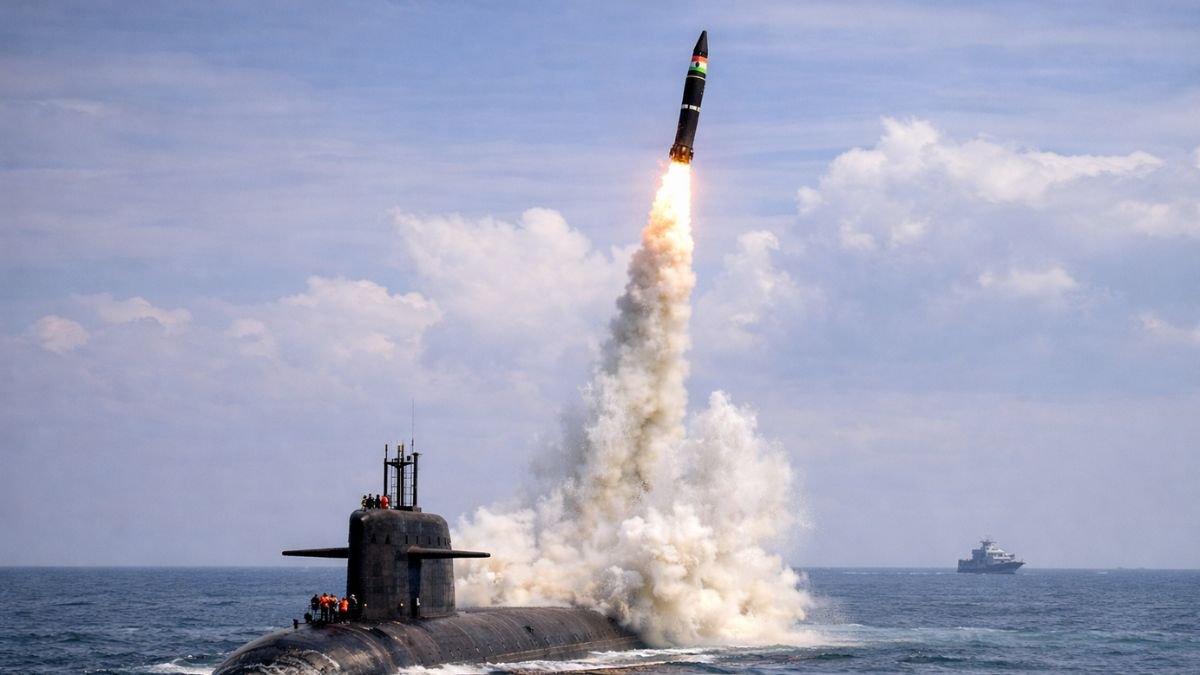


India’s reported tests of the K-4 ballistic missile from the nuclear-powered submarine INS Arighaat at the end of December 2025 have been boasted as proof that India’s sea-based nuclear deterrent is maturing. However, very little official information is publicly available about the tests. What is important is not the test itself but the danger of nuclear capability being pushed into the opaque, error-prone naval domain by a navy whose operational record raises serious doubts about its credibility.
Sea-based deterrence is often described as stabilising because survivable forces are meant to reduce incentives for early use. The argument fails once survivability is viewed as a slogan rather than a proven practice. When a state is convinced that its undersea resources are safe, it will have greater freedom in signalling, manoeuvring, or applying pressure in crisis scenarios. However, overconfidence at sea can tighten timelines and eliminate political off-ramps given the short distance and steep escalation ladders in South Asia.
Indian sources have described the K-4 as having a range of about 3,500 kilometres, allowing their SSBNs to operate far from enemy shores while still keeping targets at risk. Operational capability is not just about the design descriptions or range claims. An efficient maritime deterrent is founded on trained crews, secure communications, responsible patrolling, and a command system that can be updated and operate in crisis situations. India has not provided any verifiable evidence as to whether these institutional requirements have been achieved as a routine practice, or whether it is merely a future ambition.
The track record of India itself remains a larger problem since the leap from a test claim to an effective sea-based deterrent is an institutional leap, and India has yet to illustrate the level of reliable undersea routine that would make such assertions credible. Its extended submarine wing has suffered repeated supply troubles, long maintenance delays, and a lack of operational readiness, undermining confidence in the Indian Navy’s sustained operations.
These gaps cannot be easily ignored, since sea-based nuclear weapons require credibility, reiteration, and professional expertise, rather than periodic announcements based on selective disclosure, as in the case of the K-4 launch itself.
Secrecy concerning nuclear submarine operations is normal, but India’s approach to handling this issue is dangerous, as it employs limited, staged reporting on the location of undersea operations at a time when the area lacks well-established naval risk-reduction measures. It encourages worst-case reading and makes it more difficult for the adversary to differentiate between regular activity and intense signalling.
Simultaneously, India is pursuing an expansion of its undersea endeavours. It was reported in October 2024 that New Delhi had sanctioned two nuclear-powered submarines estimated to cost about USD 5.4 billion. Such an expansion, which lacks clear risk management, is not stabilising; instead, it aggravates unnecessary friction.
From a Pakistani standpoint, the behavioural uncertainty created by Indian choices is the central issue. When secrecy is approached as a signalling tool, there is a high possibility of a normal movement being interpreted as intent. In such conditions, restraint is required from the party striving to read ambiguity and not from the side that produces it. From Pakistan’s standpoint, Indian claims about undersea maturity should be treated as unverified signalling rather than as a settled indicator of stability.
A single organising aim Pakistan requires is to maintain credible deterrence and minimise the risk of misinterpretation at sea. The first step is to increase maritime awareness with the implementation of coastal sensors, patrol reports, and verified intelligence into a single operational picture to ensure normal movement is not mistaken for malicious intent.
The next step is to transform anti-submarine warfare into a regular standing operation through regular training and rigorous reporting lines. The third step is communication resilience, built through redundancy, protected procedures, and decision checks, along with regular updates and improvements in its already well-established command and control systems, to provide an added operational edge against the adversary during a crisis.
India’s K-4 tests, taken in isolation, do not constitute a decisive shift, particularly given the Indian Navy’s poor operational record. The risk intensifies when these tests are viewed alongside a broader pattern of naval expansion, tight secrecy, and assertive signalling by a state that has repeatedly relied on military pressure for political effect. In this combination, India’s undersea posture is more likely to be destabilising than reassuring.
India’s belligerent undersea signalling creates ambiguity in the maritime domain. Pakistan’s response options, thus, are not a choice meant to escalate but a requirement meant to contain India’s risk to ensure the credibility of its deterrence at sea. Ultimately, stability will depend less on announcements and more on disciplined routines, restraint, and clear decision-making during crises at sea.

Muhammad Aqib Zardad
The writer is a Research Assistant at the Centre for Aerospace and Security Studies (CASS), Lahore.
Originally Published in Stratheia.
CASS LAhore

The Centre for Aerospace & Security Studies (CASS) was established in July 2021 to inform policymakers and the public about issues related to aerospace and security from an independent, non-partisan and future-centric analytical lens.
CASS Newsletter

@2025 – All Right Reserved with CASS Lahore.

- Home
- About Us
- Research Domains
- Publications
- Events
- Gallery
- Contact Us
@2021 - All Right Reserved. Designed and Developed by PenciDesign