
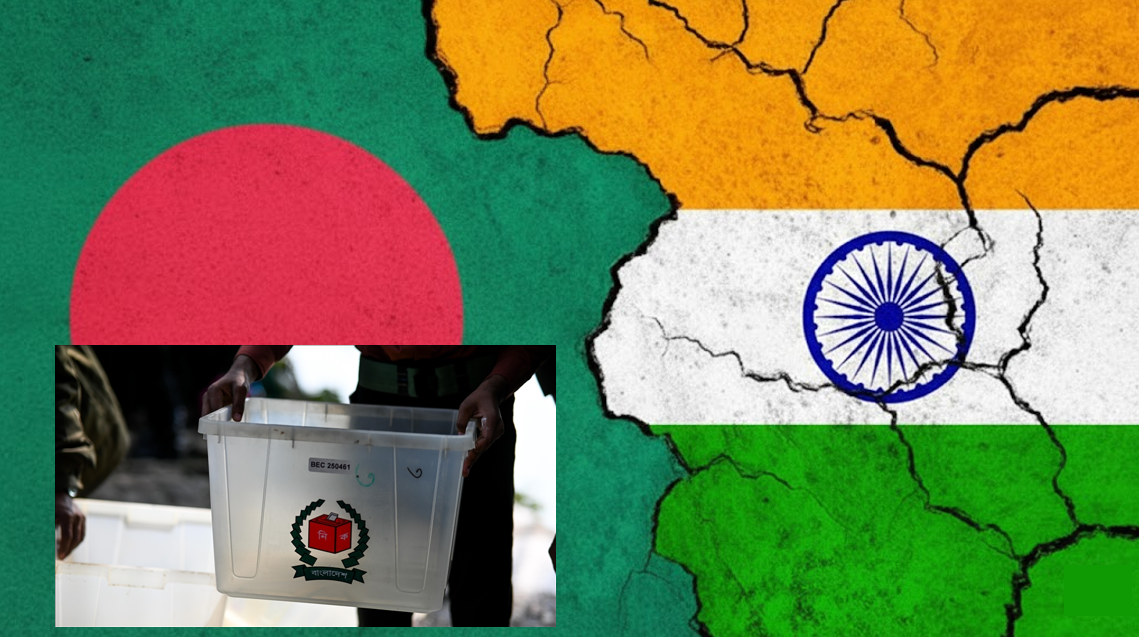


Since the fall of Hasina’s regime, New Delhi has been gripped by policy anxiety, which is becoming more pronounced as Bangladesh braces for new elections. The political order in Dhaka, once under New Delhi’s complete control, has shifted beyond its comfort zone. Approximately two weeks before the elections, India finds itself in a political environment it has not adequately prepared for.
The emerging political environment in Bangladesh reflects an anti-Indian sentiment. This is primarily due to India’s close cooperation with the previous regime, which had been in power for fifteen years. Initially rising to power on popular support, the Awami National Party’s government gradually lost public approval and resorted to oppressive measures to retain power. During this tenure, India built its relationship exclusively with Sheikh Hasina’s government, while systematically ignoring public sentiment. This strategy yielded security, trade, and connectivity at the cost of repression, electoral engineering, and the shrinking of political freedom in Bangladesh.
With the abrupt but bloody fall of the Hasina regime, India’s political capital in Dhaka also sank. India’s decision to grant asylum to the ousted Prime Minister further deteriorated bilateral relations between the two countries. The recent assassination of the student leader, Sharif Osman Hadi, led to widespread anti-India protests in Bangladesh, dipping the bilateral relations to a new low. Lastly, the expulsion of a Bangladeshi player from the Indian Premier League, under pressure from Hindu extremist groups, dragged sports into politics, prompting Bangladesh to refuse to send its cricket team to India for the upcoming T20 Cricket World Cup.
For New Delhi, this is deeply unsettling. With the popular slogan of political autonomy, Dhaka has mended ties with Pakistan and China, rejecting strategic alignment with India. As political activity intensifies, anti-India rhetoric has entered the mainstream of electoral politics, where a large segment of Bangladeshi youth and urban voters sees India as a dominant neighbour that prioritises authority over accountability.
The forces that emerged from the uprising have openly criticised Indian policy and are now at the forefront of electoral competition. The National Citizens’ Party (NCP) gained rapid visibility by framing itself as the political heir to the student movement, and its leaders directly criticise Indian policies, thereby gaining popularity around this narrative. What worries India is not rhetoric alone but the speed with which this sentiment is translating into electoral mobilisation. India’s woes are further intensifying as political alliances begin to shape. The NCP’s electoral alliance with Jamaat-e-Islami (JI) is an attempt to transform diffused public anger into a coordinated political front. This alliance alarms New Delhi because it combines the NCP’s youth-driven protest legitimacy with JI’s organisational depth.
India’s concern deepened further as other electoral alignments are emerging. The Bangladesh Nationalist Party (BNP) has aligned itself with the Jamiat-e-Ulama-e-Islam (JUI) and other religious parties. In a political landscape where the Awami League is out of the electoral race, the electoral field narrows into blocs increasingly defined by opposition to Indian influence. This makes anti-India sentiment, for the first time, electorally structured. For New Delhi, this means that the elections are no longer about a single unfriendly party but a consolidated political mood.
The victory of Jamaat-aligned candidates in the Dhaka University elections last year reinforced this trend, as the university, long regarded as the heart of secular nationalist politics, signalled a generational shift. This result carried symbolic weight for India because it suggested that anti-India narratives resonate even in elite spaces.
India’s response to this tectonic shift in Bangladeshi politics has been cautious but revealing. It has been attempting to regain political space through selective diplomacy and quiet political signalling. India appears to be indirectly shaping outcomes by engaging certain actors while trying to marginalise the provisional leadership. This approach mirrors the earlier policy of prioritising manageability over democratic choice. This strategy is questionable as it risks undermining the popular will that emerged from mass mobilisation. Instead, it reinforces the belief that India supports democracy in neighbouring states only when the outcomes align with its political interests. In a politically awakened Bangladesh, this perception carries long-term costs. Power in Dhaka has moved away from New Delhi’s familiar hands. The new government, backed by popular vote, will be less deferential and more assertive. In post-election Dhaka, foreign policy alignment will be negotiated rather than assumed. India faces a choice: it can continue to try to manage Bangladeshi politics from above, or it can accept that public consent now shapes legitimacy. Until India adapts, its anxiety over the Bangladesh elections will persist.

Ameer Abdullah Khan
The writer is a Senior Research Associate at the Centre for Aerospace and Security Studies (CASS), Lahore.
Originally Published in Daily Times.
CASS LAhore

The Centre for Aerospace & Security Studies (CASS) was established in July 2021 to inform policymakers and the public about issues related to aerospace and security from an independent, non-partisan and future-centric analytical lens.
CASS Newsletter

@2025 – All Right Reserved with CASS Lahore.

- Home
- About Us
- Research Domains
- Publications
- Events
- Gallery
- Contact Us
@2021 - All Right Reserved. Designed and Developed by PenciDesign