
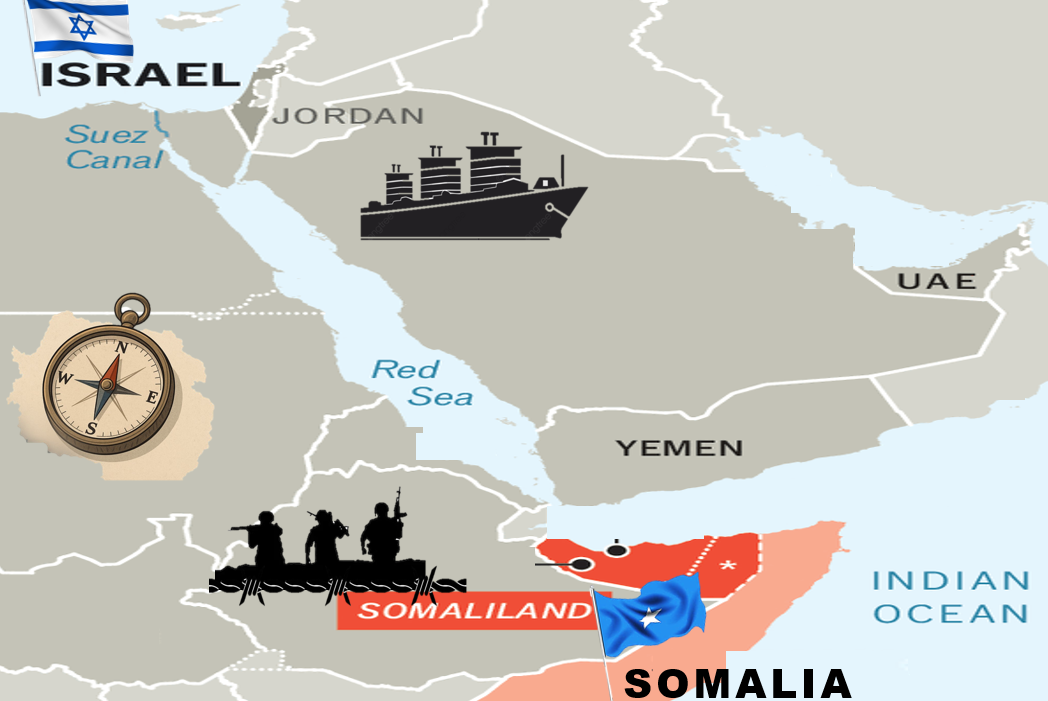


The geopolitical equilibrium in the region of the Horn of Africa is at an inflection point. The quest for regional influence is at play in the region, especially in Somalia and Southern Yemen. This has implications for the region and beyond. The latest ripples were created by Israel’s recognition of the so-called “Somaliland” as an independent state on 26th December 2025. After largely neutralising the “Ring of fire” around it, Israel is now seeking to expand its influence by creating a foothold in the strategic “Horn of Africa” region. The region controls access to the Red Sea and Suez Canal, vital for global trade, attracting major power interest in ports and naval presence.
Somaliland, part of Somalia, sits on this strategic bottleneck for global shipping and naval routes. If Israel succeeds in consolidating its presence in this strategically vital area, it will creep into the close vicinity of key GCC countries. This would also give Israel a balancing locus against adversaries like Iran and Turkey, which influence Somalia.
Predictably, this led to a strong reaction from the Islamic countries. The Council of Foreign Ministers of the Organisation of Islamic Cooperation (OIC) in its 22nd extraordinary session strongly condemned Israel’s recognition of the so-called “Somaliland.” The OIC committed its unwavering support for the sovereignty, unity, and territorial integrity of the Federal Republic of Somalia. Pakistan has strongly endorsed this position.
Somalia has been going through a prolonged period of instability, including a protracted civil war, following the overthrow of the military regime of President Siad Barre in 1991. Competing clans and warlords filled the power vacuum. An extremist group, Al-Shabaab, linked to Al-Qaeda, also emerged, controlling large territories.
Among the neighbouring countries, Ethiopia has a keen interest in the territory of Somaliland for access to the sea. Since Eritrea’s independence in 1993, Ethiopia has been the world’s most populous landlocked country. Currently, Ethiopia relies on Djibouti for over 95% of its maritime trade, paying an estimated up to 2 billion dollars annually in port fees. In 2024, Ethiopia signed an MOU with “Somaliland” that includes a 50-year lease of a twenty-kilometre stretch of coastline, which would potentially allow it to re-establish its presence in the Red Sea and the Gulf of Aden.
Apart from Israel, in recent years, the UAE has been investing in port infrastructure in the Somaliland area to secure commercial and military interests in the Horn of Africa and Red Sea region. The UAE is also a signatory to the Abraham Accords. Having agreed to the normalisation with Israel in September 2020, it has full diplomatic relations with Israel. However, the UAE and Saudi Arabia back different sides in Sudan and South Yemen and have divergent interests in Libya and Syria. Their major differences in South Yemen triggered an air strike by Saudi Arabia on account of the alleged UAE weapons supply to the Southern Transitional Council (STC). UAE was subsequently asked to pull out its troops from Yemen, which were part of the Saudi-led coalition force.
The recent developments in the area of Somaliland and South Yemen reflect a growing rupture in the region around the Horn of Africa. The geopolitics of this region is a complex web of low-intensity conflicts and competition between regional and great powers, mainly because of strategic maritime interests. The continuing instability in Sudan in the South and Yemen in the North adds to the complexity of the situation in an already volatile maritime corridor of the Red Sea.
Of late, Pakistan has a growing footprint in the Middle East. In September 2025, Pakistan and Saudi Arabia signed the Strategic Mutual Defence Agreement, which treats aggression against one as aggression against both. Reports indicate that a three-way defence arrangement between Pakistan, Saudi Arabia, and Turkey is being studied. Other GCC countries have also evinced interest in security and defence cooperation. Pakistan is an important member of the Group of Eight Islamic countries steering the Gaza Peace plan. In response to an invitation extended by President Donald Trump, the Prime Minister of Pakistan has joined the Board of Peace as a part of its ongoing efforts to support the implementation of the Gaza Peace. Pakistan is reportedly also extending defence cooperation to Sudan and Libya.
The growing cracks in the region around the Horn of Africa are destabilising and are heightening risks of proxy warfare and maritime insecurity. That would directly and indirectly concern Pakistan. Pakistan and its GCC partners would be wary of Israel’s growing footprint in the Red Sea area. Pakistan would also like to see the gradual bridging of differences between Saudi Arabia and the UAE in Yemen. Our policymakers would be well advised to play a moderating role but stay away from intra-Arab disputes and avoid getting embroiled in any Middle Eastern quagmire.

Ambassador Muhammad Haroon Shaukat (Retd)
The writer is Director Foreign Affairs at the Centre for Aerospace and Security Studies (CASS), Lahore.
Originally Published in The Nation.
CASS LAhore

The Centre for Aerospace & Security Studies (CASS) was established in July 2021 to inform policymakers and the public about issues related to aerospace and security from an independent, non-partisan and future-centric analytical lens.
CASS Newsletter

@2025 – All Right Reserved with CASS Lahore.

- Home
- About Us
- Research Domains
- Publications
- Events
- Gallery
- Contact Us
@2021 - All Right Reserved. Designed and Developed by PenciDesign