



SEMINAR
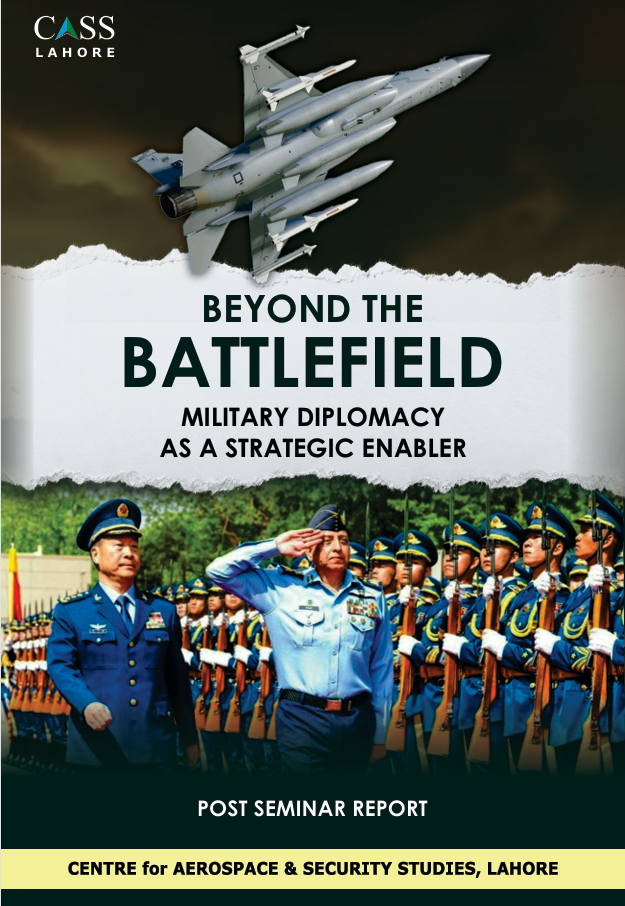
Beyond the Battlefield: Military Diplomacy as a Strategic Enabler
December 03, 2025
The complete PSR is available upon request. Please use the button below to submit your request.
president
Air Marshal Asim Suleiman (Retd)
SEMINAR COORDINATOR
Air Marshal Irfan Ahmad (Retd)
EDITOR
Dr Zahid Khan
RAPPORTEURS
Ms Maheera Munir & Ms Sibra Waseem
Executive Summary
The seminar “Beyond the Battlefield: Military Diplomacy as a Strategic Enabler”, organised by the Centre for Aerospace & Security Studies (CASS), Lahore, brought together senior military practitioners, diplomats and scholars to examine the expanding role of military diplomacy in contemporary statecraft, with particular emphasis on the Pakistan Air Force (PAF). The deliberations explored how armed forces employ non-combat instruments to advance national strategy, shape perceptions, build durable partnerships and enhance deterrence in an increasingly complex and interconnected security environment. Through doctrinal reflection, operational case studies and institutional analysis, the seminar assessed military diplomacy as an integral component of Pakistan’s broader foreign-policy toolkit.
In his opening remarks, Air Marshal Irfan Ahmad (Retd) situated military diplomacy within both classical and contemporary strategic thought, underscoring that the deliberate employment of military assets for confidence-building, humanitarian assistance, training exchanges and defence cooperation is neither contradictory nor novel, but a long-established extension of statecraft. He highlighted air power’s intrinsic attributes of speed, reach and visibility, arguing that these characteristics make it a particularly effective instrument for rapid humanitarian response, interoperability with partners and strategic signalling short of conflict.
Ambassador Aizaz Ahmed Chaudhry articulated a clear conceptual framework explaining how military diplomacy advances foreign-policy objectives. He distinguished military diplomacy as a method rather than a policy, identifying five principal avenues: high-level military dialogues, joint exercises, training exchanges, officer deputations and defence trade. Each, he argued, contributes to expanding Pakistan’s diplomatic space, strengthening deterrence and fostering sustained trust with partner states. Emphasising prudence, he stressed that military diplomacy must be applied in a calibrated, case-specific manner and should complement, rather than substitute, traditional diplomatic, economic and cultural instruments of statecraft. He also drew attention to evolving regional perceptions and recent shifts in engagement patterns, noting that Pakistan’s enhanced operational credibility has positively influenced its diplomatic standing and widened its foreign-policy options.
The seminar’s analytical and policy-oriented core was provided by Air Vice Marshal Dr Liaquat Ullah Iqbal, who presented the National Aerospace Science & Technology Park (NASTP) as a flagship national initiative underpinning technological sovereignty and military diplomacy. NASTP was described as a deliberately national, rather than service-centric, platform designed to integrate academia, industry and government across priority technology clusters, including aerospace, drones, artificial intelligence, robotics and semiconductors. Its rapid institutionalisation, multi-site architecture, incubation and certification pipelines, engagement with the private sector and diaspora, and emerging export outcomes were advanced as evidence that indigenous technological capacity strengthens military diplomacy by positioning Pakistan as a credible partner and contributor rather than a dependent consumer.
Air Marshal Abdul Moeed Khan (Retd) examined military diplomacy through the lens of operational experience, tracing the PAF’s historical contributions to regional air forces, UN missions and multinational exercises. He highlighted the post-2021 doctrinal transformation of the PAF from a predominantly fighter-centric service into a multi-domain, integrated air power. Central to his analysis was the military-to-strategic effect chain, presence, engagement, trust, interoperability, access and influence, through which tactical professionalism translates into strategic impact. He argued that Pakistan’s recent operational performance, culminating in Marka-e-Haq, reasserted the PAF’s relevance and generated strategic surprise by integrating doctrine, training and innovative employment of indigenous capabilities, thereby reinforcing deterrence and international credibility.
In his concluding remarks, Air Marshal Asim Suleiman (Retd), President CASS Lahore, observed that Zarb-e-Karrar represented a defining moment in Pakistan’s military diplomacy. He argued that the exercise demonstrated the PAF’s disciplined professionalism and multi-domain competence, thereby reshaping Pakistan’s strategic influence and external perceptions. Highlighting the leadership of Air Chief Marshal Zaheer Ahmed Baber Sidhu, he noted that under his command the PAF consolidated its technological edge, deepened defence partnerships, and broadened its global diplomatic engagement. According to Air Marshal Suleiman, these developments elevated Pakistan’s standing as a credible and responsible middle power. He concluded that Zarb-e-Karrar illustrated how military capability, when aligned with strategic vision, can function as an effective instrument of contemporary diplomacy.
Key Takeaways
- Military Diplomacy as a Force Multiplier
Pakistan’s military diplomacy has expanded foreign-policy options, strengthened long-term partnerships, and enhanced regional standing and credibility with major powers, including the US, China, and Gulf states.
- Calibrated Deterrence and Strategic Signalling
Measured use of military diplomacy, combined with operational restraint and capability demonstration, reinforces deterrence, influences adversary behaviour, and stabilises regional dynamics without escalation.
- NASTP as a National Initiative
NASTP is a national initiative that channels aerospace technology to sovereignty and economic self-reliance, with the PAF prioritising indigenous aerospace, UAV, cyber and space capabilities to enhance security and lessen foreign dependence.
- Holistic Human Capital and Youth Development
NASTP invests heavily in nurturing talent through STEM programs, aerospace incubators (NICAT), youth innovation ecosystems (Siber Koza), and partnerships with universities and international institutions, aiming to harness Pakistan’s demographic dividend.
- Integration of Academia, Industry, and Government
NASTP connects research, industry and government to develop indigenous aerospace, drone, cyber and space capabilities that bolster sovereignty, economic growth and security while cutting reliance on foreign suppliers.
- Exercises and Air Shows as Strategic Instruments
International exercises and global air shows function as strategic instruments through which the PAF builds partnerships, enhances visibility, projects professionalism, and shapes perceptions, thereby opening avenues for defence cooperation, market access, and a stronger diplomatic footprint.
- Transformation of Air Power Thinking
The post-2021 era, under ACM Zaheer Ahmed Baber Sidhu, marked a decisive shift towards multi-domain approaches that sought to align PAF doctrine, structure, and capability with contemporary global benchmarks.
- Marka-e-Haq and the Reassertion of Relevance
Operation Marka-e-Haq demonstrated the success of doctrinal evolution and repositioned the PAF as a relevant and studied air force, drawing renewed attention from partners in both the East and the West.
Policy Considerations
- Institutionalise Military Diplomacy
Pakistan must embed military diplomacy as a core instrument of foreign policy, ensuring coherence with political, economic, and strategic objectives while avoiding ad hoc application.
- Leverage Defence Industry and Technological Cooperation
Pakistan should leverage indigenous defence production and co-development as an instrument of military diplomacy, selectively aligning them with regional dynamics to advance economic growth, strengthen partnerships, and balance deterrence with influence projection.
- Strengthen Indigenous R&D and Intellectual Property
Pakistan needs to draft policies that prioritise domestic development of critical technologies and safeguard IP, ensuring that Pakistan retains sovereign control over key military and dual-use systems.
- Expand Public-Private Partnerships and Innovation Ecosystems
Pakistan must encourage structured engagement between the private sector, startups, and academia to enhance industrial capabilities, generate economic growth, and provide career pathways for skilled youth.
- Integrate Advanced STEM Education Nationally
Pakistan should institutionalise nationally coordinated programmes in aerospace, artificial intelligence, robotics, and cybersecurity across universities and technical institutes to generate a sustained pipeline of industry-ready talent aligned with NASTP’s strategic and technological objectives.
- Develop Scalable National-Level Technology Platforms
Pakistan must institutionalise frameworks to extend NASTP’s technological solutions to civil applications, national disaster management, agriculture, and urban infrastructure, ensuring broad societal impact beyond defence.
- Reinvigorate Doctrinal Evolution and Multi-Domain Thinking
The PAF must continue embedding a system-wide view of air power that integrates cyberspace, electronic warfare, space, and information effects to strengthen operational relevance.
- Protect Critical Knowledge and Capabilities
Doctrinal sharing must remain selective and controlled to safeguard national advantage while ensuring that military diplomacy remains mutually beneficial rather than extractive.
CASS LAhore

The Centre for Aerospace & Security Studies (CASS) was established in July 2021 to inform policymakers and the public about issues related to aerospace and security from an independent, non-partisan and future-centric analytical lens.
CASS Newsletter

- Home
- About Us
- Research Domains
- Publications
- Events
- Gallery
- Contact Us
@2021 - All Right Reserved. Designed and Developed by PenciDesign