
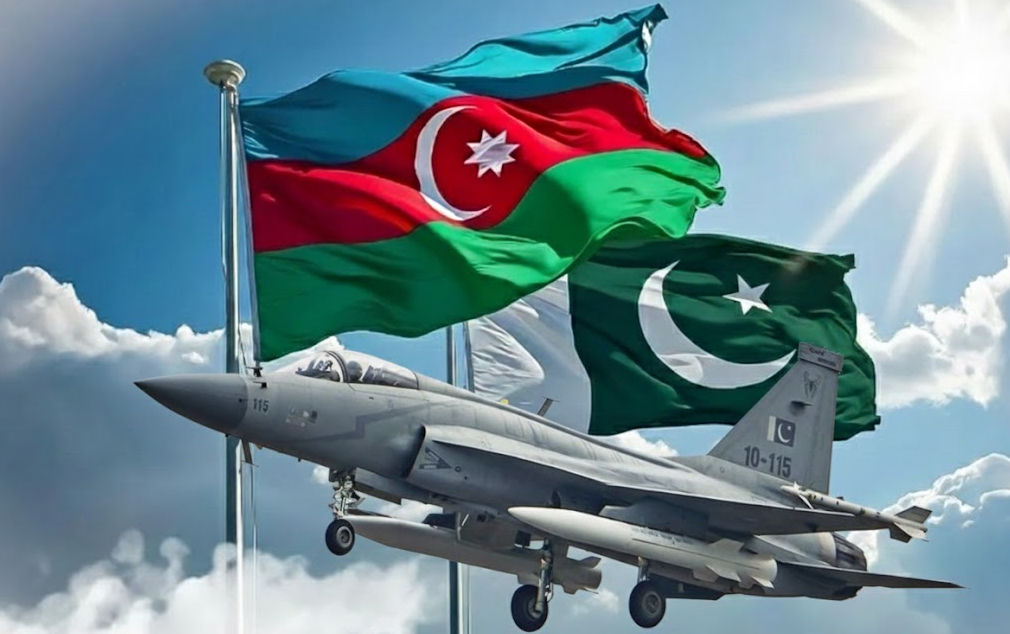


In Baku’s autumn sky this month, five JF-17 Block III fighters soaring above the Victory Day parade told a bigger story than any speech. For the first time, Azerbaijan put its new Pakistani-built jets on public display, signalling that Islamabad is no longer just an arms buyer but an emerging aerospace partner.
This moment of pride is the product of the Pakistan Air Force (PAF)’s long-standing dedication to professional readiness, disciplined engineering acumen and the inspirational leadership that turns difficult projects into national capability.
The scale of the deal with Azerbaijan alone turns heads. Initiated under the incumbent Air Chief Marshal Zaheer Ahmed Baber Sidhu, the agreement began as a USD 1.6 billion package. It has since expanded into a USD 4.6 billion programme covering up to forty JF-17C Block III aircraft, simulators and long-term logistics support, the most extensive defence export package in Pakistan’s history.
Deliveries began soon after President Ilham Aliyev inspected the first aircraft at ADEX 2024, and a first batch of single-seat and dual-seat jets has already reached Nasosnaya Air Base near Baku.
Azerbaijan has chosen the JF-17C Block III, the top end of the Thunder. The aircraft brings an AESA radar from the KLJ-7A line, a wide-area glass cockpit with helmet-mounted sight, and an upgraded electronic warfare suite that lifts it into the 4.5-generation bracket.
It can employ Chinese PL-15E beyond-visual-range and PL-10 short-range missiles, alongside precision-guided bombs and anti-ship weapons. With this extraordinary profile, the Block III gives Baku a resilient, network-friendly fighter to deliver credible performance in modern air operations.
For Pakistan, this contract is tangible recognition that its home-grown aerospace industry now commands genuine confidence and respect abroad. It is a fruit of a long, steady effort, from the prototype flight in 2003 to a fully networked Block III taking shape at Pakistan Aeronautical Complex (PAC).
In a region where prestige has long been measured by imported flagships, Islamabad has earned respect by exporting a fighter it co-designs, assembles and sustains, rather than by adding another foreign trophy to the PAF fleet.
Interestingly, Tejas was compared as the competitive of the JF-17, but the Dubai Air Show crash showcased how it is still far from maturing as a reliable platform, briefly ruining the festive mood of the show.
Azerbaijan’s choice is also a vote of confidence in Pakistan’s military diplomacy. Over the past decade, PAF contingents have flown alongside Azerbaijani and Turkish crews in exercises such as Anatolian Eagle, building familiarity in tactics and trust in each other’s professionalism.
The sale sits within a wider trilateral framework with Türkiye, where air and air defence cooperation, drone projects and training exchanges are eroding the assumption that airpower in the Caucasus must be mediated through Moscow or Washington.
The JF-17’s appeal is simple: it keeps costs manageable while still giving a medium-sized air force modern capability. For Azerbaijan, the possible integration of Turkish Gökdoğan and Bozdoğan missiles into its JF-17s indicates a shift away from ageing MiG-29s.
The platform’s cost-effectiveness and integrability are a testament that Pakistan can equip a partner with a modern, non-Western fighter ecosystem that is not hostage to sanctions or export politics.
Defence exports like the JF-17 do more than earn foreign exchange; they feed money, confidence and experience back into Pakistan’s own industry. Each deal becomes the impetus for designers, engineers and production lines to deepen indigenisation and sustain a more self-reliant national defence base over time.
The Block III in Azerbaijan is therefore less an advertisement for an airframe than a proof of concept for a Pakistani approach to networked, affordable airpower.
Zarb-e-Karrar was the sharpest demonstration of this philosophy. The air battle of May 2025 delivered a seven-to-zero kill ratio, including four Rafales, against the Indian Air Force.
The PAF’s performance rested on cross-domain integration, dispersed basing and resilient command and control, with platforms like the J-10C and JF-17 carrying much of the load. The same habits are now being exported in training teams and simulators that accompany the jets to Azerbaijan.
The JF-17 story also reflects the foresight of PAF leadership. In the 1990s, when sanctions, ageing fleets, and financial constraints converged, the Air Force chose a difficult path of co-designing a fighter rather than importing one.
That resolve has carried through to today under Air Chief Marshal Zaheer Ahmed Baber Sidhu, whose modernisation agenda emphasises self-reliance, systems integration, shared growth with partners, and a quiet insistence that Pakistan be treated with the respect due to a capable aerospace actor.
All in all, Pakistan’s aerospace advantage rests on the quiet disciplines under extraordinary leadership that brought the JF-17 to Baku. A Thunder in Azerbaijani colours is therefore more than an export success.
It is a signal that Pakistan is maturing into a credible designer, operator, and partner in integrated airpower, with a future shaped by cooperation, self-reliance, and a growing circle of states that see value in betting on Pakistani ingenuity.

Amjad Fraz
The writer is a Research Assistant at the Centre for Aerospace and Security Studies (CASS), Lahore.
Originally Published in Stratheia.
CASS LAhore

The Centre for Aerospace & Security Studies (CASS) was established in July 2021 to inform policymakers and the public about issues related to aerospace and security from an independent, non-partisan and future-centric analytical lens.
CASS Newsletter

@2025 – All Right Reserved with CASS Lahore.

- Home
- About Us
- Research Domains
- Publications
- Events
- Gallery
- Contact Us
@2021 - All Right Reserved. Designed and Developed by PenciDesign