
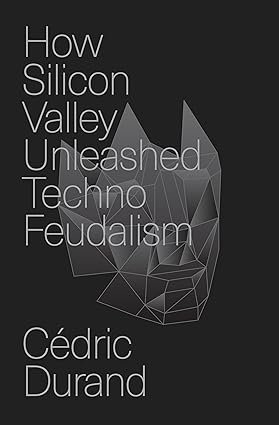


“How Silicon Valley Unleashed Techno-Feudalism: The Making of the Digital Economy” is the latest work from French economist and sociologist Cédric Durand. It is an ambitious and timely intervention in the debates on capitalism, technology, and political economy. At the heart of this intervention is the argument that the digital revolution has not simply reinforced capitalism’s well-known dynamics but has precipitated something new.
It has unleashed a new order that resembles feudalism more closely than the competitive markets celebrated in liberal economic thought. What is often sold to us as an “age of innovation,” Durand insists, is in reality an age of enclosure, dependence, and rent-seeking in which digital platforms are less like firms competing in open markets and more like lords exercising authority over digitally constituted fiefdoms. This overlaps with Yanis Varoufakis’ well-known concept of “techno-feudalism”, which similarly points to how digital capitalism gives rise to new hierarchies of dependency and control.
Durand’s education and expertise make him a reliable expert on political economy. He is a professor at the University of Geneva and was a professor at the University of Paris. He is also a prominent critic of globalisation and financial capitalism. His previous book, Fictitious Capital: How Finance Appropriates Our Future, focused on how finance exploits real economies through rent-seeking.
In this book, Durand brings his long-time issues with capitalism’s structural changes to the advent of Silicon Valley, successfully showing how economic power and digital technology merge in modern capitalism. Given his expertise in political economy and his focus on digital technology, Durand is well-positioned to tackle the intersection of these two fields, and he largely succeeds in showing how structural economic power manifests in Silicon Valley.
To substantiate his claims, the author cited numerous examples. He argued that platforms such as Google, Amazon, Apple, Facebook, and Microsoft are not just ordinary firms trying to outperform their competitors. Instead, he links them to landlords operating in the digital sphere. He illustrated this by mentioning Google’s Android operating system, seemingly provided for free to phone manufacturers.
However, in reality, it secures its control over mobile internet, weaving together developers, advisers, and consumers. Likewise, Microsoft has become so embedded in one’s institutional life that giving it up would inflict significant cost on its users. Therefore, these platforms have locked people into a system that is reminiscent of medieval peasants’ dependency on their landlords. Through such cases, the author elucidates that what may appear as a consumer’s choice can be better conceptualised as digital captivity.
Moving on, the author sharply criticises the propagated narrative of Silicon Valley as the driver for innovation and perpetual change. Durand argues that the majority of start-ups fail, and those that are able to compete are the ones acquired by bigger companies. Therefore, instead of fair competition, it is consolidation that defines the parameters of the digital economy.
Facebook’s acquisitions of Instagram and WhatsApp, Amazon’s voracious purchase of competitors, and Apple’s tight control of its ecosystem all confirm that the rhetoric of innovation disguises a logic of monopoly and predation. However, the author does not consider non-profit or alternative digital initiatives, which could offer counterpoints to the dominant corporate logic in Silicon Valley, leaving the analysis largely focused on for-profit platforms.
A particularly compelling section of the book deals with labour in the platform economy. Durand shows how workers in the gig sector, whether Uber drivers or food couriers, are formally treated as self-employed “contractors” yet are, in reality, subject to an extraordinary degree of algorithmic control. It is the app, not the worker, that sets the rules: deciding which ride to allocate, which route to take, what price to charge, and even how performance is judged.
The much-vaunted independence of such workers is therefore illusory. They may own the car or bicycle they use, but their earning capacity is tied to the opaque logic of the platform, hardly different, Durand suggests, from medieval peasants who farmed their own land but owed service to their lord. The continuing legal battles in California, France, and elsewhere over how to classify such workers only underline the point: the regulatory system is still struggling to keep up with this new form of dependency.
Furthermore, Durand is equally compelling when highlighting the rise of non-physical assets and intellectual property. As opposed to tangible infrastructure that sustained industrial capitalism, monopolies today rely on elements such as software, patents, algorithms, and most importantly, data. Scaled at little to no cost, these assets create what the author terms “differential rents.” Here, the logic does not pertain to production but to control.
This suggests that whoever has control over chokepoints, such as the operating system, the app store, data infrastructure, etc., can easily extract profit from those who depend on its access. For example, a “patent troll” buys intellectual property exclusively to extract rents. Similarly, Apple maintains a strong hold over its ecosystem, illustrating that power derives less from innovation than from maintaining control over the bottlenecks. Here, the author’s comparison to the traditional feudal system feels apt: peasants plough the soil, but the gate to the field remained under the tight control of the landowner’s lock and key.
The third argument advanced by the author is the role of these platforms in shaping consumer behaviours. Factors, such as algorithms, ranks, and predictive analytics, directly influence how users behave, what they view, and even what they choose. Durand outlines examples of Facebook’s reliance on user ratings, Amazon’s prioritisation of its own products in search results, and the operational logic behind China’s Social Credit System to substantiate his argument.
A commonality between all these platforms is that decisions are built into code, not made as a result of public debate or laws. This lack of accountability or transparency generates a subtle yet powerful mode of governance. In such a system, users or companies are being controlled without realizing its extent.
What makes this book stand out is its intellectually ambitious scope and robust empirical foundation. The author successfully integrates Marxist political economy, as well as theories and concepts relating to intellectual property, with contemporary debates surrounding surveillance capitalism. In this way, he creates a unified framework for understanding how digital capitalism functions through the commodification of information and control.
Additionally, the author uses cases and examples from multiple regions, including the US, China, Europe, etc., to show that the trends and patterns he analysed are not confined to a particular geographical region. Instead, these configurations are ubiquitous and formulate the digital ecosystem as a whole
Moreover, Durand’s use of familiar examples like those of Android, Uber, Microsoft, and Amazon allows readers to make sense of complex arguments by grounding them in observable realities. Last but not least, the book dares to challenge the widely accepted view that capitalism mainly adjusts to new technologies without altering its fundamental nature. Instead, the author highlights how digital capitalism represents a distinct order with its own rules of how power operates and how profits are extracted.
Despite its numerous strengths, there are certain limitations of the book. The use of the feudalism analogy provides a fresh perspective, but sometimes the comparison is stretched too far. As opposed to medieval serfs who were bound and could not move freely, digital users today retain a certain degree of rights and alternative pathways. If interpreted literally, this comparison can be misleading as it obscures key distinctions of the contemporary era. Another weakness of the book is that it pays little to no attention to states from the global south, where digital economies are informal, regulations are weaker, and alternative platforms are used.
Therefore, readers from such a background may feel the author’s analysis to be less applicable or irrelevant to their conditions. Lastly, the author has comprehensively identified problems underpinning the current digital structure, but the solutions provided are limited. While the author touches upon strategies like economic democracy and collective control over algorithms, he fails to provide ways to institutionalise such remedies, especially when power structures are deeply entrenched.
All in all, How Silicon Valley Unleashed Techno-Feudalism makes a significant contribution to discussions about the digital economy. Durand pushes readers to think beyond traditional assumptions associated with capitalism, indicating how the dominance of big platforms is more than just market power.
It is a structural change that not only curtails autonomy but also deepens dependencies, and profit seeking largely replaces true innovation. The book provides conceptual clarity to the scholar of political economy, highlights the urgent need for policymakers to update regulations, and leaves the general reader to reflect upon how modern structures influence options and even consequences with or without agreement.
Originally Published in Stratheia
CASS LAhore

The Centre for Aerospace & Security Studies (CASS) was established in July 2021 to inform policymakers and the public about issues related to aerospace and security from an independent, non-partisan and future-centric analytical lens.
CASS Newsletter

@2025 – All Right Reserved with CASS Lahore.

- Home
- About Us
- Research Domains
- Publications
- Events
- Gallery
- Contact Us
@2021 - All Right Reserved. Designed and Developed by PenciDesign