
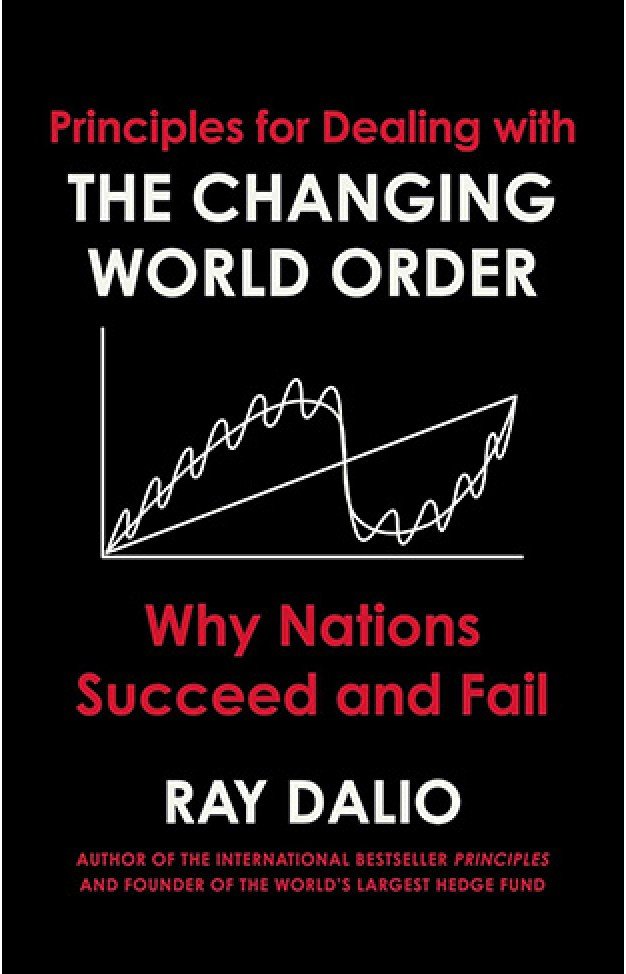


Today’s world is largely characterised by rising geopolitical tensions, mainly in the form of the great power competition, which is redefining the world order in front of our eyes. It is a world grappled by economic turbulence, as evident from the recent trade war that the United States has imposed on the world under the garb of so-called reciprocal tariffs.
However, such a world is not emerging for the first time; rather, it has many historical parallels. Ray Dalio’s 2021 book Principles for Dealing with the Changing World Order: Why Nations Succeed and Fail is mainly a historical exploration of these historical parallels, and in the process serves as a timely and relevant read.
Ray Dalio is the founder of Bridgewater Associates, one of the largest hedge funds in the world. He holds an MBA degree from Harvard Business School. He has more than 40 years of experience studying markets and economies. Besides his recent book, Principles for Dealing with the Changing World Order, he has authored several other books as well, including the New York Times bestselling book, Principles: Life and Work, and Principles for Navigating Big Debt Crises. This extensive experience placed him in a good position to analyse and write on the subject matter, which has been taken up in the book under review.
If one is to describe the central theme of Dalio’s book in four sentences, Michael Hopf’s famous words, i.e., “Hard times create strong men. Strong men create good times. Good times create weak men. And, weak men create hard times,” can be helpful. The book is exactly about these four sentences, in a sense, that it is a tale about the rise and fall cycle of various empires in history.
Dalio narrates this tale by employing a “Big Cycle” framework that captures the arc of the development of various empires. According to the author, this cycle has repeated itself across history on several occasions, in the case of the Dutch Empire and the British Empire, and now can repeat itself once again in the case of the American Empire.
In the first half of the book, the author developed the model of the “Big Cycle”. The model, as aforementioned, is central to the author’s analysis, with the help of which he not only explains the rise and fall of various empires in history but also predicts the future of empires or global powers in the contemporary world.
According to the author, the “Big Cycle” unfolds in three major stages, namely: the Rise, the Top, and the Decline. The Rise phase in the cycle, as evident from its name, is mainly characterised by prosperity and constructive activity. During this phase, institutions of the state strengthen, and their productivity grows, which consequently leads to significant wealth accumulation.
The Rise phase is followed by the Top phase of the cycle. According to the author, the phase represents the zenith of power. However, paradoxically, in the said phase, complacency and excesses also set in the empire in various forms, such as financial overextension, political polarisation, and military overreach. Consequently, it begins to erode the foundations of the empire’s strength and marks the beginning of the end of a golden era of the empire.
The complacency and excesses that set in the Top phase ultimately precipitate into the Decline phase of the cycle. The phase is characterised by a painful period of internal conflict, disorder, and restructuring. It involves severe economic downturns, sociopolitical instability, and geopolitical conflicts. This turbulence, according to the author, then paves the way for the creation of a new internal order and returns the cycle to square one
In the second half of the book, Dalio applies the aforementioned Big Cycle framework to major global powers in history and analyses how they rose to prominence and eventually declined. Dalio further provides a comparative analysis of these empires and shows, for example, how the Dutch Empire, which pioneered global trade, finance, and innovation in the 1600s, was eventually overtaken by the British, and then how the British in turn met the same fate and were surpassed by the Americans.
He then juxtaposes these historical shifts with current trajectories of China and the United States and argues that given the China’s current trajectory which is marked by rapid technological advancement, military buildup, and increased influence in global institutions, China appears to be in the rise stage of the cycle and could potentially replace the United States hegemony as a mighty power which is entering in the decline phase of the cycle.
The book has a number of positive aspects. One of the most appreciating aspects is its foundations in massive datasets, which cover the last 400 years of history—economic indicators, military strength, innovation metrics, reserve currency status, and more. It is no less than a feat that deserves consideration and appreciation. The accessibility of the content of the book to the wider audience is another positive aspect of the book, which merits attention.
Despite dealing with complex and technical topics such as macroeconomics and historical transitions, Dalio writes in a clear and simple language to make these complex issues understandable to a common reader. Moreover, his use of visuals throughout the book, which includes charts, graphs, and timelines, further helps the readers to grasp complex concepts with relative ease.
Having said this, Dalio’s Principles for Dealing with the Changing World Order also has shortcomings. One of the most significant shortcomings is that the central framework of the book, the so-called “Big Cycle”, upon which the whole book is based, is greatly borrowed from the work of earlier scholars. The notion that history unfolds in cyclical patterns, and that civilisations rise, reach their apex, and eventually decline, has been extensively discussed by the 14th-century Muslim Historian Ibn Khaldun in his seminal work, Muqaddimah.
In the book, Khaldun presented a remarkably similar thesis and theorised that dynasties and empires follow a predictable cycle of growth, peak, and decay. Besides, the German polymath, Oswald Spengler, and the renowned historian Arnold Toynbee have also discussed this cyclical nature of history in their works, such as The Decline of the West and A Study of History.
While drawing on the works of other scholars or existing intellectual traditions is a common and often valuable practice in academia, Dalio’s failure to explicitly acknowledge these foundational thinkers in his book somehow weakens the scholarly rigour of his work and also raises a question mark. This lack of acknowledgement risks giving the impression of conceptual novelty, when in fact there is substantial scholarly precedent.
Consequently, readers familiar with the subject, particularly the students and scholars of history, may find the book’s central argument somewhat derivative and may rightly question the author’s omission of proper attribution to those who first came forward with these ideas.
However, despite the aforementioned shortcomings, the book remains a valuable read for those interested in understanding historical patterns in general and the current global shifts, particularly those prompted by the rise of China. It is recommended to general readers who are seeking a macro-level perspective on global dynamics, though with the caveat that its central framework is not entirely novel. For scholars, it may serve as a supplementary resource rather than a groundbreaking work.
Originally Published in Stratheia
CASS LAhore

The Centre for Aerospace & Security Studies (CASS) was established in July 2021 to inform policymakers and the public about issues related to aerospace and security from an independent, non-partisan and future-centric analytical lens.
CASS Newsletter

@2025 – All Right Reserved with CASS Lahore.

- Home
- About Us
- Research Domains
- Publications
- Events
- Gallery
- Contact Us
@2021 - All Right Reserved. Designed and Developed by PenciDesign