
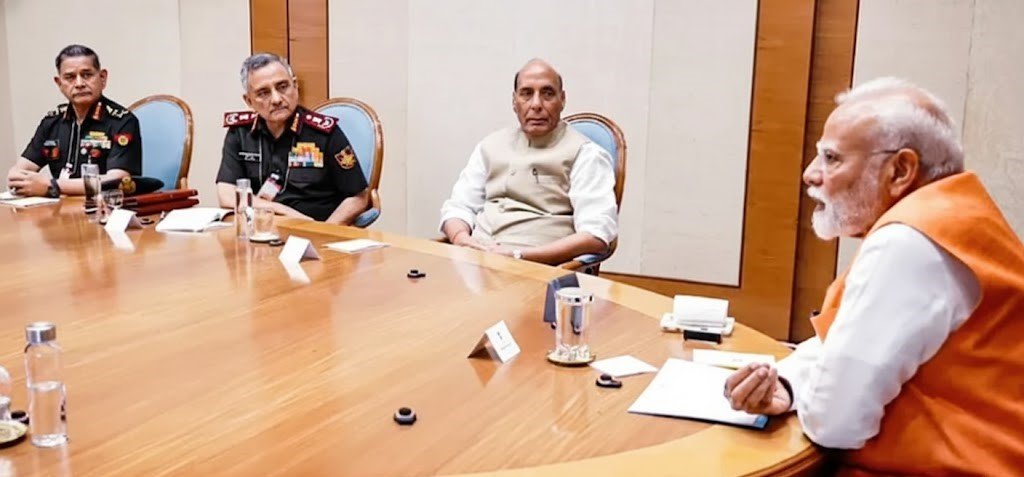


The prevailing situation in South Asia is a demonstration of deep political and strategic anxiety within India’s leadership. This comes after New Delhi’s defeat in the May 2025 war. The Indian government is still licking its wounds inflicted upon it by the Pakistan Air Force (PAF) as a response to their ill-fated Operation Sindoor. However, rather than introspecting and reassessing their defeat, the Indians want to nurture their ego by going for Operation Sindoor 2.0. This is evident through India’s militarisation and provocative rhetoric.
Involved in this bellicose rhetoric is the Indian Army Chief, General Upendra Dwivedi. He declared that Operation Sindoor 2.0 can begin anytime. The Indian Defence Minister, Rajnath Singh, is at the forefront of this confrontational discourse. He has repeatedly issued provocative statements about Operation Sindoor being halted, not stopped. Particularly, he has referenced the Sir Creek region in rhetoric cloaked in brinkmanship and blatant disregard for diplomatic norms, oblivious to the reality that any confrontation in the South will not spare New Delhi from suffering, as its own strategic assets — oil refineries at Jamnagar, the major seaport at Kandla, airbases at Nalia and Bhuj along with the aircraft carriers — would become endangered. Most recently, a week ago, at a Bihar poll rally, Singh vowed to continue Operation Sindoor. These statements are not a reflection of strength in any way whatsoever; rather, they signal the internal and political duress India finds itself in.
These exaggerated claims come as India is attempting to project itself as big, which is actually a low point in India’s military strength, to pressure Pakistan through a combination of military posturing and regional manipulation. However, New Delhi seems to have forgotten its mortifying defeat in May 2025. As a ramification of its misadventure, India has become the pariah of the world.
During the May war, the world saw the exceptional professionalism and precision of Pakistan’s Armed Forces and its leadership. The exemplary leadership of Air Chief Marshal Zaheer Ahmed Baber Sidhu proved pivotal as he commanded and choreographed each and every move of the PAF through a centralised system. In a coordinated one-hour operation, beginning shortly after midnight, the PAF’s Zarb-e-Karrar downed India’s seven aircraft and one Heron drone. All of them were neutralised by the PAF’s brave pilots operating within an MDO framework. This grounded the Indian Air Force for two days, making them turn to the degraded choice of weapon i.e. drones. However, the drones, too, were effectively countered by Pakistan. Later, Operation Bunyan-ul-Marsoos saw 34 strategic targets struck across India: 18 airbases, two S-400 batteries, two BrahMos depots, India’s command centre, brigade headquarters, and an intelligence hub. An aggressive response also came from the Pakistan Army as they launched Fatah-I and Fatah-II across India. Humiliated, embarrassed, and beaten down, India had to beg the US President Donald Trump for a ceasefire.
Still reeling and hurt from this defeat, it is very much possible that India is looking for another opportunity to go to war with Pakistan. This is demonstrated every day as New Delhi is looking for reasons to instigate hostilities, as false-flag operations have become a doctrine of India’s national security policy. Following the gas cylinder blasts outside the Indian Red Fort in New Delhi, Pakistan’s Islamabad court complex was targeted by an Afghan national — a malicious manifestation of Indian-sponsored state terrorism. Furthermore, India continues to create and co-opt anti-Pakistan elements by wooing Fitna-al-Khawarij and Fitna-al-Hindustan i.e. TTP and BLA through its networks in Afghanistan. This aligns with New Delhi’s broader attempt to engage Pakistan on three fronts. The first front is the eastern side, with a threat of Sindoor 1/2. The second is by scuttling peace talks between Pakistan and Afghanistan to keep the western border simmering and active by instigating the Afghan Taliban to attack Pakistan through TTP. The third is by sustaining terrorism within Pakistan’s heartland by cossetting terrorists.
India’s growing fear is also visible in its deepening defence cooperation with Israel. Israel views India as a strategic partner and is determined to continue deepening cooperation in fields of defence, technology, and industry. The India-Israel Memorandum of Understanding signed in November 2025 on defence technology and industrial cooperation does not represent a new strategic development; rather, it formalises pre-existing weapons and equipment procurements that were already underway. Therefore, Pakistan should not look too much into it, but also be mindful. This partnership with Israel comes at a moral cost, as India’s alignment with Israel amid its ongoing atrocities in Gaza exposes its willingness to side with repressive regimes.
For Pakistan, the path forward lies in vigilance and strategic composure. While India’s bellicosity and political insecurity drive it towards escalation, Pakistan’s calibrated deterrence posture, robust defence capabilities, and commitment to regional stability continue to ensure peace with strength. Pakistan is fully prepared to defend its sovereignty while continuing to advocate regional stability, lawful conduct, and equitable international engagement. Mr Modi, the Indian political and military leadership should look at the world with sanity rather than winning public support by sabre-rattling.

Air Marshal Asim Suleiman (Retd)
The writer is President at the Centre for Aerospace and Security Studies (CASS), Lahore.
Originally Published in The Nation.
CASS LAhore

The Centre for Aerospace & Security Studies (CASS) was established in July 2021 to inform policymakers and the public about issues related to aerospace and security from an independent, non-partisan and future-centric analytical lens.
CASS Newsletter

@2025 – All Right Reserved with CASS Lahore.

- Home
- About Us
- Research Domains
- Publications
- Events
- Gallery
- Contact Us
@2021 - All Right Reserved. Designed and Developed by PenciDesign