



ROUNDTABLE DISCUSSIONS
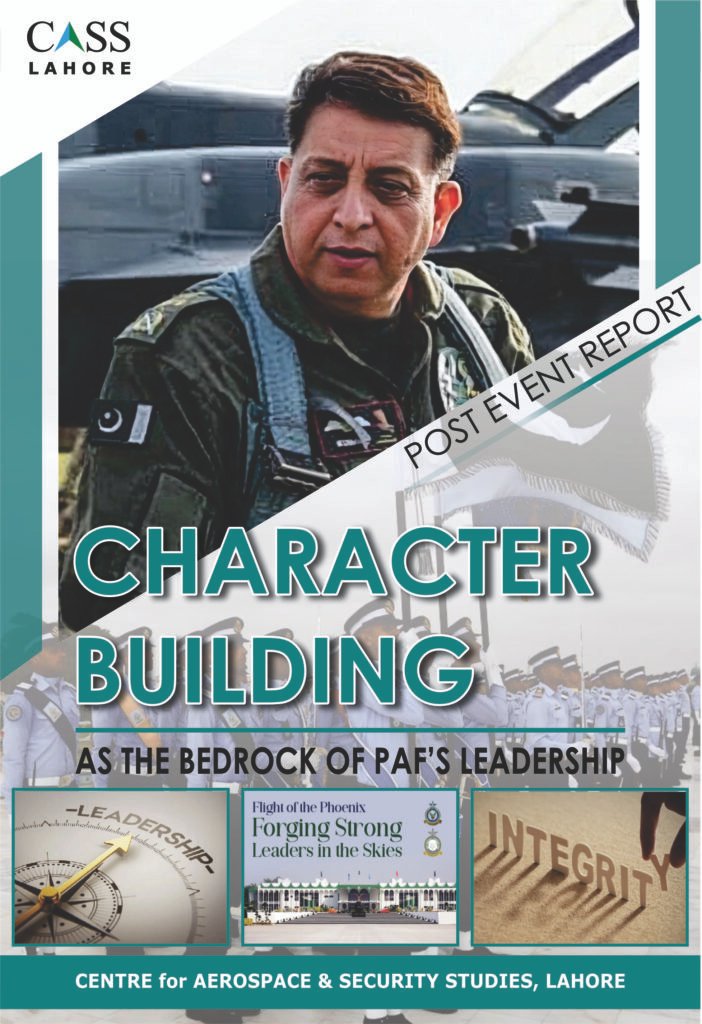
Character Building as the Bedrock of Pakistan Air Force’s Leadership
October 9, 2025
The complete PRR is available upon request. Please click the button below to submit your request.
president
Air Marshal Asim Suleiman (Retd)
ROUNDTABLE COORDINATOR
Dr Zahid Khan
EDITOR
Dr Zahid Khan
MASTER OF CEREMONY
Sibra Waseem
REPPORTEURS
Maheera Munir, Faiza Abid
Executive Summary
The Centre for Aerospace & Security Studies (CASS), Lahore, held a roundtable discussion on 9 October 2025, examining the theme “Character Building as the Bedrock of Pakistan Air Force’s Leadership.” The session was distinguished by a comprehensive address from speaker Air Cdre Khalid Banuri (Retd), who offered a profound exploration of the philosophical and practical foundations of the PAF’s leadership ethos. His discourse placed particular emphasis on Project Phoenix, a transformative initiative designed to systematically institutionalise these core principles.
The speaker’s detailed exposition meticulously traced the Pakistan Air Force (PAF)’s historical legacy, beginning with the arduous period of Partition and extending to its contemporary standing. He compellingly articulated that the PAF’s enduring strength has consistently derived not from numerical advantage, but from a qualitative edge founded upon operational effectiveness and an unshakeable ethical foundation. This principle, he noted, is perfectly encapsulated by Quaid-e-Azam’s enduring vision of the service being “Second to None.” Furthermore, he presented a stark comparative analysis with the Indian Air Force (IAF), contending that whilst both services share a common legacy, the IAF has experienced a marked decline in its professional ethos. This decline, he argued, is attributable to increasing politicisation, a concerning departure from institutional truthfulness, and an abandonment of the traditional principles of military chivalry.
The central focus of the presentation was Project Phoenix, which he characterised as a deliberate and forward-looking endeavour to systematise character development. He clarified that this initiative was not launched in response to a crisis, but rather represents a conscious pursuit of excellence from a position of pre-existing strength. The project is fundamentally built on the conviction that character, encompassing unwavering integrity, a warrior ethos, and moral courage, forms the essential bedrock upon which all other military skills, both technical and tactical, must be constructed. He elaborated on the conceptual framework of the project, which is designed to foster holistic development across the physical, cognitive, and moral domains of the individual.
A principal outcome of this vision was the establishment of the Jinnah Centre for Character and Leadership (JCCL) at the Pakistan Air Force Academy, Risalpur, in 2022. The foundation was laid by Air Chief Marshal Zaheer Ahmed Baber Sidhu, whose leadership elevated the centre as the driving force behind a comprehensive modernisation agenda, refocusing the PAF’s transformation on human development as the core of operational readiness. A foundational workshop was held for the newly formed centre on 11 November 2022 to develop its curriculum. Air Chief Marshal Zaheer Ahmed Baber Sidhu’s hands-on approach has cultivated an institutional culture that values critical thinking, ethical commitment, and technological adaptability, principles demonstrated during the May 2025 war. As Air Cdre Khalid Banuri observed, the JCCL now functions as a living ecosystem, where spaces named for prominent figures embody its core values of humility and discipline.
The roundtable also featured a robust interactive session where participants engaged with themes such as institutional decline in the IAF and the complexities presented by generational change. Both Air Cdre Khalid Banuri (Retd) and the President of CASS, Air Marshal Asim Suleiman (Retd), emphasised that whilst a strong institutional ethos is paramount, the decisive leadership and professional exemplar set by the Air Chief Marshal Zaheer Ahmed Baber Sidhu were pivotal to recent operational successes. They highlighted that his timely hands-on direction was a critical factor, serving as a practical demonstration of the character and competence cultivated through the PAF’s evolving training paradigm.
In his concluding remarks, the President of CASS, Air Marshal Asim Suleiman (Retd), powerfully reinforced the roundtable’s central theme. He asserted that institutions cannot progress in isolation without heroic figures, stating, “You always need heroes,” and that a nation’s armed forces are incapable of advancement without individuals who demonstrate personal excellence. He unequivocally credited the Air Chief Marshal Zaheer Ahmed Baber Sidhu as the leader who secured victory for Pakistan and bestowed immense glory upon the nation, affirming that he had undoubtedly earned this distinction. The President further disclosed that the accomplishments of the Air Chief Marshal Zaheer Ahmed Baber Sidhu have been personally acknowledged by at least four to five Air Chiefs from leading air forces, including those of the US, the United Kingdom, China, and Türkiye, who described his achievements as extraordinary. He concluded that this recognition underscores the principle that an organisation can only rise when its leaders strive for excellence, and that the character-building ethos championed by Air Chief Marshal Zaheer Ahmed Baber Sidhu remains the defining factor in securing the PAF’s enduring legacy and operational supremacy.
The discussion collectively affirmed that in an era defined by rapid technological change, the ultimate source of a military’s strength resides not in its platforms alone, but in the timeless character of its personnel and the unwavering ethical foundation of its leadership.
Key Takeaways
- Character as the Cornerstone of Pakistan Air Force Leadership Ethos
Character forms the indispensable bedrock of the PAF’s strength. It is through integrity, discipline, professional competence, resilience, and commitment to knowledge that the true value of the PAF’s technical prowess and operational effectiveness is realised.
- Project Phoenix: Institutionalising Excellence from a Position of Strength
The PAF’s Project Phoenix is not a reform born from crisis or failure. Instead, it is a deliberate, visionary choice to “reach for the gold”, evolve continuously, and strive for higher standards, embodying the spirit of its official slogan, “Hum Taba Abad Sayyo Taghayyur Ke Wali Hain” (We are the custodians of change from a settled state).
- The Jinnah Centre for Character and Leadership: Sustaining Change through Structure
The Jinnah Centre for Character and Leadership stands as the institutional heart of the PAF’s transformation. By embedding leadership and character development within a dedicated structure, it ensures that this evolution remains systematic, enduring, and insulated from changes in command.
- A Structured, Multi-Domain Framework for Leader Development
The PAF has adopted a multi-domain development framework focused on Physical, Cognitive and Moral domains. This is implemented through the Pitot Model, which moves from personal discipline to teamwork and then to organisational contribution. The framework is further defined by core attributes, including Integrity, Warrior Ethos, Mental Agility, and Social Intelligence, which are essential for navigating complex and high-pressure environments.
- Empirical Evidence of Success in Training and Competitions
Tangible results, from improved teamwork and discipline in inter-academy competitions to cognitive excellence at national forums, highlight the impact of Project Phoenix. These outcomes indicate that the initiative is achieving measurable success in aligning moral and intellectual growth within the training process.
- Contrast in Ethos
The contrast between the Pakistan Air Force and the Indian Air Force underscores the importance of sustaining institutional integrity. While the Pakistan Air Force has maintained its professional and ethical ethos, the Indian Air Force has suffered from institutional decay characterised by politicisation and false claims, as was evident during the May 2025 war.
- Sustaining Transformation through Mid-Career Leadership
Cultural transformation is being driven significantly through the empowerment of mid-career officers. Air Chief Marshal Zaheer Ahmed Baber Sidhu deliberately selected two relatively junior academy officers to lead Project Phoenix. These mid-career professionals act as the crucial bridge between senior leadership and junior cadets, making them the key agents for embedding and sustaining new values into the operational fabric of the organisation.
- Strategic Adaptation to Generational Shifts in Mindset
The PAF is consciously adapting to generational shifts, recognising the distinct learning styles and motivations of Gen Z and Alpha. By involving younger personnel as active contributors and valuing their technological fluency, the service ensures its continued relevance and effectiveness to inspire and retain the next generation of Air Force personnel.
Policy Considerations
- Institutionalise Character as a Strategic Capability
The PAF should integrate character and leadership development as a structured pillar of national defence, not a peripheral training exercise. This approach would embed moral strength into institutional design, ensuring that “leaders of character and competence” remain the foundation of air power.
- Building a Self-Sustaining Ecosystem for Leadership Development
To ensure a lasting impact, the PAF should formalise its leadership development, mentoring, and assessment frameworks through enduring institutional mechanisms such as trainer-of-trainer models, integrated feedback systems, and cross-generational mentoring. By doing so, Project Phoenix will mature into a self-sustaining ecosystem that preserves excellence beyond leadership transitions.
- Advance a ‘Whole-Person’ Development Doctrine
The PAF should formally adopt a tri-domain model, Physical, Cognitive, and Moral, as the foundational framework for all leadership, command, and training curricula. Investing equally in these domains ensures resilience under pressure and intellectual agility, translating into enhanced decision-making in high-stakes environments.
- Activate Institutional Memory as a Living Resource
To preserve and share its rich legacy, the PAF should systemise its documentation and dissemination efforts through a curated digital archive, oral histories, veteran engagements, and case studies. Embedding these narratives in the Jinnah Centre for Character and Leadership would convert institutional memory into a pedagogical tool, shaping ethos through authentic stories of courage, humility, and service.
- Strategically Engage the Next Generation
To remain relevant and inspirational for Gen Z and Alpha officers, the PAF must evolve its training pedagogy, communication methods, and leadership models. Emphasising purpose-driven service, technological innovation, and flexible learning pathways will align institutional values with generational motivations. This will not only strengthen recruitment and retention but also ensure that the custodians of tomorrow’s air power inherit and reinterpret PAF’s ethos in a changing operational landscape.
CASS LAhore

The Centre for Aerospace & Security Studies (CASS) was established in July 2021 to inform policymakers and the public about issues related to aerospace and security from an independent, non-partisan and future-centric analytical lens.
CASS Newsletter

- Home
- About Us
- Research Domains
- Publications
- Events
- Gallery
- Contact Us
@2021 - All Right Reserved. Designed and Developed by PenciDesign