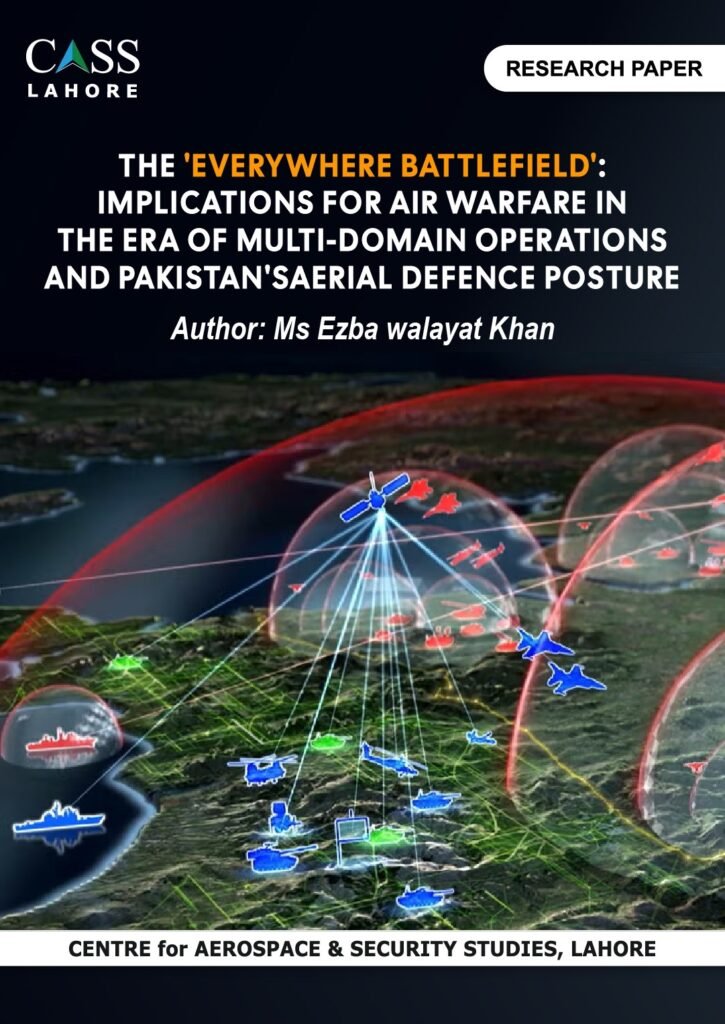
THE ‘EVERYWHERE BATTLEFIELD’: IMPLICATIONS FOR AIR WARFARE IN THE ERA OF MULTI-DOMAIN OPERATIONS AND PAKISTAN’S AERIAL DEFENCE POSTURE
SEPTEMBER 2025
ABSTRACT
The evolving character of war due to technological advancement and integration of the fields has led to the notion of the everywhere battlefield. This paper is a review of how Multi-Domain Operations (MDO) are transforming the way strategic and operational thinking is being addressed by bringing together land, air, naval, cyber, and space capabilities into a unified framework. The main aim of the study is to examine the consequences of MDO to Pakistan, and more specifically Pakistan Air Force leading role in the development of network-centric and cross-domain capabilities. The paper uses the Network-Centric Warfare theory to place the trajectory of Pakistan in the context of global trends, such as the US doctrine of JADC2, the Chinese doctrine of Integrated Joint Operations, and lessons of the war in Russia and Ukraine. Methodologically, the study adopts a qualitative approach, combining semi-structured expert interviews with systematic analysis of secondary sources. A case study of Operation Zarb-e-Karrar illustrates that MDO in May 2025 war with India provided Pakistan with a concrete operational advantage, and also shows why institutional integration and technological adaptation is more necessary. The paper highlights critical issues, such as interoperability and hybrid threats, and resource limitations and wraps up with policy suggestions on how Pakistan can sustain tri-service synergy, technological innovation, and resilience in operations in the era of multi-domain warfare.
Keywords: MDO, C4ISR, Network-Centric Warfare, Everywhere Battlefield, Air Power, Cyber, Space
This paper is currently under review for publication in a domestic/international journal. It will be available once published.
The Centre for Aerospace & Security Studies (CASS) was established in July 2021 to inform policymakers and the public about issues related to aerospace and security from an independent, non-partisan and future-centric analytical lens.