
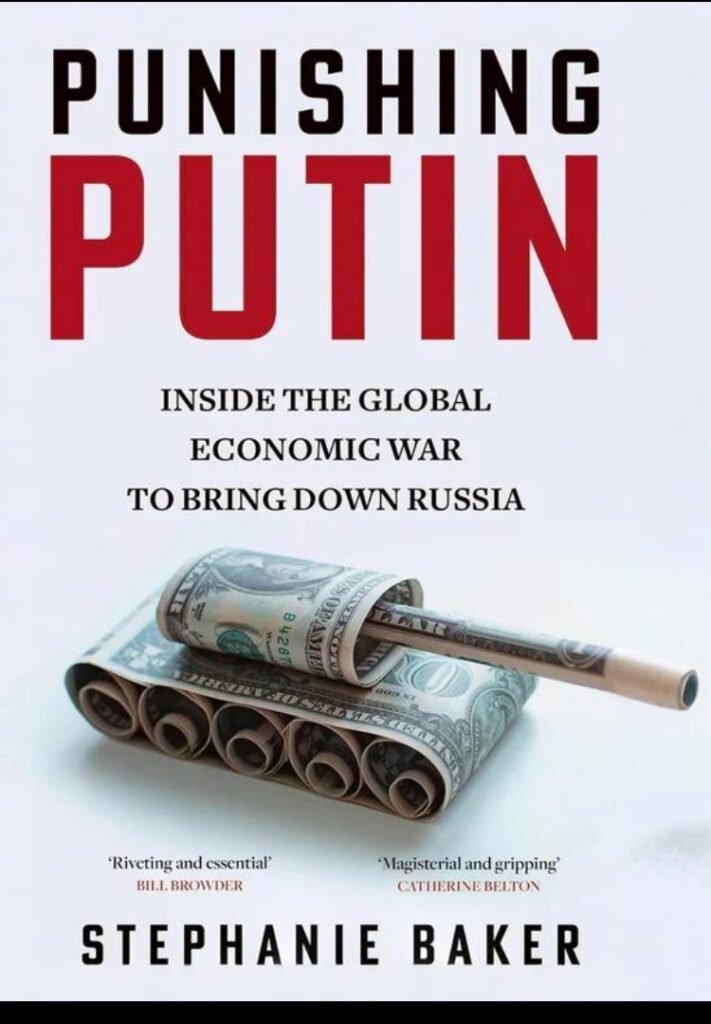


Stephanie Baker’s book “Punishing Putin: Inside the Global Economic War to Bring Down Russia” provides a pertinent and thorough analysis of the global initiatives to hold Russia responsible for its invasion of Ukraine in 2022. This is more than just a historical account of diplomatic strategies and sanctions; Baker explores the inconsistencies, ambiguities, and frequently unexpected repercussions of the tactics used by Western countries and their allies. She draws on her frontline experience to outline the tactical interplay to bring Putin to heel with the most potent weapon, money, to threaten his inner circle.
Stephanie Baker is a Bloomberg News investigative reporter and has won multiple awards. She started working as a reporter in Moscow during the 1990s. She graduated from the London School of Economics with a master’s degree. Moreover, the UK Foreign Press Association, the Gerald Loeb Awards, the Overseas Press Club, the UK Society of Editors, and the Society for Advancing Business Editing and Writing have all recognised her work.
The book opens dramatically by chronicling the United States’ attempts to lay confiscatory hands on the opulent yachts and private jets of Russian billionaires. The author highlights the striking and punitive episode of targeting the assets of oligarchs, especially the superyachts, to pull Putin’s circle out of the international economy.
Former US President Joe Biden enforced a wide-ranging round of sanctions against Russian banks and elites, illuminating war expansion from banking halls to open seas. A case study in this war of finance would be the tale of the Amadea superyacht which is only a small fraction of assets. It was associated with a Russian oligarch; the $300 million vessel wove its way across the oceans, dodging port refusals and prying intelligence eyes, ultimately falling into the FBI’s clutches in Fiji. Baker calls attention to the fact that the yacht was not just a spectacle but became an extremely powerful symbol of the West’s financial weaponisation, pulling in the luxury assets to wreck the Russian elite. Almost twenty richest men of Russia were under sanctions in the US, EU, and UK with almost $60 billion in private assets frozen worldwide.
From enforcing export controls and cutting financial relationships to freezing central bank assets and pursuing oligarchs, Baker painstakingly describes the extraordinary scope and coordination of the sanctions regime. She examines Russia’s resilience and adaptation to lessen the effects of these restrictions, while not denying the initial shock and disruption they caused to the Russian economy. For example, the heaviest blow that Baker cites was that of freezing more than $300 billion in Russian foreign currency reserves abroad, the largest asset freeze in contemporary history. This action was intended to immobilise the Russian economy overnight.
Furthermore, Baker explores the nuances regarding the removal of Russia from the SWIFT banking system and how European banks had to manoeuvre their way through arduous loopholes to ensure adherence. She mentions that while initially lauded as remarkable, these measures only put a damper on the shock that Russia had been preparing for and was unlikely to be affected by financial buffers before the outbreak of the war. The freeze and the removal of several major Russian banks’ access to SWIFT triggered a financial shock, contained within the borders of Russia, but the Kremlin managed to withstand it because the West’s sanctions left one significant gap which is energy.
Russia continues to earn petrodollars through the sale of oil and gas. These income sources were unaffected by the economic warfare, as Europe continued to rely heavily on Russian supplies. Another significant aspect was that the oil price cap policy was set in place too late. The US and G7 decided to place a cap on Russian oil exports, but this was decided after months of contorted debates. By the time it was enforced, Russia had already built a “shadow fleet” of workarounds for tankers and insurance. According to Baker, this showcases the West’s persistent struggles to adapt to Russian evasion of sanctions ingenuity.
The US and its allies have imposed sanctions on Russia, which have certainly caused economic pain to the country; however, they were within manageable limits for the Kremlin. While inflation, capital flight, and a slowdown in growth were noticeable, Russia has avoided an economic collapse through sustained energy revenues and increasing trade ties with non-Western countries, especially with countries in the Global South. Instead of bringing Putin’s regime to its knees, these sanctions have allowed Russia to adapt by refocusing its economy toward Eurasia and using methods like parallel importation and alternative financial systems such as China’s UnionPay to dodge Western restrictions. From a strategic perspective, the sanctions have woefully proved ineffective; they have neither dissuaded Russia from military advances nor affected Putin’s hold on power. The Kremlin has used the sanctions narrative to rally support at home, claiming that the economic burden is evidence of Western animosity.
Despite the united front presented by the US and the EU, enforcement loopholes and divergent national interests have weakened the overall impact of the sanctions regime. The countries in which more than two-thirds of the world’s population live have not backed sanctions against Russia, which offers Russia several routes for circumventing economic pressure.
Moreover, public and political fatigue became more visible in the Western centres. With this disparity in endurance, Putin had an advantage and opportunity to firmly position himself and the country. Most sanctions were not sufficient to achieve the intended wider strategic objectives such as stopping the ongoing war between Russia and Ukraine or changing Russia’s strategic decisions or actions. For example, limiting Putin’s capacity, required not only enforcement of sanctions but cohesion in strategy from the West. Now that Trump is back in power, divisions within the Western bloc are becoming even more pronounced, adding to the difficulty of putting up a unified front against Russia.
Upon the critical analysis of the book, legal ambiguities surrounding the Western states’ economic sanctions on Russia have been revealed. As stated under Article 41 of the UN Charter, non-military sanctions are only permissible through the collective agreement of all permanent members within the UN Security Council. Russian veto has foiled such sanctions and this implies that existing sanctions are not formally under the law. Although these measures by the Western states are camouflaged as legal countermeasures as per the customary international law, critics believe that they are unilateral and not legitimate. Any attempt to conceptualise them as collective or third-party reactions is confronted with a legal dilemma, which represents a further conflict between international legal norms and action driven by geopolitical interests.
Moreover, the list of Russian banks that have been blocked by SWIFT has revealed the hypocrisy of the neutrality of the platform. Although the purpose of SWIFT was to be a politically neutral financial message system, its compliance with EU sanctions draws it in the geopolitical sphere. These advancements lead to the establishment of parallel systems such as the active development of a System of Transfer of Financial Messages (SPFS) by Russia.
The book stands out due to the detailed information on the strategically used economic sanctions and assets seizures of Russia and especially in the descriptions of international coordination. It offers the reader with back stage decision making process. Nonetheless, the limitations lie in its lack of analysis and repetition of focus on oligarchs that renders it redundant. It presents the scope of the sanctions but does not show any further geopolitical implications, including what it may mean in the long-term to the global trade, whether sanctions are legal or not, the formation of new economic blocs or a shift in global financial systems.
In conclusion, Punishing Putin narrates how economic policy was turned into a geopolitical weapon of confrontation. It thereby provides an interesting account of how the west was adamant and used money as its policy to alienate Russia. Sanctions and asset seizure can be discussed as the new tools of war that change the balance of power and transform the international system in relation to influence in the 21st century. The book provides subtle understanding and insights to those who desire to understand the current Russia-Ukraine war and the macroeconomic game between the great powers in the globalised world and the complexities of international relations.
Originally Published in Stratheia
CASS LAhore

The Centre for Aerospace & Security Studies (CASS) was established in July 2021 to inform policymakers and the public about issues related to aerospace and security from an independent, non-partisan and future-centric analytical lens.
CASS Newsletter

@2025 – All Right Reserved with CASS Lahore.

- Home
- About Us
- Research Domains
- Publications
- Events
- Gallery
- Contact Us
@2021 - All Right Reserved. Designed and Developed by PenciDesign