
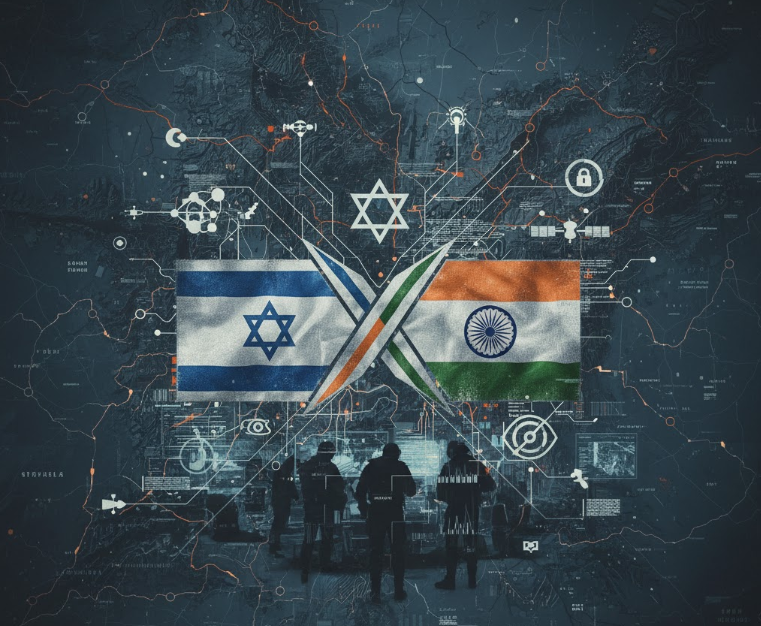


Not many are aware of what lies behind the scenic charm of Kasol, a small town in India’s Himachal Pradesh, once a peaceful hub for backpackers drawn by its tranquil valleys and mild climate. In recent years, this Amsterdam of India has transformed into a mini-Israel. Nearly 70 per cent of the region’s foreign visitors are Israelis, and many parts of this beautiful destination have evolved into Israeli-dominated enclaves. While the influx may seem touristic, evidence suggests Kasol’s transformation is linked to the Israel-India military nexus, turning the town into a covert war room, serving deeper strategic and intelligence-linked purposes.
The bond between Kasol and Israel dates back to the 1980s, when young Israelis, after completing their mandatory military service, found solace here. The local economy is so heavily influenced by Israeli presence that even trade is conducted in Israeli currency. Additionally, Kasol and the nearby Parvati Valley are known for producing high-quality hashish. This drug is reportedly popular among many Israeli Defence Forces personnel, who have also systematically promoted drug culture among the local populace. Large quantities are also exported globally. Reports indicate that the notorious intelligence agencies of these states use drug money to finance their multiple black operations. This convergence, though under the guise of culture and economy, reveals how soft power can evolve into an instrument of influence and control.
A more notable and nefarious feature of the congruence in Kasol are Chabad Houses, which, on face value, are Jewish spiritual, cultural, and religious centres. In reality, these Chabad Houses have often been used as secretive networking points by Mossad all around the globe. This becomes clearer if one takes into account how the Indian police heightened security around these Houses during Israel’s Gaza offensive, with Himachal authorities acknowledging them as intelligence-linked establishments. From discernible patterns, there is hardly any evidence suggesting that the Chabad Houses in India deviate from their traditional functions, reflecting a more sensitive and strategic design.
The question that arises here is whether this growing Israeli presence is a mere coincidence or part of a systematically planned infiltration strategy, and why Kasol, in particular, has emerged as the focal point. There is no denying the fact that the Israel-India military nexus is already well established in destabilising the region. For example, in 2017, Israel supplied India with the Pegasus spyware purportedly to enhance its surveillance capabilities against Pakistan. Israel has also provided New Delhi with signal jammers, drones, and AI-based software tools, which were also used against Pakistan during the May 2025 hostilities. Despite such advanced technology, India faced a decisive setback. Similarly, India remains ill-prepared to sustain a full-scale conflict or contend with China’s superior infrastructure in high-altitude warfare, exemplified by its humiliating defeat in the Galwan Valley in 2020. Even within India’s own defence circles, there is growing acknowledgment that its local resources and conventional strategies are inadequate to manage what India perpetuates as the persistent threat of a two-front war.
Consequently, India and Israel have sought a solution to the two-front war dilemma in Kasol’s geography, which lies at the centre of three significant regions of the world with disputed territories alongside. To the northwest lies Azad Jammu and Kashmir, to the east China’s Tibet Autonomous Region, and to the south Manali and Shimla, which serve as key logistic and administrative hubs for the Indian Army’s western Himalayan deployments. This triangulation of strategic points around Kosal explains the Israeli stronghold in this region with potentially catastrophic regional and global consequences.
What augments this point is the fact that many of the Israeli personnel visiting Kasol belong to Israel’s advanced cyber and signal intelligence Unit 8200. India and Israel had signed an agreement in July 2020 to expand cooperation in cybersecurity. Under this, Israeli experts from Unit 8200 trained Indian cyber units. The Unit is known for developing, using, and analysing information-gathering tools, conducting surveillance, cyber intrusions, and sharing intelligence with relevant agencies, particularly Mossad. This highlights how the picturesque valley may serve as a forward operating zone for Israel, providing India with enhanced surveillance, signal interception, and real-time intelligence through cyber and drone support. This also explains why Israelis enjoy elite privileges even at the expense of locals. Ironically, libraries and cafes in this area display signs “Indians not allowed.” The RAW-Mossad congruence, which seems to have an epicentre in Kosal, allows the Indian military a potential edge in monitoring and pre-empting regional threats. It also bolsters India’s military war preparedness and complicates the security calculus of India with both Pakistan and China.
Conclusively, Kasol embodies the subtle theatre of modern warfare, where spirituality masks surveillance, data replaces diplomacy, and culture conceals control. For Pakistan and China, this transformation is a quiet warning: the frontiers of conflict have shifted from borders to bandwidths, from soldiers to software. To remain mere spectators in this invisible contest would be perilous; vigilance, cyber cooperation, and strategic foresight must now form their first line of defence.

Sibra Waseem
The writer is a Research Assistant at the Centre for Aerospace and Security Studies (CASS), Lahore.
Originally Published in Daily Parliament Times.
CASS LAhore

The Centre for Aerospace & Security Studies (CASS) was established in July 2021 to inform policymakers and the public about issues related to aerospace and security from an independent, non-partisan and future-centric analytical lens.
CASS Newsletter

@2025 – All Right Reserved with CASS Lahore.

- Home
- About Us
- Research Domains
- Publications
- Events
- Gallery
- Contact Us
@2021 - All Right Reserved. Designed and Developed by PenciDesign