



ROUNDTABLE DISCUSSIONS
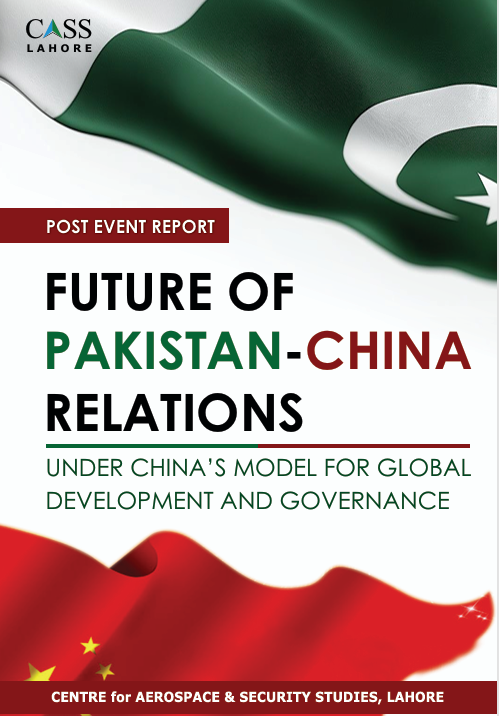
Future of Pakistan-China Relations under China’s Model for Global Development and Governance
July 24, 2025
The complete PRR is available upon request. Please click the button below to submit your request.
president
Air Marshal Asim Suleiman (Retd)
ROUNDTABLE COORDINATOR
Ms Maheera Munir
EDITOR
Dr Bilal Ghazanfar
MASTER OF CEREMONY
Ms Maheera Munir
REPPORTEURS
Faiza Abid & Maheera Munir
Executive Summary
The Centre for Aerospace and Security Studies (CASS), Lahore, organised a guest lecture titled “Future of Pakistan-China Relations under China’s Model for Global Development and Governance” on 24 July 2025. The event featured insights from Mr Shakeel Ahmad Ramay, who delved into China’s governance framework, economic model, strategic vision, and lessons for Pakistan.
Maheera Munir, Research Assistant at CASS, opened the session by highlighting China’s rise as a strategic global power shaping governance through initiatives like BRI, GDI, GSI, and GCI. She stressed that Pakistan must move beyond rhetoric and meaningfully align with this evolving model. With CPEC as a foundation, she called for institutional reform, policy clarity, and intellectual readiness to secure Pakistan’s place in a multipolar world.
Mr Shakeel Ahmad Ramay, in his comprehensive lecture, charted China’s remarkable journey from the trauma of colonial subjugation during the “Century of Humiliation” to its rise as a global power. He highlighted the pivotal role of the Communist Party under Mao Zedong in liberating China, dismantling internal feudal structures and initiating national reconstruction. Early emphasis on rural empowerment and productivity reforms demonstrated that long-term, inclusive development must begin from foundational sectors, a lesson he suggested Pakistan has yet to internalise.
Building on this historical evolution, Mr Ramay described how China’s accession to the WTO signified its full integration into the global economy, further cemented under Xi Jinping’s leadership, which introduced governance legitimacy through anti-corruption drives, institutional discipline, and a “New Development Philosophy” prioritising green growth, innovation, and strategic autonomy. Mr Ramay pointed out that China’s innovation and poverty reduction efforts are guided by self-reliance, precision targeting, and capacity-building, rejecting dependency-based welfare. Contrasting this with Pakistan’s politicised policymaking and elite capture, he urged Pakistan to embrace people-centric governance, indigenous knowledge, and long-term institutional reform. China’s experience, he concluded, offers valuable inspiration, not for imitation, but for grounded, sovereign policymaking in Pakistan’s own context.
The interactive session addressed critical questions regarding the feasibility of adopting China’s model in Pakistan, China’s internal challenges, and its strategic rivalry with the US. Mr Ramay responded that while Pakistan cannot fully replicate China’s system, it can integrate essential principles such as merit-based governance, indigenous knowledge use, and institutional reform. He emphasised that Pakistan’s failure to attract Chinese green financing is due to weak project planning rather than China’s unwillingness. He also explained how China’s long-term preparations for technological self-reliance and economic resilience have enabled it to withstand Western pressure. The session concluded by stressing that Pakistan must shift from short-termism and dependency to a disciplined, data-driven, and future-oriented governance approach to meaningfully benefit from its strategic partnership with China.
Air Marshal Asim Suleiman (Retd), President CASS, emphasised that China and Pakistan share an enduring partnership founded on mutual respect, strategic trust, and support for each other’s core interests. He noted that this relationship, anchored by the China–Pakistan Economic Corridor (CPEC), is evolving into a model for regional connectivity and shared prosperity. Realising the CPEC Long-Term Plan for a competitive and inclusive Pakistan by 2030 will require investment in human capital, greater policy coherence, and the adoption of Chinese digital standards within the Digital Silk Road framework. He further stressed the importance of leveraging China’s Global Development, Security, and Civilisation Initiatives to enhance Pakistan’s role in a multipolar global order, securing greater inclusion in platforms such as BRICS Plus, and expanding academic and cultural exchanges to strengthen long-term mutual understanding.
Key Takeaways
- Strategic Continuity in China’s Rise
China’s transformation is deeply informed by its Century of Humiliation, and has evolved through four distinct phases – Liberation, Leap, Learning, and Leading – to reshape it from a colonised nation to a global power.
- Strategic, Step-by-Step Development Model
China’s rise was driven by pragmatic experimentation and gradual liberalisation, prioritising domestic industrial capacity before opening up to global markets, contrary to liberal economic orthodoxy.
- China’s Alternative Geopolitical Vision
Through Mao’s Three Worlds Theory and the Third Front strategy, China resisted alignment with Cold War superpowers, focusing instead on alliances across the Global South and internal strategic relocation.
- Shift towards Proactive Global Engagement
China evolved its foreign policy from passive non-involvement to actively shaping global partnerships and influence, economically pre-empting geopolitical competition.
- Governance Rooted in Rule of Law
Internal reforms focused on anti-corruption, the rule of law, and disciplined governance have strengthened state legitimacy and accountability at the grassroot level.
- Innovation as Core National Strategy
China’s focus on knowledge creation, STEM talent development, and targeted sectors like Electric Vehicles (EVs) illustrates how innovation is treated as a pillar of national security and global competitiveness.
- Pakistan’s Self-Reliant Development
Pakistan’s long-term development and strategic partnership with China depend on reducing reliance on external institutions like the IMF and aligning more closely with China’s people-centric, merit-driven, and self-reliant development model.
Policy Considerations
- Aligning with China’s Global Rise
Pakistan must craft a forward-looking policy approach that aligns with China’s transition to a global power is crucial for exploring mutually beneficial avenues within the evolving global order.
- Prioritising Agricultural Reforms
Pakistan must undertake land restructuring, pricing incentives, enhanced market access, and subsidised inputs to boost agricultural productivity, reduce rural poverty, and create a sustainable base for future industrial growth.
- Adopting People-Centred Governance
Pakistan needs to adopt people-centric governance that embeds transparency, accountability, cultural ethics, and truthful data practices into all levels of policymaking and implementation, and prioritises public welfare over elite interests.
- Reviving State-led Strategic Sectors
China’s mixed economy model can help Pakistan reconsider its approach to privatisation and explore ways to revitalise and strategically utilise state-owned enterprises in support of national development objectives.
- Strengthening Institutional Capacity before Driving Innovation
Pakistan needs to invest in data infrastructure, skilled human capital, and coherent governance systems to build institutional capacity for effective digital transformation and technological advancement.
CASS LAhore

The Centre for Aerospace & Security Studies (CASS) was established in July 2021 to inform policymakers and the public about issues related to aerospace and security from an independent, non-partisan and future-centric analytical lens.
CASS Newsletter

- Home
- About Us
- Research Domains
- Publications
- Events
- Gallery
- Contact Us
@2021 - All Right Reserved. Designed and Developed by PenciDesign